This post is by Dillon Blankenship, one of our Hubbard Fellows.
Though I came into the Hubbard Fellowship to learn about restoration and conservation of prairies, I have had the good fortune to spend a fair amount of time in, associated with, or, at least, thinking about stream and river systems too. Most of these experiences have been of the Platte River – from surveying for mussels in a southern braid to visiting the various dams, diversions and other irrigation structures that utilize its mighty flow. Oh, and of course, how about the bazillion hours shared with roosting sandhill cranes and awestruck visitors in riverside blinds this spring!
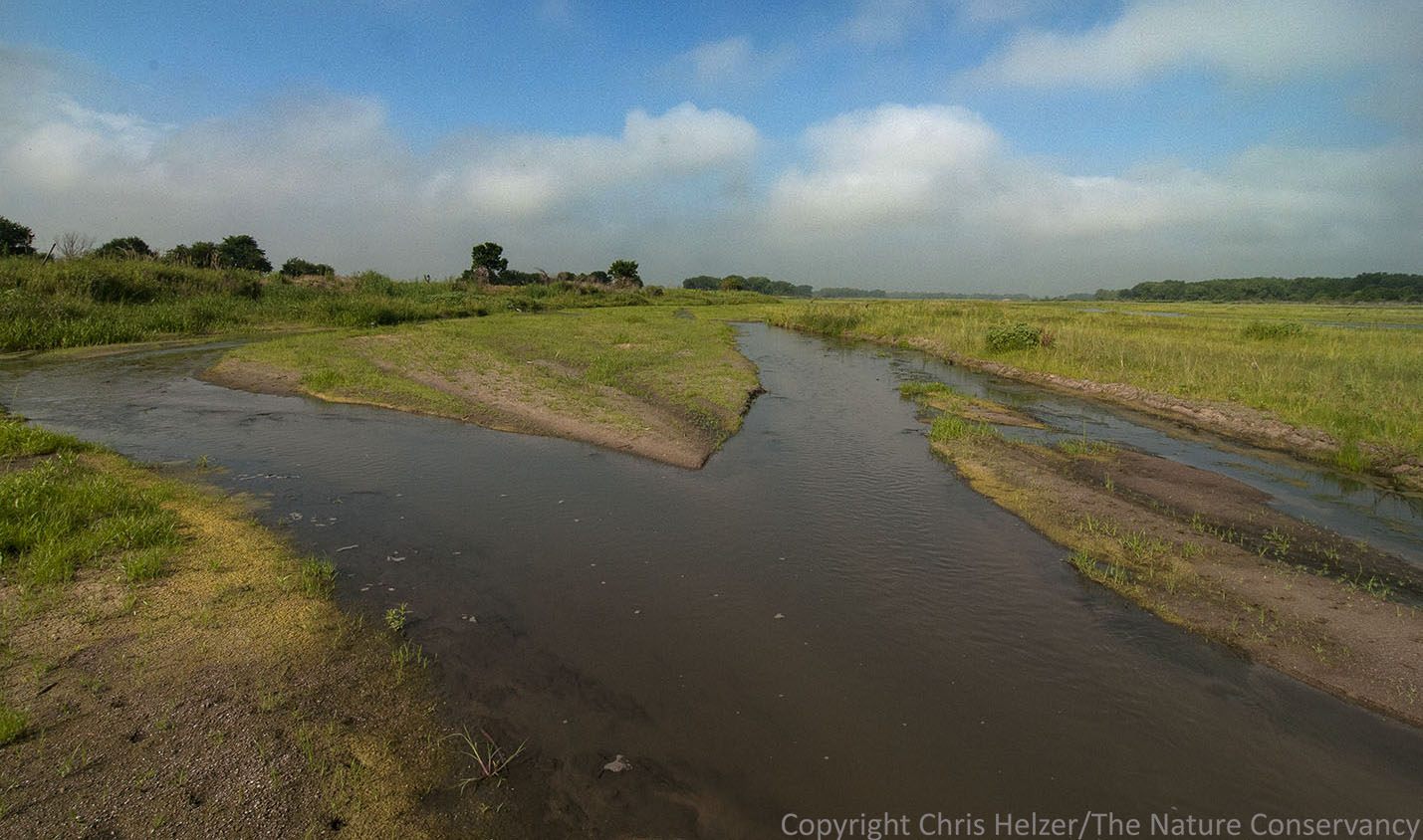
The Central Platte River near Wood River, Nebraska.
Even when my work does not lead me there, the Platte is inescapable – I drive across it to go just about anywhere and often parallel it for miles on end (who is following who?) as I journey across the state. It is also a persisting reference point and a comforting explanation for some of the tree lines I see from Interstate 80. Its associated groundwater makes possible our impressively realized agricultural potential and supports a great diversity of plants and wildlife. Here is a good map of the extent of the Platte Watershed – http://en.wikipedia.org/wiki/Platte_River#/media/File:Platterivermap.jpg – which I see in the embodiment of the Platte River itself, but is much more expansive than a single waterway.

Hubbard Fellows Dillon Blankenship (left) and Jasmine Cutter stand near an irrigation ditch while on a tour to learn about irrigated agriculture and the Platte River.
I mention this on The Prairie Ecologist blog now because I am feeling particularly inspired to appreciate my watershed today. I’ve been doing an online course concerning water issues in the western United States that has had me thinking a lot about where my water comes from – which, thankfully, is plentiful enough from its origins in the Rockies to me and on to the Missouri that I don’t have to borrow from watersheds beyond my own. It has also illuminated the complexity of how we allocate water resources to satisfy interests across state boundaries (Colorado, Wyoming, and Nebraska for the Platte) and has altogether inspired a deeper appreciation for this vital fluid’s movement across the landscape.
Of course, The Prairie Ecologist blog community is a diverse crowd when it comes to geography, so I expect many of you to be intrinsically tied to rivers and watersheds beyond the Platte and that is great!
Some of your attachments must be physical – you live on them and in them and they, quite literally, are a part of you. However, I also suspect you have been affected by water systems in nonmaterial ways– the memory of a family canoeing trip (or “tanking” excursion if you are Nebraskan), the viewing of an inspiring water-related natural spectacle, or the comfort of a secret fishing spot for contemplation and big catfish.

Many people’s strongest personal connection with the Platte River comes from watching migratory sandhill cranes in the spring.
Despite being a Platte River patron – and to some extent a lover of the Loup and a Niobrara nut – I also feel the pull of waters from previous, far-off stations (Oregon’s Willamette River, the Buffalo River of Arkansas…) and am excited to be shaped by whichever watersheds I call home in the future.
For the sake of this watershed reflection, I want YOU to get involved in these musings…
In a book*I have been reading I found this gem of a question, which is particularly relevant here:
After the author reminds us that the human body is nearly 2/3 composed of water, he asks, “What body of water makes up 2/3 of you?”
Well? [This would be a good time for you to utilize that comments section at the bottom of the page…]
And if, by chance, the Platte IS your river, I hope you will check out what our friends at the Platte Basin Timelapse project have been up to as they document and share “a watershed in motion.” http://www.plattebasintimelapse.com/
*Urrea, Luis Alberto. Wandering Time. Tucson: University of Arizona Press, 1999. Print.

 The Prairie Ecologist
