More Timelapse and More Wetland Restoration

Having just downloaded nearly two months of images from the timelapse cameras at our Derr Wetland Restoration Project (I showed photos and video from this site last week as well), I went through the images to see what stories the photos might tell.  Long term, of course, those images will help show changes in water levels, habitat conditions, and many other aspects of the site, but even in the short term, the timelapse images tend to have interesting stories to tell.
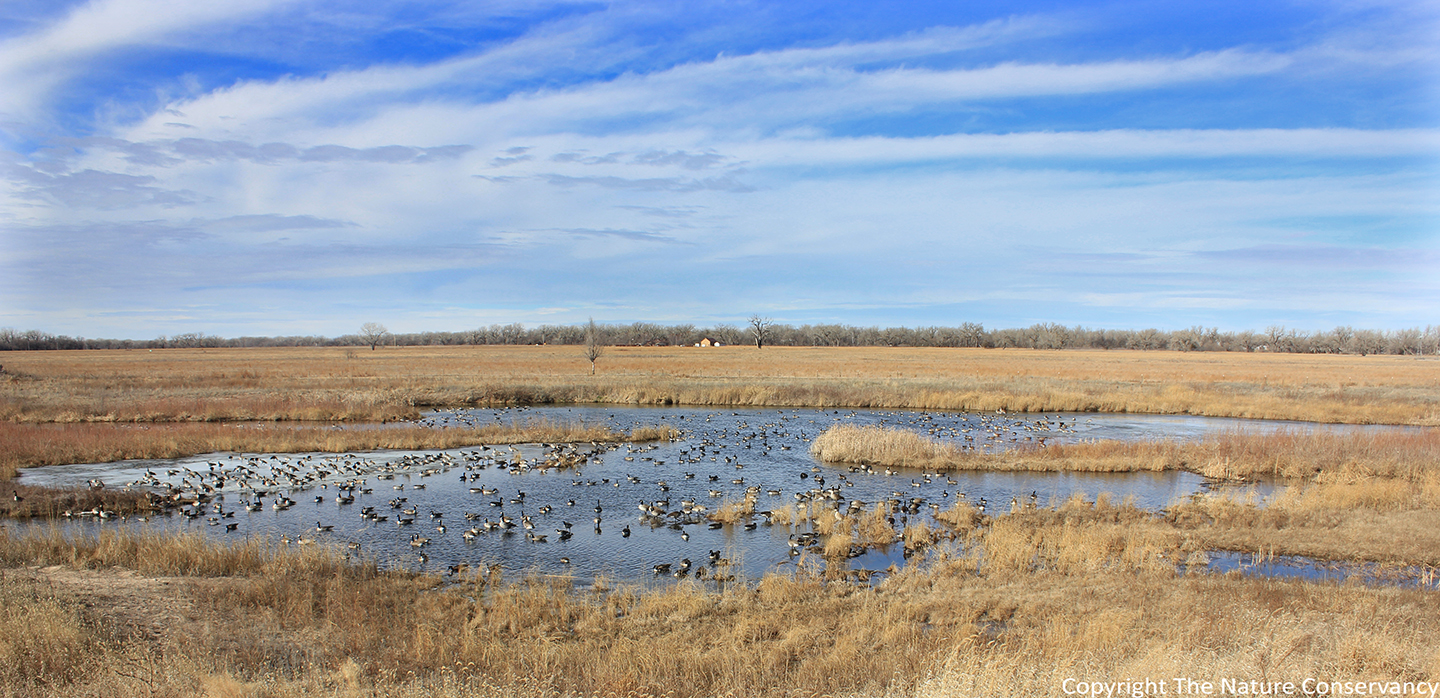
Canada geese on the Derr Wetland Restoration.

Canada geese on the Derr Wetland Restoration.  January 24, 2015.

This batch of photos showed the wetland hosting quite a few Canada geese.  That’s not a new occurrence – I’ve shown that in prior posts from this timelapse project.  However, it’s good to see them back again this winter, especially because much of the wetland has become more fully vegetated during the last couple of years, and I’m glad they weren’t just coming to hang out on bare sand.  Comparing this year’s photos to the photos in that prior post also shows that the water level in the wetland is considerably higher this year.  Some of that is because of this winter’s high groundwater levels, but it’s also because the beavers have a couple of big dams just downstream of these images.

Another interesting story from this batch of photos has to do with ice.  This wetland is valuable habitat for many species because of its relatively consistent water availability – water levels go up and down, but I’ve never seen it completely dry, even during some pretty severe drought conditions.  However, the wetland is also valuable because the strong groundwater influence at the site means the wetland rarely freezes completely over (water flowing from underground helps keep the water temperature warmer than if the water was just sitting on top of the ground).  Among other things, this means there is usually a place for waterfowl to land on open water during the winter months.

The site does freeze over at times, however, and apparently it can happen pretty quickly.  The following two photos were taken 15 hours apart, and the first photo shows completely open water on one evening and the second shows the site nearly frozen by the next morning.  The temperature dropped significantly overnight, but the speed at which the wetland surface froze still surprised me.

photo 1

5 pm. January 31, 2015.  32 degrees F and 6 mph wind.  Ice free.

photo 2

8 am. February 1, 2015.  10 degrees F and 35 mph wind.  Two inches of snow and nearly complete ice cover.  Clicking on photos will bring up a larger and sharper version of them.

Only a few tiny areas of open water remained after the cold night.  The ice was thick enough, at least in places, to support the huddled group of geese near the right side of the photo.  The wetland remained in this mostly (but never completely) frozen state for a few days, but by the morning of February 4 a line of open water appeared along the main stream flow corridor, and by February 6 the big numbers of geese returned.  The  photo below was taken on February 7.

geese again

Geese again  February 7, 2015.

The geese apparently adapted to the freezing of the wetland just fine, though I’m very curious to know where they went during the five days they were gone.  I’d also like to know why they felt it was ok to return when there wasn’t enough open water for all of them to swim in, and it looks like most of them just stood on the ice anyway!

Regardless, one of the fun things about timelapse photography has been the ability to see changes – sometimes very rapid changes – in the habitat conditions at places like this wetland.  Sometimes, those conditions can literally change overnight!
Why Does Plant Diversity Matter? Help Us Figure It Out!

How important is plant diversity in restored prairies?

Are diverse prairies more resistant to drought and invasive species than less diverse prairies?

How does plant diversity influence invertebrate communities and their ecological functions?

These kinds of questions have been the focus of multiple research projects in our Platte River Prairies over the last decade or so.  We have numerous restored (reseeded) and remnant (unplowed) prairies that provide excellent field sites, and have also established two sets of experimental research plots to help focus specifically on questions related to plant diversity.  Those plots are 3/4 acre (1/3 ha) in size and represent varying levels of plant diversity, allowing us to investigate the functional differences between them.  Researchers from the University of Nebraska, Kansas State University, the University of Illinois, and Simpson College have been involved in data collection efforts so far.

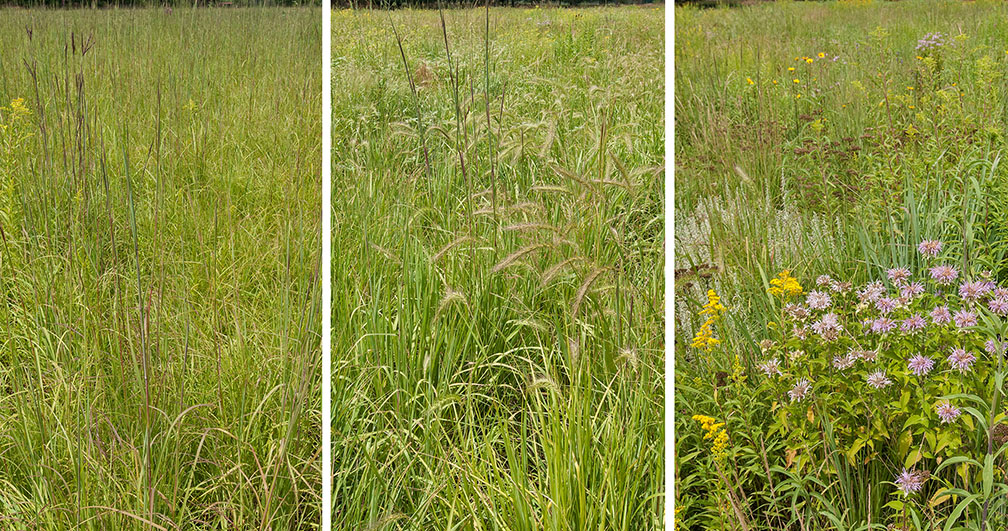
2013 photos from

2013 photos from our experimental research plots.  The plots from left to right were planted to a monoculture (big bluestem), a low diversity mixture (mostly grasses and a few late season wildflowers) and a high diversity mixture (100 plant species).  We are investigating functional differences between these kinds of plant communities.

Craig Allen, Leader of the Nebraska Cooperative Fish & Wildlife Research Unit, and I are hoping to take the next step in these efforts by bringing on either a PhD or Post-Doctoral Research Associate.  We have data to build upon, including some intriguing results regarding invasive species and insect herbivory rates at varying levels of plant diversity, but want to greatly expand upon those data.  If you or someone you know is interested in these kinds of questions, please read below and contact Craig or me with questions.

Here is the official description of the position:

Ph.D. or Post-Doctoral Research Opportunity:  Grassland diversity, restoration and resilience

Ph.D. graduate research assistantship or Post-Doctoral Research Associate.  Available starting in May 2015, to investigate the relationship between grassland restorations and ecosystem services and resilience.  The assistantship (or Post-Doc) is with the Nebraska Cooperative Fish and Wildlife Research Unit, in the School of Natural Resources at the University of Nebraska, working closely with the Nature Conservancy scientists and resource managers.   The research project will include a synthesis of literature to identify prominent knowledge gaps related to the restoration of grasslands and resilience.  In addition to synthesis, field work will occur on a suite of restorations in central Nebraska.  Some questions of interest are listed below, but ultimately, successful candidates will be expected to develop a specific research project(s).  The candidate could approach this project from a broadly ecological, or botanical, or entomological frame.

The successful applicants will be highly motivated, with a strong work ethic, strong and demonstrated writing skills, a passion for field work, and the ability to work in collaboration.  Experience in restoration ecology is helpful, but not required.  Ph.D. applicants should possess a M.S. in Wildlife, Biology, Zoology, Botany, or Entomology, or a related field and have a valid driver’s license.  Post-doctoral applicants should possess a Ph.D.

Interested applicants should send a cover letter, names and emails of 3 references, GPA and GRE scores, and an updated CV as an electronic PDF or Word document to Craig Allen, allencr@unl.edu

Review of applications will begin March 15 and continue until a qualified candidate is identified.  For more information on the Nebraska Coop. Unit and the University of Nebraska-Lincoln please visit us at:

http://snr.unl.edu/necoopunit/default.asp

Applicants should also review:

https://prairieecologist.com/

Specific projects could include all or part of the following:

Relationship between restoration diversity and ecosystem services, such as invasion resistance and herbivory; interactive effects that might mediate some resilience properties; responses to multiple disturbances; how invasions might weaken the ability to cope with disturbance; microbial diversity and ecosystem function and services; response to pulse and press disturbances and mechanisms driving responses; functional trait diversity and redundancy and resilience.