
Based on some comments and questions I’ve had over the last month or two, I thought it might be a good idea to provide a few tips on how to get the most from this blog site.
Reading Posts
There are several ways to read posts. For those of you who are email subscribers, you get the entire post in an email, and can read and see the photos right there in your email. (for those of you who aren’t subscribers, you can become by signing up under “email subsciption” to the right of this post) Others of you just check the home page periodically and can scroll down through the most recent posts to catch up on what’s been posted since you last visited. That format allows you to see all of the text and photos as well. HOWEVER, both of those options (and some others) prevent you from seeing the comments and discussions that have taken place since the post was published. While some posts spark little or no discussion, others spark a lot – and that discussion can be just as interesting (or more) than the original post. To see the full version of each post, simply click on the title of the post in your email or on the home page of the blog and you’ll get everything.
…and please participate in the discussions – they make the blog a better product for everyone. If you like, when you leave a comment, you can click a little box so that you’ll get an email when someone else responds to the same post that you have – that way you can follow the whole discussion without having to keep checking back at random intervals.
You can see a list of recent posts in the right-hand column of the blog page, and can click on any of them to see the full version. In addition, however, there are many older posts, and you can find them in several ways. First, you can search by keyword by typing that word (or words) in the blank next to “Search” in the right-hand column of the blog page. Second, you can search by either category or month of publication by using the menus right underneath the “Search” function. If you’re interested in a particular aspect of prairies or photography, there’s a good chance you can find a post that has dealt with the subject.
PHOTOS
Many of you come to the blog for the photos more than anything else – and that’s great. What you see is what you get with photos, with one exception. If you click on the photo itself, you often can get a larger view of that photo to open up in its own window. So, if you see a photo you really like, you can see it even better by clicking on it! Here – you can try it on this one:
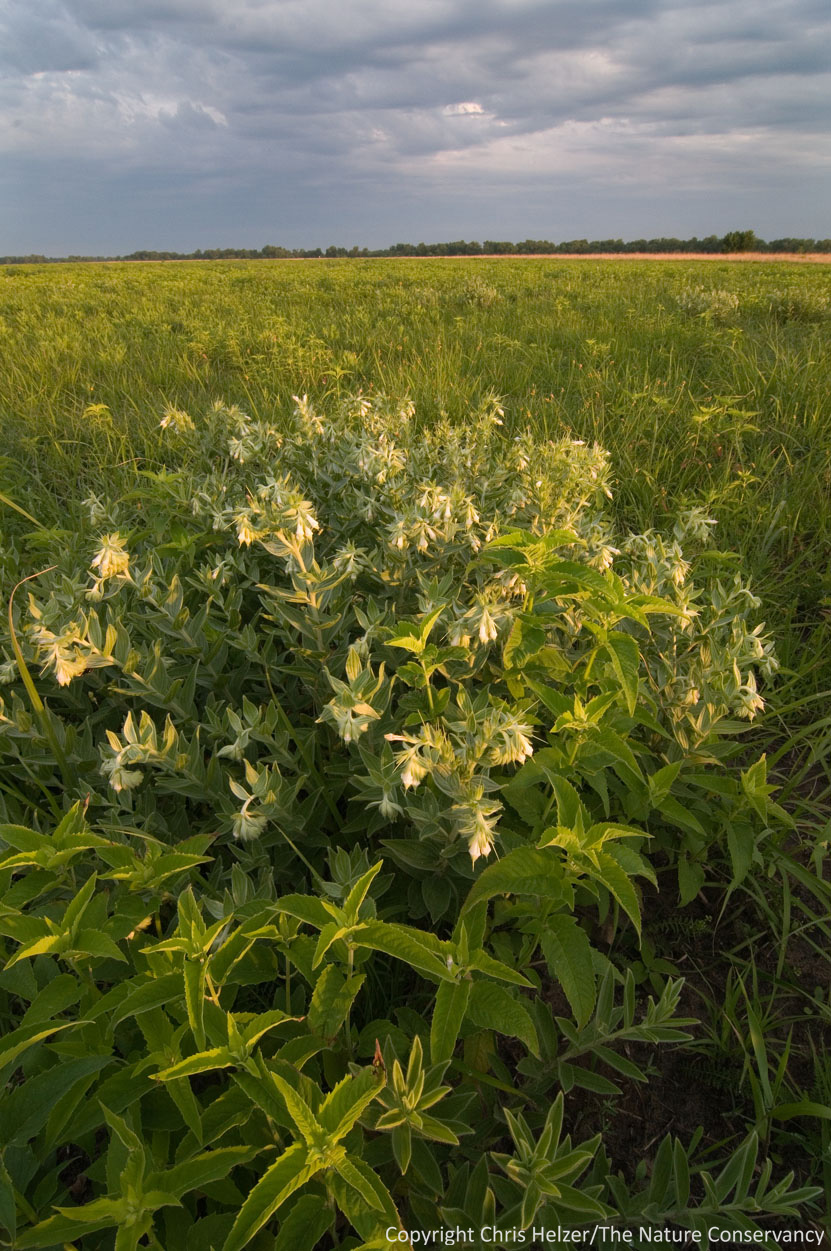
False gromwell, aka marbleseed (Onosmodium molle) in restored prairie. The Nature Conservancy's Platte River Prairies, Nebraska.
PAGES
Hidden at the top of the blog page, right under the panoramic photo of a guy in a prairie (that’s not me, by the way – there’s a little Prairie Ecologist trivia for you) are the links to the four pages currently available on the Prairie Ecologist website. Besides the home page, there are three others that have information and photos on different topics. I like the format for this blog in most respects, but one disadvantage is that those pages are somewhat hidden if you don’t know to look for them. You can also access the same pages through links found in the right-hand column of the blog homepage.
.
Thanks, as always, for visiting the site…


 The Prairie Ecologist