
Apply Now to be a Hubbard Fellow

We are now accepting applications to join our 2016-2017 class of Hubbard Fellows.  Please share this with anyone who might be interested.  I’m biased, but I think it’s the best opportunity in the world for a recent college graduate looking for a career in ecology or conservation.
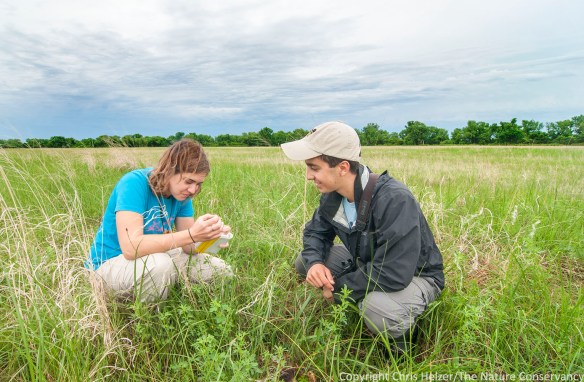
Kim Tri inspects a skunk skull in the prairie while Evan Barrientos looks on. The Nature Conservancy's Platte River Prairies, Nebraska.

Kim Tri and Evan Barrientos are this year’s Hubbard Fellows.  You can be one of the next Fellows – apply now!

The Claire M. Hubbard Fellowship Program bridges the gap between school and career by providing Fellows with a broad set of experiences that supplement their college education.  Fellows are employed for a full year by The Nature Conservancy.  During that year, they spend much of their time doing prairie restoration and management, including invasive species control, prescribed fire, livestock management, equipment maintenance and repair, seed harvest and planting, etc.  In addition, Fellows attend a wide variety of conferences and meetings and gain experience with grant writing, marketing, outreach, research and monitoring, budgeting, conservation planning, and much more.  Each Fellow also designs and carries out an independent project that fits their individual interests.

The Fellowship is based at the Platte River Prairies, west of Grand Island, Nebraska, but Fellows also spend considerable time at the Niobrara Valley Preserve and many other sites.  Click here to see this year’s brochure, which includes much more information and guidance for interested applicants.

The Fellowship is open to graduates (by May 2016) of undergraduate and graduate programs in natural resources, conservation biology, or related subjects.  We are looking for highly-qualified, motivated people with strong leadership and communication skills.  Applications are due January 8 and the Fellowship will begin in early June, 2016.

We are extremely grateful to Anne Hubbard and the Claire M Hubbard Foundation for funding this Fellowship Program. 

Hubbard Fellowship Blog – Wasp Slumber Party

This post was written by Evan Barrientos, one of our Hubbard Fellows.  Evan is a talented writer and photographer and I encourage you to check out his personal blog.
08032015_nebraska_1906

I was enjoying a sunset walk in the prairie when I stumbled upon an alarming sight: several dozen large wasps covering a clump of grass. They had menacing eyes and dagger-like stingers, but I wanted photos of this new species so I could identify and learn more about them. Cautiously edging closer and closer to the wriggling mass of black and yellow, I got my photos and escaped unscathed. Thanks to these photos I was later able to identify these wasps to the Myzinum genus, and by doing so learned that there was absolutely nothing dangerous about them.

08032015_nebraska_1956

After doing some research, it turns out that these wasps weren’t forming a murderous attack squad; they were  just having a big ‘ol slumber party. Male Myzinum wasps are known to sleep together in large groups such as this, although no one seems to know why. Furthermore, males don’t even have stingers, just curved spines that seem to only serve as intimidation. During they day they feed on a vegetarian diet of nectar and look for females to mate with. The females, however, are a little less gentle.

08032015_nebraska_1921

Females actually have functional stingers and they’re bigger, built for digging underground in search of scarab beetle larvae.  Like the last wasps I wrote about, Myzinum larvae are parasitoids, parasites that kill their hosts. When a female Myzinium finds a scarab beetle larva, she paralyzes it with neurotoxins injected from her stinger lays a single egg on it. After hatching, the wasp larva devours its host like a sci-fi alien.

So the next time you find a swarm of scary-looking wasps, instead of grabbing the can of wasp spray, consider that they might just be harmless insects that pollinate your flowers and eat the beetles that damage your flowers and lawn.

For more information: