
It’s well past time for me to provide an introduction to our latest class of Hubbard Fellows. Alex Brechbill and Olivia Schouten are spending a year of their lives working with us here in Nebraska, helping us with all aspects of our conservation work. At the same time, we are trying to give them the most well-rounded experience possible and prepare them for their future conservation careers. This is the 5th class of Hubbard Fellows we’ve had now, and definitely the most local. Olivia hails from Pella, Iowa and Alex is from right here in Aurora, Nebraska. I could tell you lots more about them, but I’ll let them do it in their own words below. Stay tuned for future blog posts by both Fellows throughout this year.

Olivia Schouten, Chris Helzer, Alex Brechbill.
Olivia –
I am a Midwesterner born and raised, growing up in Iowa among seemingly endless cornfields. Though there isn’t a lot of public land in the state, I was lucky enough to not only grow up near Lake Red Rock, one of the larger public recreation areas in the state, but to have parents that took their children on week-long camping vacations every year to our country’s amazing state and national parks. These trips gave me a love of the outdoors and our wilderness areas, those places where human’s touch was minimal and the plants and animals living in these places could do so in relative peace.
For most of my childhood, I didn’t think that Iowa could offer the same sense of wildness as our parks out west. There were just too many humans, and our impact was too great. That perception changed in high school, however, when I realized that just down the road from my hometown was one of the most ambitious conservation projects in Iowa; Neal Smith National Wildlife Refuge, a massive prairie restoration just 20 minutes from downtown Des Moines. I walked into this refuge as a high school student and left with my eyes opened to what wild places could look like in the Midwest, with dreams of vast grasslands once covering the entirety of the American heartland. My love of prairies and conservation began then, and never left. Though I have broad interests, ranging from art to astronomy, ultimately I decided that I wanted a chance to work on the landscape that I love, and do what I could to make sure our Midwestern ecosystems persist in the future.
My experience is rooted firmly in research, starting with my time at Central College working for my B.A. degrees in biology and anthropology. I had the opportunity to work with a professor researching the ecosystem services provided by diverse plantings of prairie species, where I learned about the potential there is in the prairie states to incorporate our native habitats into out altered landscape. After leaving Central, I worked in South Dakota and Iowa collecting data on plant and animal communities, and in January of 2015 I started attending Wichita State University in Kansas as a master’s student, studying the processes influencing the development of prairie plant communities.
Now I find myself in Nebraska, the fourth state I’ve had the opportunity to work on prairies in. I love prairies in all of their forms, and I’m excited to see what aspects of prairie ecology can be transferred from Kansas or South Dakota, and what unique challenges the prairies along the Platte River face here in Nebraska. I’ve already been inspired more than once in my short time here, from seeing the majesty of the sandhill crane migration firsthand, to enjoying the subtle beauty of the winter prairie dusted with snow.
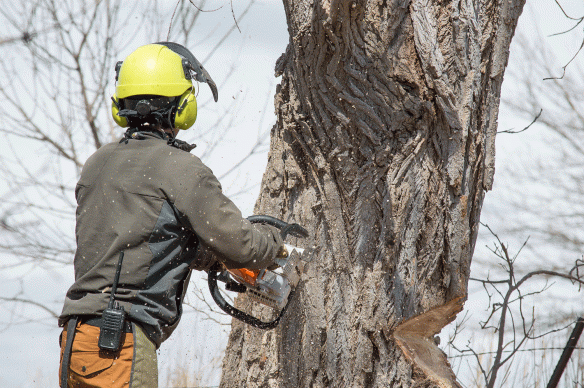
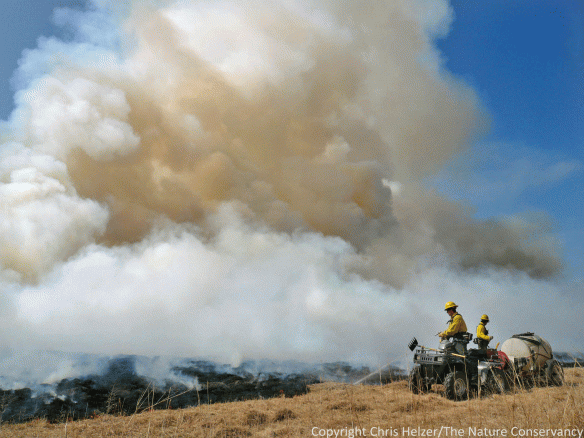
I am excited to have the opportunity over the coming year to develop my hands-on skills in prairie stewardship and management, and I believe I’m off to a good start! I’ve already managed to put five prescribed burns under my belt, gotten a chainsaw in my hands to fight back woody encroachment, and had many insightful conversations about the use of grazing in managing diverse prairies. The year ahead looks exciting, and I’m eager to see the prairie through all its seasons, learning about management and conservation along the way. When I’m done, I’m sure I will leave a more effective advocate and lover of prairies!

Olivia (left) and Alex (right) last month at our first burn of the year.
Alex –
In February, I was ice fishing with my dad near my parents’ house in Doniphan, Nebraska. As I dropped my line into the icy waters of the freshly drilled hole, I heard the trills of Sandhill cranes from the North. My heart raced at the excitement of seeing the first cranes of the Spring migration circling above the Platte River. Soon, dozens of Sandhill cranes were circling in the skies.
Seeing them made me think about my own return to central Nebraska. I was raised in Aurora, Nebraska, just down Interstate 80 from TNC’s Platte River Prairies. I graduated from Aurora High School in 2013 and went to Nebraska Wesleyan University, where I studied Political Science, with a focus in environmental policy. While a student, I worked at the Nebraska State Unicameral for two sessions as a legislative page. I saw, firsthand, how crucial policymaking is in Nebraska. Inspired by state politics, I pursued national law by accepting an internship at the U.S. Department of Justice in the Environment and Natural Resources Division. Working alongside federal trial attorneys, I researched various environmental policies, helping me shape my professional aspirations to pursue environmental law. Although I enjoy research, I am always looking for a way to get outdoors.
I spent my collegiate summers seeking new outdoor experiences, which allowed me to travel around the United States, and even Central and South America. My love for wild, untrammeled landscapes brought me to the Boundary Waters in Northern Minnesota as a canoe guide for two summers. Guiding was an unforgettable experience, surrounded by dedicated staff and seemingly endless lakes. After graduating from Nebraska Wesleyan University, I went to the Siuslaw National Forest on the coast of Oregon in the temperate rainforests for a summer of interpretation as a Field Ranger for the U.S. Forest Service, sponsored by The Student Conservation Association. Whether it’s canoeing, hiking, or climbing, I am always looking for new places to go and different ways to experience them.
The Hubbard Conservation Fellowship is a phenomenal opportunity for me to be able to work both as a land steward, working hands-on with chainsaws, tractors, and prescribed burns, and as a researcher. The fellowship offers a holistic conservation experience working all over: the Niobrara Valley Preserve, the Omaha field office, the Platte River, and a peek into other states. I am continually impressed with The Nature Conservancy as a worldwide organization; the largest environmental organization in the world, but also one that affects local communities.
It’s been wonderful reconnecting with central Nebraska. To see the great outdoors, I always thought I needed to go west, but it turns out I just needed to go to my backyard. I can’t wait for the brisk mornings, the blistering hot afternoons, and the crisp evenings that I grew so acquainted with growing up. The next year has so much opportunity, and I can’t wait to explore the prairies of the Heartland.
 The Prairie Ecologist