
Photo of the Week – June 9, 2018

This week’s featured photos include three small creatures.  One is a beetle (I have no idea which kind) that was barely visible to my naked eye.  A second is a nymph of a praying mantis – probably a Chinese mantis.  The third is the most exciting to me, which is a burrowing owl nesting in our Platte River Prairies this spring.

This tiny beetle was perched on one of the flowers of false gromwell, aka marbleseed (Onosmodium molle) last week.
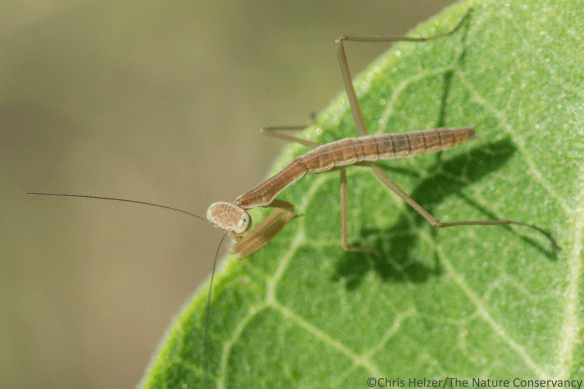
A praying mantis nymph hunting on a milkweed plant.

I was able to get barely close enough to this owl for a photo by using my pickup as a photo blind. I still had to crop the image a little to make the owl as prominent as it is in the photo, but I wanted to stay far enough away that I didn’t discourage it from nesting.

Burrowing owls occupy burrows of other animals as nesting sites.  These tiny owls are about the same size as an American robin, but their wingspan can be up to 8 inches wider.  They have a fascinating habit of spreading animal dung around the entrance to their burrow to attract dung beetles – one of their favorite foods.

We usually see a few nesting pairs of burrowing owls up at the Niobrara Valley Preserve each year, and they can be found elsewhere in the Sandhills and western Nebraska, especially within prairie dog towns.  However, their populations are in decline across most of their continental range, and it’s uncommon to see them outside of landscapes of mostly intact grasslands.

In this case, this owl and its mate are using a badger hole for a nesting site.  As far as I know, this is the first burrowing owl pair that has nested in one of our Platte River Prairies during the 21 years I’ve been working here.  As you might expect, they are nesting in a site we burned this spring and that is being grazed fairly intensively by cattle.  On its own, this pair of owls doesn’t equate conservation success, but it’s one more piece of evidence that makes us feel good about our work.

Photo of the Week – June 1, 2018

I ran into a couple mysteries this week.  I enjoy mysteries, whether they get solved or not, but I’m wondering if maybe we can crowd source answers to both of these.  Stay tuned to the comments section for potential answers, and add your own suggestion if you have one.

First, when I was out at our family prairie last week, I found something interesting along the edge of our wetland.

Mystery #1. Who ate this bullfrog on top of this fencepost and left the remains hanging there afterward?

Something is helping us control our invasive bullfrog population, which I’m grateful for, but I’d like to know who to thank!  What kind of creature would pick up a full sized bullfrog, move it to the top of a nearby fence post and eat it?  The remains of another frog were on the next post over from this one, so it’s not an isolated event.  I’m thinking it has to be a bird, and a large one at that.  Herons like to eat frogs, but as far as I know, they leave the remnants floating in the water.  Do hawks eat frogs?  Owls?  Osprey?

The second mystery is a little different, and I’ve already had help solving part of it.  I’ve been walking past a couple New Jersey tea plants recently (on the way to my square meter photography project site).  Each time, I’ve noticed a particular kind of insect hanging around on and near the flowers.  The way the bugs (because they are clearly Hemipterans – true bugs) are sitting poised and apparently waiting for something, I’ve been assuming they are predators.

This bug, and several more like it, have been hanging around on a couple New Jersey tea plants lately.

I recognized the bugs but didn’t know what they were.  They reminded me of leaf-footed bugs, but instead of the flattened “leaf” structure being on their legs, this bug had them on its antennae.  I submitted the above photo to Bugguide and got a quick response, identifying it as a Euphorbia bug (Chariesterus antennator) – a kind of leaf-footed bug, after all.  That was easy, but my next step was to try to learn more about it, and that’s where I got stuck.

I found information on a couple other leaf-footed bugs, but not the Euphorbia bug.  It appears most leaf-footed bugs are plant feeders, with some doing minor damage to crops or garden plants.  Photos of the Euphorbia bug I can find on the internet often show it on Euphorbia plants (spurges), which makes sense, but I can’t find anything that says it actually feeds on spurge plants themselves.  Maybe that’s a favorite plant, but not its only food source?

So, I want to know what Euphorbia bugs eat.  Are they predators that hang out on plants waiting for opportunities to catch prey?  Or are they plant feeders that may or may not prefer spurge species?  While we’re at it, what do their larvae feed on?  Where do they live?  Is there anything else interesting about them?  Mysteries.

Help?