
Years ago, we hired an older mechanic (older than me, anyway) to take care of our equipment so I and other staff could focus more on ecology and land management and less on carburetors and oil changes. Fred (not his real name) always seemed a little grumpy. That was completely understandable, given his responsibilities. Not only was our equipment old and worn out, we tended to be pretty rough on it.
Trained as ecologists, not mechanics, we often used equipment for purposes it was never intended for. (“You know that old Massey combine was built for harvesting soybeans on flat fields, right? Not for harvesting dense prairie cordgrass in wet meadows or rose hips on steep hills??”) Even worse, we were pretty cavalier about checking oil, greasing zerks, and other basic maintenance. When equipment inevitably broke down, Fred would come out with his tools, grumbling under his breath about carelessness and laziness, and fix the problem. The next time we used that particular piece of equipment, we were likely to see a note scrawled on the equipment in paint marker reminding us to “CHECK OIL BEFORE DRIVING!”, “DRIVE IN LOW GEAR!”, or “BLOW OUT THE RADIATOR!” We always knew Fred was mad when the paint markers made an appearance.

A paint marker note reminder from “Fred”. Photo by Eric Chien
I’ve often thought that land managers are much like mechanics. Instead of maintaining machines, we are charged with keeping natural areas working properly. Sometimes, we’re called upon to fix (restore) land that has been degraded by chronic overgrazing, broadcast herbicide use, or even tillage. Other times, we just perform minor tune ups to keep things humming along. There isn’t really an end point to land management, no pinnacle of success to be reached. Instead, success is being able to hand off a piece of land to the next manager and feel good about it. “Welp, here’s the keys…”
Because he cared about the equipment he was responsible for, Fred always got justifiably frustrated with us when we would fail to take obvious (to him) steps to help prevent a potential breakdown. He also felt personally offended when he saw machinery – ours or otherwise – that was obviously neglected and rundown. We land managers experience the same emotions about land.
We understand the importance of plant and animal diversity in prairies, for example, and know that good management can maintain both that diversity and the ecological function it supports. It is immensely frustrating to see prairies neglected and over-run by trees or other invasive plants. It can be even harder to watch a prairie get chronically overgrazed, broadcast with herbicide, or (especially) tilled for row crop production. We have a deep understanding of what’s lost when prairie is degraded or destroyed, and we appreciate how difficult restoration can be.
Just as Fred got cranky with us because we didn’t take care of the equipment he was invested in, it’s easy for us as land managers to feel the same way about people who neglect or abuse land. However, whenever Fred would gripe at us about what we were doing, we tended to tune him out (“Oh, that’s just Fred – he’s always cranky about something.”) Only on the rare occasions did he calmly explain why it was important to do something and how it might affect us personally. That’s when we actually listened.
I think there is an important lesson here for land managers and anyone involved in conservation. Being grumpy doesn’t build credibility. People don’t usually respond well when you lash out at them or make them feel dumb or lazy. If we want to change the way people treat land, we need to figure out the motivation behind what they’re currently doing and start a conversation there. Often, they have good intentions but lack the information and larger context that we have. We can help with that. Demonstrating what good land management looks like and showing how better habitat helps wildlife, pollinators and humans will go a long way toward improving the world around us.
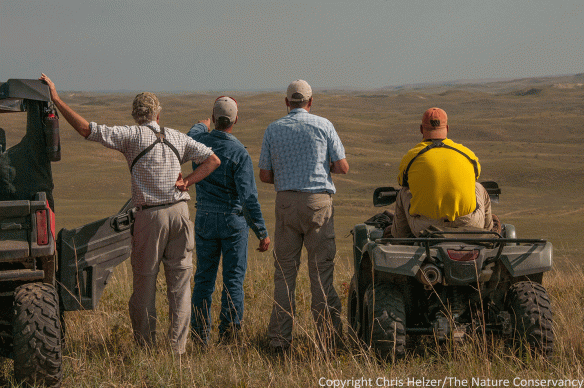
It’s vital that land managers share what we learn with other land managers, land owners, and others. Looking at management results on site can be the most effective way to trade ideas and strategies, but there are other options as well. Starting conversations is the first step.
A related lesson is that working in isolation doesn’t change the hearts and minds of others. Most land managers tend to enjoy working alone, or in small groups of like-minded people. While that may be comfortable, it doesn’t help inspire action on other lands. Inviting people to well-managed land for field days, volunteer work days or similar events can show others what great habitat looks like and motivate them to imitate good work. Sharing effective strategies and important lessons through presentations and publications can reach a broad audience. All land managers are constantly learning, but unless that knowledge is shared, it isn’t advancing conservation.
There is plenty to shake our heads about these days. The human race does a lot of silly things, and it’s tempting to just around and grumble to ourselves about it – or to snipe at anyone who offends us. That doesn’t really get us anywhere, though, does it? Instead of griping, let’s start conversations. Let’s find out what others care about and explain what conservation looks like to us and why it matters. Let’s be proactive about sharing both the lessons we learn and the wonder we gain from our lands.
After all, I think we can all agree that empathy and conversation are more effective than paint markers…




 The Prairie Ecologist