Photo of the Week – June 1, 2018

I ran into a couple mysteries this week.  I enjoy mysteries, whether they get solved or not, but I’m wondering if maybe we can crowd source answers to both of these.  Stay tuned to the comments section for potential answers, and add your own suggestion if you have one.

First, when I was out at our family prairie last week, I found something interesting along the edge of our wetland.

Mystery #1. Who ate this bullfrog on top of this fencepost and left the remains hanging there afterward?

Something is helping us control our invasive bullfrog population, which I’m grateful for, but I’d like to know who to thank!  What kind of creature would pick up a full sized bullfrog, move it to the top of a nearby fence post and eat it?  The remains of another frog were on the next post over from this one, so it’s not an isolated event.  I’m thinking it has to be a bird, and a large one at that.  Herons like to eat frogs, but as far as I know, they leave the remnants floating in the water.  Do hawks eat frogs?  Owls?  Osprey?

The second mystery is a little different, and I’ve already had help solving part of it.  I’ve been walking past a couple New Jersey tea plants recently (on the way to my square meter photography project site).  Each time, I’ve noticed a particular kind of insect hanging around on and near the flowers.  The way the bugs (because they are clearly Hemipterans – true bugs) are sitting poised and apparently waiting for something, I’ve been assuming they are predators.

This bug, and several more like it, have been hanging around on a couple New Jersey tea plants lately.

I recognized the bugs but didn’t know what they were.  They reminded me of leaf-footed bugs, but instead of the flattened “leaf” structure being on their legs, this bug had them on its antennae.  I submitted the above photo to Bugguide and got a quick response, identifying it as a Euphorbia bug (Chariesterus antennator) – a kind of leaf-footed bug, after all.  That was easy, but my next step was to try to learn more about it, and that’s where I got stuck.

I found information on a couple other leaf-footed bugs, but not the Euphorbia bug.  It appears most leaf-footed bugs are plant feeders, with some doing minor damage to crops or garden plants.  Photos of the Euphorbia bug I can find on the internet often show it on Euphorbia plants (spurges), which makes sense, but I can’t find anything that says it actually feeds on spurge plants themselves.  Maybe that’s a favorite plant, but not its only food source?

So, I want to know what Euphorbia bugs eat.  Are they predators that hang out on plants waiting for opportunities to catch prey?  Or are they plant feeders that may or may not prefer spurge species?  While we’re at it, what do their larvae feed on?  Where do they live?  Is there anything else interesting about them?  Mysteries.

Help?

Square Meter of Prairie Project – May, 2018

Back in January, I wrote about a photography project I’m embarking upon this year.  I am trying to photograph all the beauty and diversity I can within a single square meter of prairie.  I chose a little parcel of prairie right here in town so I have easy access to it.  Even on crutches, I can lug my camera gear out to that little square of prairie whenever the light is nice.

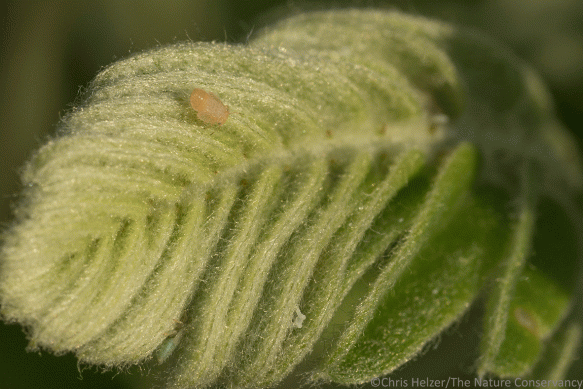
Lead plant (Amorphs canescens) leaves were just starting to emerge from buds back in early May.

At the end of May, lead plant leaves were nearly all opened.

My initial idea for the project was to help illustrate how much life happens in prairies, even at a small scale, and to show how dynamic prairies are over time.  I’m still excited about those aspects of the project, but I’ve also been pleasantly surprised at how much I’m enjoying the artistic challenge of finding compelling photographic opportunities within a tiny area.

My typical approach to photography is to venture out when lighting conditions are good and wander around widely, looking for something that catches my eye.  When I see a flower or bee that interests me, I’ll stop and photograph it for a while.  Often, I’ll see something else nearby and I might spend 5 or 10 minutes in one spot, photographing a series of subjects.  But that “spot” might be the size of a big living room or so, and I get nervous staying in the same place too long because I’m afraid of missing a better opportunity elsewhere.  Because good photography light is fleeting, I usually keep moving, roaming around and looking for the next great shot.

This tiny insect might be the nymph of a hopper of some kind? It appeared to be feeding on the lead plant leaf.

For this square meter project, I’m forcing myself to go to a single tiny place, stay put, and find multiple subjects to photograph.  I usually arrive and stare down into the space between my four yellow flags, wondering what I’ve gotten myself into – trying not to think about all the great photo opportunities I’m missing while I’m peering into this little square.  No wildflowers have bloomed within my plot yet this spring (there are others nearby), partly because it wasn’t burned this year and there is a thick layer of thatch covering the ground.  What the heck am I supposed to take pictures of?

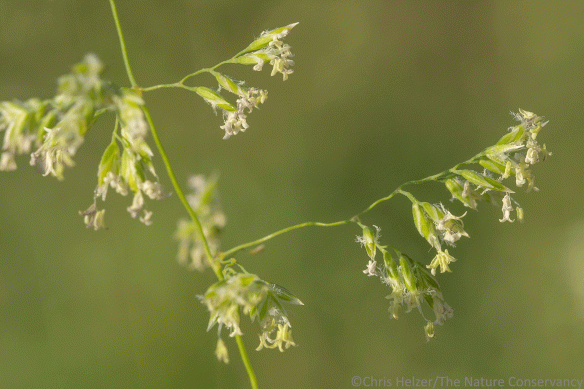
Kentucky bluegrass (Poa pratensis) was in full bloom this last weekend.

Magically, however, as I kneel in the grass and concentrate, I start to see more and more.  A lacewing or fly will pop in for a quick visit (usually quicker than I can capture with my camera).  Miniscule ants patrol the area, often following a fairly predictable pattern.  Patterns of light and texture start to pop out of the background, and as I move around the square, looking at it from different angles, I start to really enjoy the challenge of using what is in front of me.  It’s a little like being given a small box of rsndom objects and being told to create a sculpture.  You just work with what you have and try to find beauty.  I’m starting to love it.

A tiny ant explores a Maximilian sunflower (Helianthus maximiliani) leaf.  This ant and its colleague were moving up and down the stems and leaves of this plant for several minutes.  I was able to set up my tripod on this backlit section of leaf and just wait for the ant to move into the frame.

Flies have been common within the square meter, but difficult to photograph. This one landed on one of the flags I’m using to mark the plot corners.

I’m shocked that no one has ever written about the value of sitting quietly in nature… (I’m kidding, of course).  Regardless, while it can be a tired cliche, there’s a reason many people have espoused the practice, and it’s been great for me to force myself back into it.  I’m probably more in tune with my natural surroundings than most of my peers, but that doesn’t mean I can’t dig in even more.

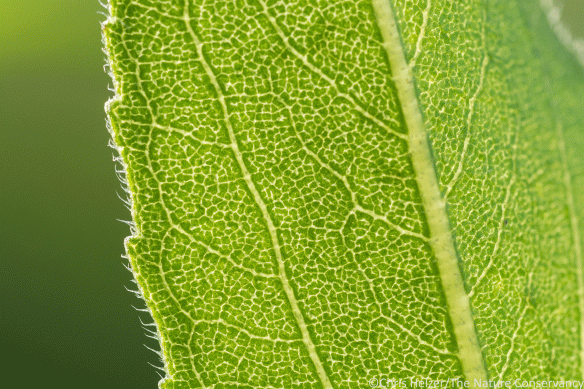
This stiff sunflower (Helianthus pauciflorus) leaf was beautifully backlit last weekend.

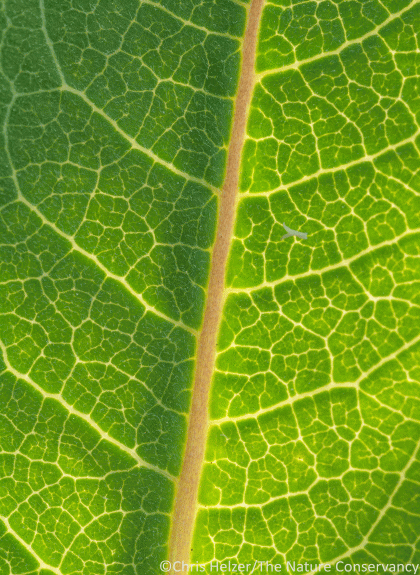
During my most recent trip to the square, I spent a lot of time appreciating the way light passed through various leaves and made them glow.  It wasn’t the first time I’d noticed or photographed backlit leaves, but I spent much more time enjoying the effect than I usually do.  The pattern of veins and the glowing translucent hairs on the leaf margins were mesmerizing when viewed through my macro lens.  I spent a solid 15 minutes photographing two leaves from different angles and distances.

I’ve always thought common milkweed leaves (Asclepias syriaca) are particularly beautiful when backlit.  This one was no exception.

Now, as I crutch myself down the trail to my little square, I’ve stopped worrying about whether or not I’ll find something interesting to photograph.  Instead, I’ve started getting excited about the chance to sit quietly and search for beauty I would have otherwise missed.  While I’ve found some great photo opportunities along the trail to and from the plot, the vast majority of images – and most of my favorites – from those trips have come from within my four yellow flags.