“I love it when a plan comes together.” Col. John “Hannibal” Smith.
Last summer, my wife and I were exploring at the Niobrara Valley Preserve and found what we thought were pasque flower plants, though they were well past blooming. There were hundreds of plants on north-facing slopes in the mixed-grass prairie north of the river. The soils in that mixed-grass prairie are more loamy than the vegetated sand dunes south of the river, and they support a different prairie plant community. We don’t see pasque flower along the Platte River or at my family prairie, so I was really excited to see it. I hadn’t realized it grew at the Niobrara Valley Preserve, so it was a pleasant surprise.
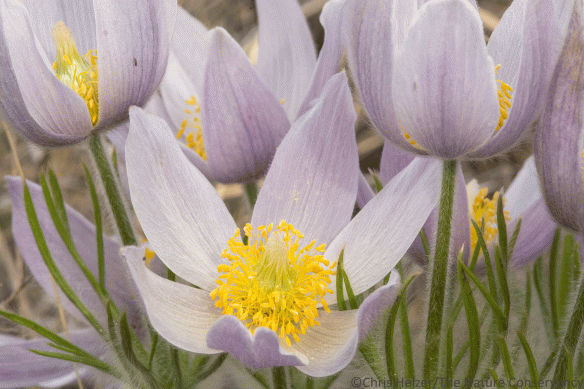
Pasque flowers (Anemone patens, aka Pulsatilla patens) are among the earliest bloomers in Nebraska prairies, but are found only in selected locations around the state. They are more widespread to the north and west of Nebraska.
As Kim and I walked around those hills last summer, I promised myself I’d figure out a way to photograph the pasque flowers in bloom during the spring of 2018. As spring finally staggered out of the gate this year, I kept a watchful eye on Facebook and Instagram posts and checked in periodically with friends – all in an effort to gauge the best time to head north for pasque flower photography. A couple weeks ago, our Hubbard Fellows made a trip up to the Preserve, and I had them scout the site for me. Olivia sent me a photograph of a blooming pasque flower, but said the majority of plants hadn’t flowered yet. Shortly after that, the area got over a foot of snow, which I figured would slow things down a little. For the next two weeks, I nervously watched the calendar, focusing on this week’s scheduled staff meeting at the Preserve, and hoping the timing would work out for pasque flowers too. I was sorely afraid I’d arrive only to find that I’d missed the peak bloom by just a few days.
Finally, this Monday, we drove up to the Niobrara Valley Preserve, arriving about 45 minutes before our noon meeting was scheduled to start. I immediately hopped on my ATV and rode out to the hills north of the river to find the pasque flowers. The sky was cloudy, but the clouds were thin enough to create beautiful diffused light, and winds were light. I tried not to get my hopes up as I climbed the last hill to one of the spots Kim and I had found the flowers last summer. As I crested the hill I grinned from ear to ear.
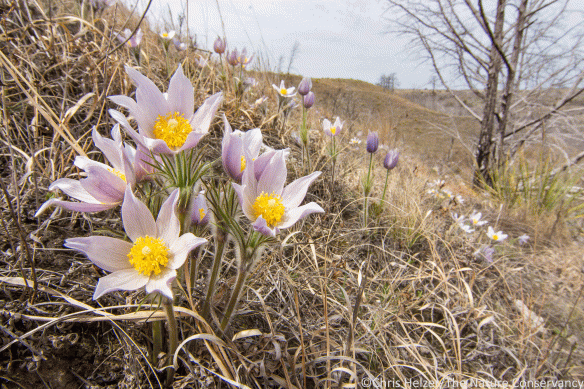
It looked like nearly every pasque flower in the prairie was blooming when I arrived at the Niobrara Valley Preserve this week.
I spent the next 30 minutes frantically scampering about, trying to photograph as many flowers as I could before I absolutely had to head back for the meeting. Later, during a break before supper, I talked a few colleagues into coming out again with me, and I managed another hour or so of photography. I could have stayed for days. Everything had worked out just as I’d hoped. I was right on time for peak bloom, and the light and wind cooperated as well. Life was just perfect. I loved the world and the world loved me.
The very next day, I broke my ankle. No kidding.
My photography outings might be a little limited for the next few weeks, but I’ll have a whole raft of pasque flower photos to stare at in the meantime:
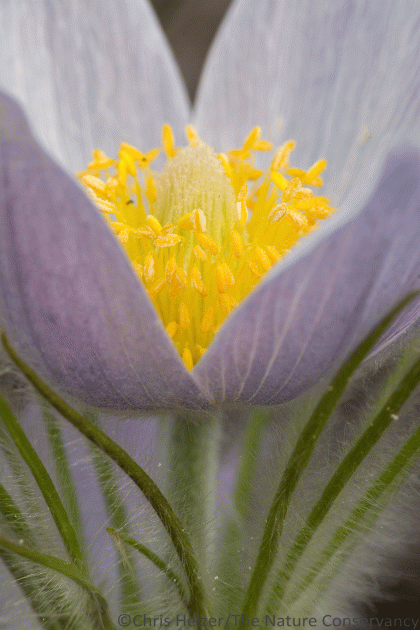
The flowers and early leaves of pasque flower are amazingly hairy. One of the reasons I wasn’t completely sure of the identification of the plants we saw last summer was that their summer leaves are much less woolly.

Many of the flowers were nearly completely white, while others had more lavender color to them, especially on the undersides of the petals.
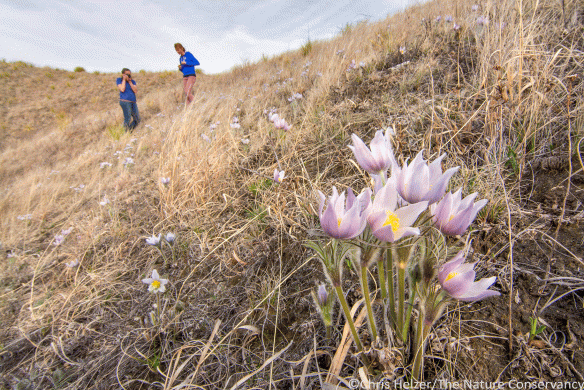
Olivia (Hubbard Fellow) and Amber (Bio-Technician) came out later in the day to appreciate the abundant flowers.

These flowers show the more lavender extreme of the color spectrum represented by the flowers we saw. I’m not sure if the color changes (becoming more white?) with maturity or if there is just a lot of variation from plant to plant. Someone with more experience with pasque flowers might be able to chime in on that.

This photo, taken with a short telephoto lens, gives a better feel for the density of the plants than my more wide angle shots, which make the plants look more widely dispersed than they really were.

I hope to photograph these flowers every year, now that I know where they are. I captured a lot of angles and perspectives this year, but I feel like there are nearly unlimited possibilities for more photos in the future!




 The Prairie Ecologist