The Life of a Single Mom (Bee)

Most of what we read in the news about declines in bee populations focus on (non-native) honey bees.  Yes, those populations are suffering declines from the combined impacts diseases, habitat loss, pesticide use and other factors.  However, there are nearly 4,000 bee species in North America, and many of them are dealing with the same pressures and threats as honey bees.  In addition, honey bees are social insects, living in large collaborative colonies of workers and queens.  The vast majority of bees in North America, however, are not social, and they succeed or fail on the backs of single moms.

Solitary bee

At first glance, some solitary bees might appear similar to honey bees (I’ve certainly been guilty of making that mistake many times) but while their appearance might be somewhat similar, their life stories are very different.  This one is a solitary bee in the genus Svastra.  At least I think it is…

Solitary bees – bees that don’t live in colonies – are all around us, but they go largely unnoticed.  Many escape our attention because of their small size, but others are as big as or bigger than honey bees.  Solitary bees can vary greatly in their diet preferences.  Some are generalists, feeding on nectar and pollen from a wide variety of flower species.  Others have much more narrow diets, feeding only from sunflowers, for example, or other categories of flowering plants.

Most solitary bees in prairies live in underground burrows, though others live in hollow plant stems or similar spaces.  In colonies of social bees, the work of gathering food, maintaining and defending the home, and feeding and caring for the kids is split between hundreds or thousands of bees.  In the case of solitary bees, the single mom does everything.  In most cases, she finds a likely spot, digs a burrow and prepares it for eggs.  Then, she flies around the neighborhood in search of the kinds of flowers she can collect food from.  As she nears the flowers, she’s likely to encounter males of her species, who basically spend their entire lives buzzing from flower to flower, hoping to find females to mate with.
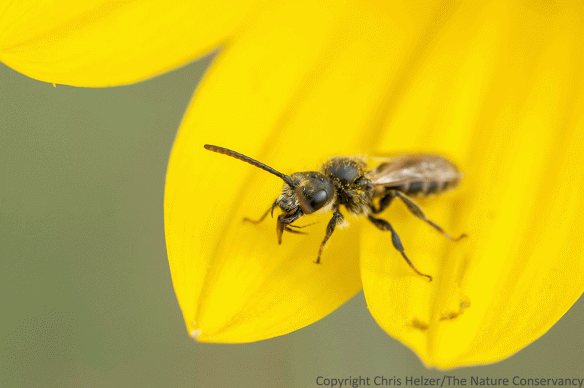
Male

A male solitary bee (Dufourea sp.) waits for females at a sunflower.

Assuming the single mom can find food nearby, she returns from foraging with a load of pollen and nectar, which she combines into a ball of sticky dough.  She places that in a cell within her burrow, lays an egg on or next to it, and seals up the cell.  Then, she takes off to repeat the process: find food, mix it together, lay an egg with it, seal up the cell.  Later, the eggs will hatch, and the larvae will stay in their cells and feed on the dough balls provided for them until they grow into adults and leave the nest.

As you might imagine, life isn’t easy for single mom bees.  They have to gather food for themselves and their kids, while fighting off overly-enthusiastic males with only one thing on their minds.  When they aren’t out finding food, they are building and provisioning baby rooms or sitting vigilantly at the entrance of the burrow, defending it from marauding wasps or other threats.  After mother bees have filled their burrow with eggs-in-cells, they seal up the whole nest and fly away, hoping for the best.

Single mom solitary bees have difficult lives, but there are ways we can help them.  First, we can help ensure the availability of nesting sites.  Some ground-nesting bees need areas of bare ground, and many others need at least access to the soil without having to fight through a dense layer of plant litter.  Similarly, stem nesters would appreciate it if you didn’t chop down all of last year’s plant skeletons, especially those of raspberry, sunflower, rose, leadplant, and other plants with hollow stems.  Providing this kind of nesting habitat is important in prairies and other natural areas, but also in backyard gardens and other urban areas.  Because solitary bees aren’t aggressive toward humans, there’s no downside to sharing your yard or garden with them (and, as pollinators, they’ll work for their housing).

A "long-horned bee" (Melissodes sp) on dotted gayfeather (Liatris punctata).

A “long-horned bee” (Melissodes sp.) on dotted gayfeather (Liatris punctata).

Perhaps more importantly than housing, what bees need most is food.  The key to supporting strong bee communities is plant diversity.  A prairie or garden with lots of different kinds of flowers will support lots of different kinds of bees.  Specialist bees will be able to find the particular flowers they need, and generalist bees won’t run out of food when one kind of flower stops blooming, gets eaten by insects, or is wiped out by disease.  Early spring can be a particularly difficult time for bees to find food because of the relative scarcity of flowers at that time of year.  Boosting the spring-time abundance of both native wildflowers and flowering shrubs in gardens and natural areas can be very helpful.

In prairies and other large-scale habitats, it’s important to think about the flight range of bees.  Honey bees can travel up to several miles to find food.  Most solitary bees are considerably smaller, however, and they may be limited to a range of a few hundred yards or less from their nest.  During their nesting season, bees will need to find everything they need to survive and supply their nests from that relatively small circle of habitat.  The availability of abundant flowers of many kinds within that circle helps ensure that bees can find food throughout the season.  If a large area surrounding a bee’s nest is mowed or grazed intensively, it is left stranded with a nest in the middle of a food desert.
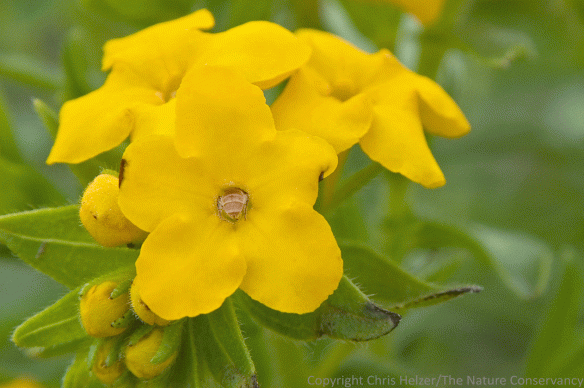
this

This tiny sweat bee fits perfectly into this puccoon flower (Lithospermum carolinense).  Its size gives it access to flowers larger bees (including honey bees) can’t get into, but that size also limits its ability to forage far from its nest.

If you’re a landowner or land manager, think about your property from the perspective of a single mom bee.  Pick a few spots on your land and visit them every few weeks to see what the abundance and diversity of flowers looks like.  If a bee was nesting where you stand, could she find what she needs for food within a short distance of that location?  Are there times of year when it’s hard to find abundant flowers?  If so, can you tweak your management or implement restoration strategies to make more flowers available?  Are there places where bees can find bare soil for nesting, or is there a layer of thatch covering the soil across your whole site?  Burning, intensively grazing, or haying portions of your land each year can help reduce thatchiness and help ensure bees’ access to soil.  However, creating patches of prairie habitat representing a full spectrum of vegetation structure types (tall/dense, short/sparse, mixed-height, etc.) will be of maximum benefit to both bees and other insect and wildlife species.

Single mom bees deserve our respect and admiration.  They build and prepare their nest, seek out and harvest food while dodging predators and lustful males, and provision their eggs with food and a safe place to grow up.  Oh, and along the way, they also pollinate and help ensure the survival of the majority of plants on earth.  It seems only fair that we should acknowledge their work and do what we can to help them out.


More information:

While the vast majority of native bees are solitary bees, some are social as well, including bumble bees, some sweat bees, and others.  Bumble bees, in particular, are very important pollinators because of their size and mobility as well as their willingness to visit many different kinds of flowers.  As opposed to honey bees, whose colonies can survive the winter intact, all bumblebee individuals except fertilized queens die at the end of the growing season.  Those fertilized queens overwinter and then become single moms in the spring.  Once the queen’s first brood matures, those bees take over the foraging work and take care of the queen.  You can learn much more about solitary bees and other native bees here.

Many thanks to Mike Arduser and Jennifer Hopwood for reviewing this post for accuracy.  Any remaining errors are mine, not theirs.
A Milestone for Prairie Restoration

Because conservation work can sometimes seem like blowing into the wind, it’s important to pause periodically to celebrate progress.  For example, I am really excited about what has been accomplished in the field of prairie restoration.  We’ve known for a while that we can convert cropland to prairie vegetation with a high diversity of plant species (150 or more species per planting), and that we can do that on a scale of thousands of acres.  The Nature Conservancy has large projects in states like Indiana, Illinois, and Minnesota where restored prairie landscapes now range from about 5,000 to 20,000 acres in size.  The U.S. Forest Service is transforming an old U.S. Army Arsenal into 20,000 acres of prairie in Illinois.  Prairie Plains Resource Institute, the organization that pioneered restoration techniques in Nebraska, is planting up to 1000 acres a year now and has established well over 10,000 acres total across the state.

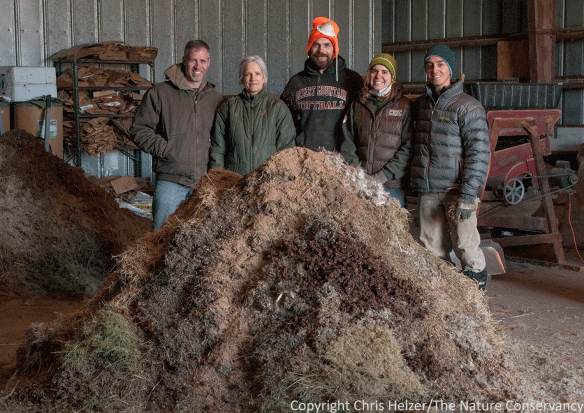
Our staff celebrates a successful year of seed harvest back in 2015.

Our staff celebrates a successful year of seed harvest back in 2015.

Here in our Platte River Prairies, we’ve restored more than 1,500 acres of cropland to prairie.  That’s not insignificant, but more importantly, we’ve been testing the idea that those restored prairies can help defragment the ecological landscape around them.  Habitat fragmentation is one of the largest threats to today’s prairies because it shrinks and isolates populations of species, making them vulnerable to becoming locally extinct without the chance of recolonization from nearby sites.  The real promise of prairie restoration is that it can enlarge and reconnect scattered remnants of native prairie, providing populations of animals and plants a much better opportunity to survive and thrive.  It’s not feasible or desirable to convert the majority of cropland in the central North America back to prairie, but there are particular sites where strategic restoration work could make a huge difference in the potential survival of prairie species and ecological services.

In order for prairie restoration to help defragment landscapes, restored prairies have to provide suitable habitat for the species living in small isolated prairies.  Many bees and other insects specialize on certain plant species, for example, and other animals rely upon an abundance of prey, a diversity of seeds, or other particular food or habitat conditions.  Satisfying the individual needs of all those prairie animals is a critical measure of success if prairie restoration is going to successfully stitch isolated prairies back together.

Over the last several years, we’ve been collecting data to see whether the species of bees, small mammals, grasshoppers, and ants in our unplowed prairie remnants have moved into adjacent restored habitat.  The results have been very positive.  While not every species of animal living in our remnant prairies has been found in nearby restored habitat, we’ve found the vast majority of those we’ve looked for.  We suspect that most of the remaining species are also present but that our limited sampling effort just hasn’t yet picked them up.  We’ll keep trying.

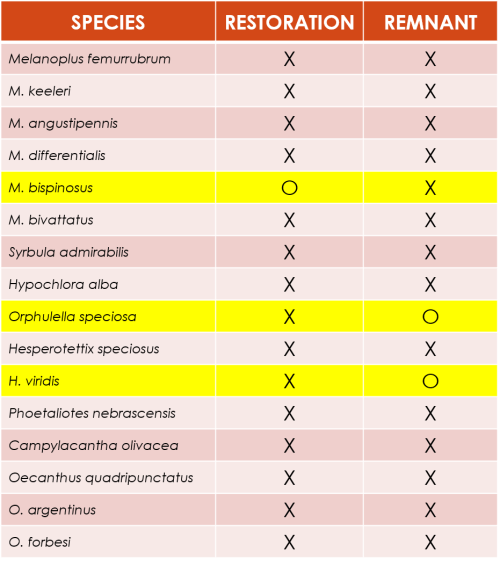
Dillon Blankenship, a Hubbard Fellow, compared grasshopper, katydid, and tree cricket communities on three pairs of remnant/restored prairies back in 2014. Almost all species were present in both restored and remnant habitats. In the three species that weren't, only one or a very few individuals were found, so it's likely just a sample size issue.

Dillon Blankenship, a Hubbard Fellow, sampled grasshopper, katydid, and tree cricket communities on three pairs of remnant/restored prairies back in 2014. Almost all species were present in both restored and remnant habitats. In the three species that weren’t, only one or a very few individuals were found, so it’s likely just a sample size issue.

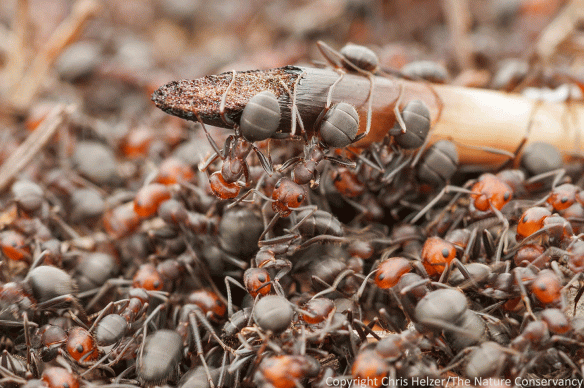
Data from James Trager and Kristine Nemec has helped us compare ant species composition in restored versus restored prairies along the Platte River. So far, we've documented 30 species and only one has been found exclusively in remnant prairie (and, again, it's likely to be a sample size issue).

Data from James Trager and Kristine Nemec has helped us compare ant species composition in restored versus restored prairies along the Platte River. So far, we’ve documented 30 species and only one has been found exclusively in remnant prairie (and, again, it’s likely to be a sample size issue).

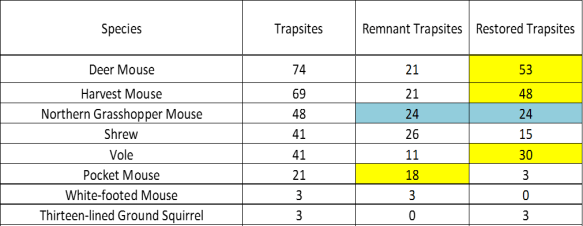
Master Naturalist Mike Schrad and Hubbard Fellow Jasmine Cutter have both helped us compare small mammal populations between restored and remnant prairies. This table shows some of Jasmine's data from one site. In general, we're finding that the same species are in both restored and remnant prairies, but the relative abundance of those species is often different - with some apparently favoring remnant habitat and others favoring restored areas.

Master Naturalist Mike Schrad and Hubbard Fellow Jasmine Cutter have both helped us compare small mammal populations between restored and remnant prairies. This table is from Jasmine’s data from one site, showing the number of trapsites in which each mammal species was caught back in 2014. In general, we’re finding that the same species are in both restored and remnant prairies, but the relative abundance of those species is often different – with some apparently favoring remnant habitat and others favoring restored areas.  We’re now looking at how our management affects presence and abundance of each species through time.

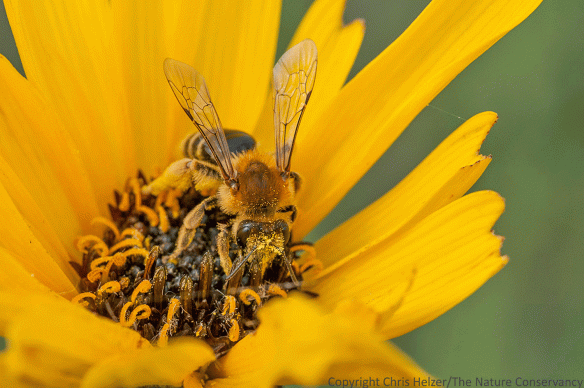
We've had several research projects look at native bees in our prairies. Mike Arduser, Anne Stine (Hubbard Fellow), Bethany Teeter, and Shelly Wiggam Rickets have all helped us compare restored and remnant prairies. So far, we've found over 72 species and the vast majority have been in both remnant and restored prairie.

We’ve had several research projects look at native bees in our prairies. Mike Arduser, Anne Stine (Hubbard Fellow), Bethany Teeters, and Shelly Wiggam Rickets have all helped us compare restored and remnant prairies. So far, we’ve found over 72 species and the vast majority have been in both remnant and restored prairie.

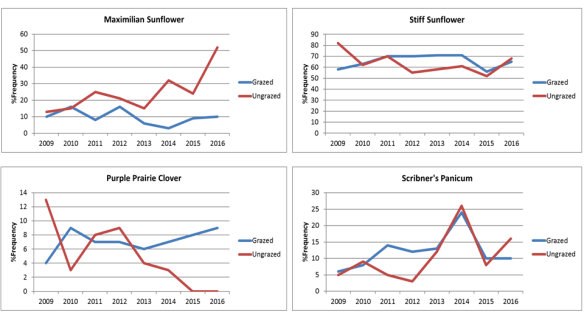
I've collected more than 15 years of data showing that plant diversity and the frequency of occurrence of prairie plant species has remained stable through time. These four graphs show four species in one restored prairie where we're comparing fire/grazing management to fire only management.

I’ve collected more than 15 years of data showing that plant diversity and the frequency of occurrence of prairie plant species has remained stable through time. These four graphs show four species in one restored prairie where we’re comparing fire/grazing management to fire only management.  The long-term persistence of prairie plants and diverse plant communities is critically important for plant communities, but also for the success of efforts to defragment habitat for animals.

These results mean that where prairie landscapes have been largely converted to row crops, we don’t have to just watch while insect or small mammal populations careen toward local extinction in tiny isolated prairies.  We’ve shown that we can make those prairies larger and more connected, and that animal populations can grow and use new restored habitat and diverse plant communities.  We’ve also shown that restored prairies can sustain their biological diversity for decades, even through periods of intensive grazing and drought.  While there are still plenty of questions and potential improvements we can make, we’re now at the point where society needs to decide whether and where to do this kind of restoration.

I don’t know about you, but I think that’s pretty exciting!

Nebraska and other states in central North America have large swaths of productive and important cropland.  As I said earlier, I’m not advocating that we convert most of that back to prairie.  However, there are specific sites where row crop agriculture is marginally productive/profitable and the long-term interests of both society and local landowners might be best served by putting land back into diverse and productive grassland.  Agricultural policies and subsidy programs will obviously play a huge role in this kind of strategic large-scale restoration, and getting the policies in place to facilitate this kind of common sense restoration will be plenty difficult.  That’s nothing new, however.  What’s new is our confidence that if we can implement targeted restoration work, it can make a real difference to prairie conservation.

Restoring the viability of prairies in fragmented landscapes is critically important to prairie conservation success.  The challenges of conserving species in small isolated prairies are immense, and many of those prairies will continue to see declines in biological diversity and ecological function over time unless we can make them bigger and more connected with other prairies.  Helping to document our ability to do that – at least for many prairie species – has been one of the most satisfying things I’ve done during my career.


Important footnote:  Restored prairies are not the same as remnant unplowed prairies.  Soil organic matter levels, for example, can take many decades to recover from tillage, and relationships between plant and microbial communities may take just as long to become reestablished.  Our success in prairie restoration should definitely not be used as justification for plowing up remnant prairie!  However, it’s equally true that prairie restoration efforts aren’t failures just because they can’t create an exact replica of prairie as it existed before it was converted to farmland.  If defragmenting prairie landscapes is the primary goal of restoration, we just need to create restored prairies that complement – not copy – remnant prairies.