The Gluttonous Crab Spider

The following post was written by Evan Barrientos, of our two Hubbard Fellows for this year.  Evan is a talented writer and photographer, and if you enjoy this post, I encourage you to check out his personal blog as well.  …For the record, I did not in any way encourage Evan to photograph or write about crab spiders.  This is despite my well-known affinity for them and my personal inability to walk past one without taking its portrait.

Over this summer I’ve tried to focus on photographing the prairies with a wide angle in order to show what the landscape looks like, but sometimes it’s just impossible to resist delving into the tiny details and dramas of prairie microfauna. One morning in June I was admiring the spiderwort flowers when I stopped to photograph a crab spider (Thomisidae sp.) sucking the juices out of a hoverfly (Syrphidae sp.) that she had caught.

06142015_nebraska_8934

If you’ve been reading this blog for a while, you’ll know that many crab spiders hide on flowers and ambush insects as they stop for a drink of nectar (similar to ambush bugs). Some crab spiders can even change their color to yellow or white in order to match the flower they are on, but this spider didn’t seem to need that trick. To my great surprise, a second hoverfly was brave, hungry, or stupid enough to land on the same flower while I was taking photos. Maybe it thought the spider would be content with the hoverfly already in her fangs. It was wrong.

06142015_nebraska_8953

The spider quickly honed in on the intrepid visitor, even though her fangs were already more than full. What she planned to do with the second hoverfly, I don’t really know, but  watch what happened when the clueless hoverfly strayed a little too close:


Apparently, this hoverfly liked adrenaline, because it continued to gorge itself on delicious spiderwort nectar for a few more moments and eventually flew off to safety. Thinking the spectacle had ended, I started to pack up my camera gear, but before I could, another fly landed on the flower!

06142015_nebraska_9073-4

As you can see from the photo sequence, the spider was once again too slow to catch the visitor. I watched her for a little longer, but eventually left to photograph a bird singing nearby. I came back a few minutes later to check on the spider and found yet another surprise.

06142015_nebraska_9068

In the five minutes I was away, the crab spider had finished eating the first hoverfly and caught another one. I don’t know if spiderworts are irresistible to flies, or if hoverflies are terrible at spotting white crab spiders on purple flowers, but this spider sure was lucky that morning!

Encounters like this remind me how important it is to pause every once in a while and notice the little details. When I do this I’m often amazed by how much is going on around me and how much I would have missed it if I hadn’t stopped. Wide-angle views certainly have their place too, but to fall in love with prairies you really need to stick your nose in them at times.
Life on a Weedy Plant

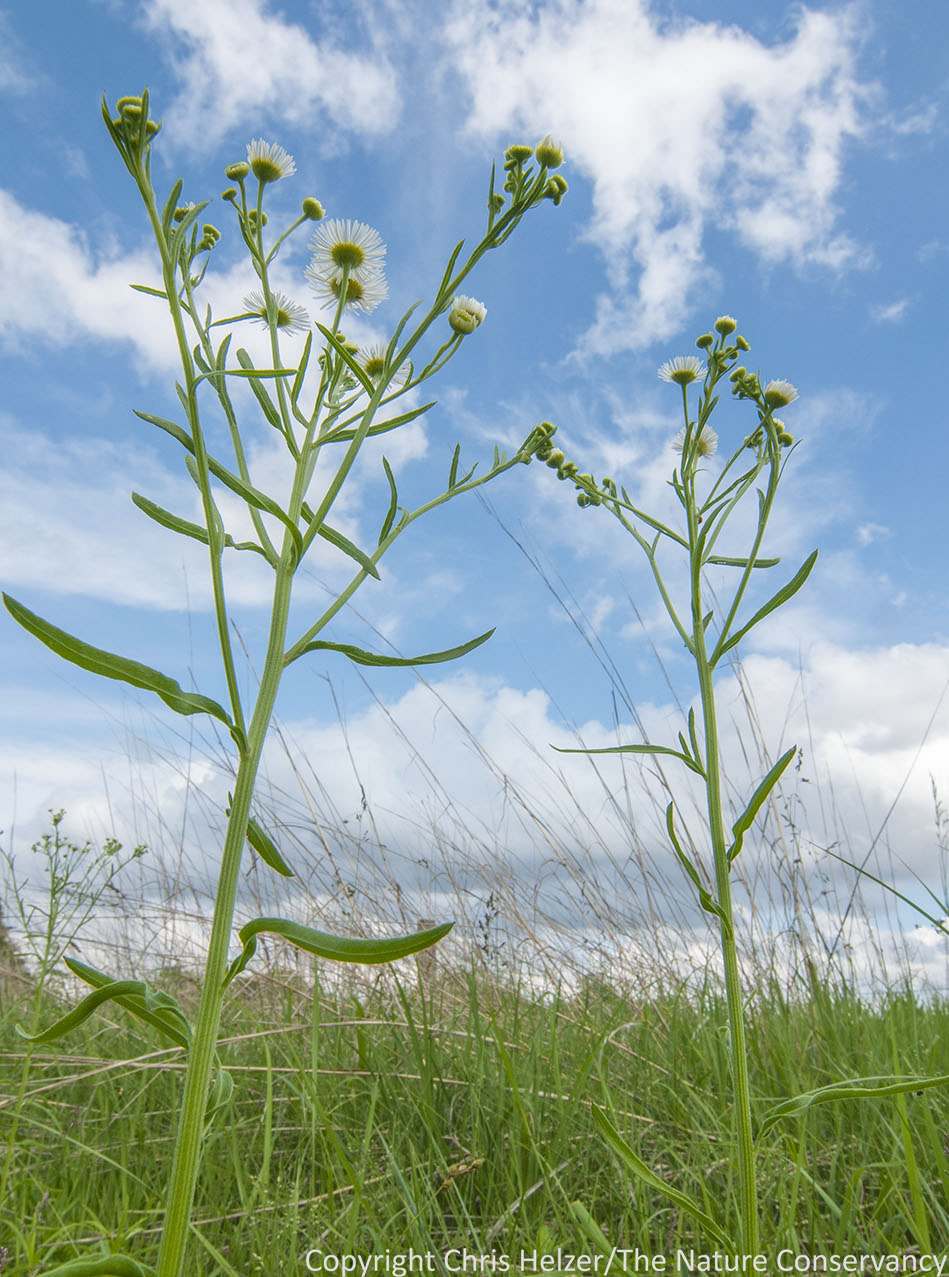
Daisy fleabane (Erigeron strigosus) is considered by many people to be a weed.  It’s a biennial with very pretty, albeit small, daisy-like flowers that flourishes when the dominant plants around it have been weakened.  As a prairie manager, I’ve always appreciated daisy fleabane as an indicator that we’ve created conditions for new wildflowers (short- and long-lived) to insert themselves between the grasses in our sites.

Daisy fleabane (erigeron strigosus).  Lincoln Creek Prairie.  Aurora, Nebraska.

Daisy fleabane reaches toward the sky. Lincoln Creek Prairie. Aurora, Nebraska.

Last Friday evening, I took my camera for a walk in a small prairie here in town and found quite a few daisy fleabane plants growing along the trail.  I wasn’t the only one enjoying them – I saw numerous small bees and flies feeding on the pollen, and a few crab spiders hoping one of those pollinators waiting to ambush those same small pollinators.

Daisy fleabane (erigeron strigosus).  Lincoln Creek Prairie.  Aurora, Nebraska.

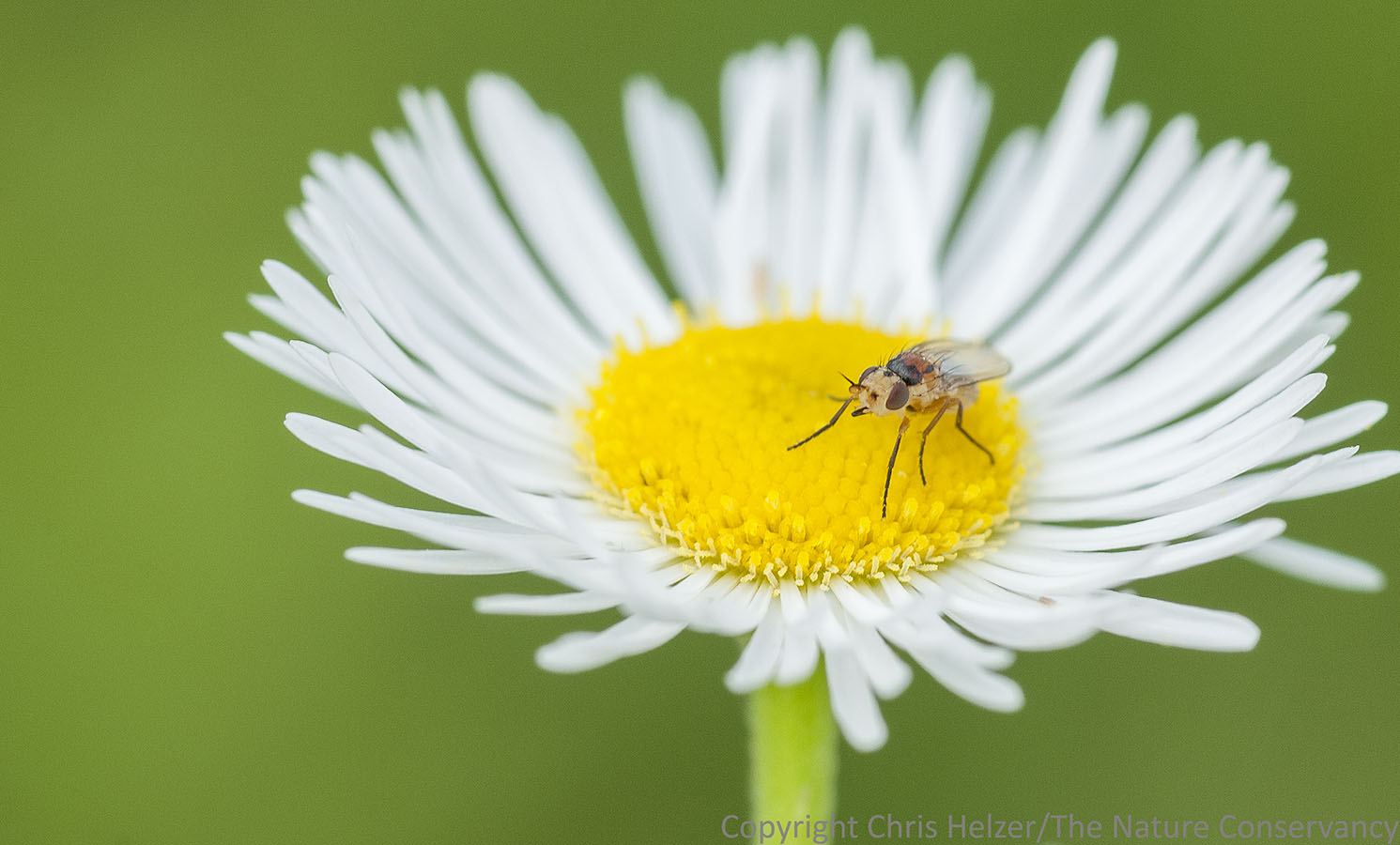
Daisy fleabane flowers and small fly.

Fly on Daisy fleabane (erigeron strigosus).  Lincoln Creek Prairie.  Aurora, Nebraska.

A closer look at the fly.

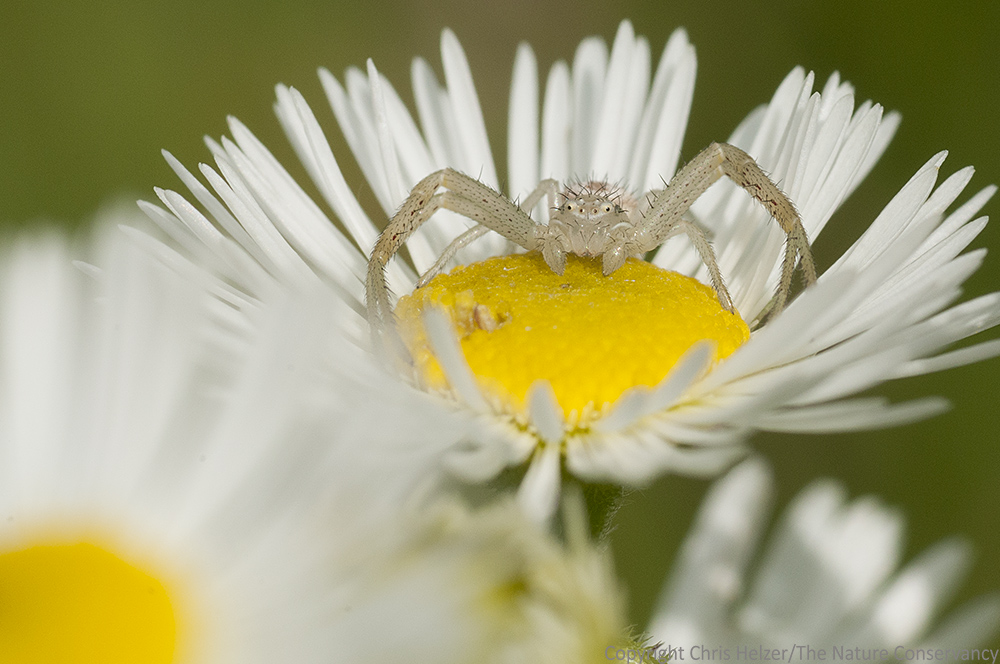
The first crab spider I noticed slipped over the edge of the flower to hide when it spotted me coming toward it.  I turned away to photograph something else nearby.  When I looked back, the spider was back on the flower.  I adjusted my position very slightly and the spider slipped back to its hiding place.  Argh.  Stubbornly, I decided I was going to photograph that spider if I had to wait all evening to do so.  I didn’t have to wait quite that long, but it felt like it.  I got my tripod positioned so that I could take the photo when/if the spider reappeared.  Holding perfectly still, (with sweat running down my nose and mosquitoes feeding on my neck) I stayed in position for at least 5-10 minutes until the spider finally showed itself again.  Got it!

Crab spider on daisy fleabane.  Lincoln Creek Prairie.  Aurora, Nebraska.

This spider photo is nice enough, but will always be memorable to me because of the effort it took to get it.  I hate to think how many mosquitoes got a free meal while I sat still waiting for my little spider buddy to make itself available for a photo…

A little further up the trail, I saw another crab spider that had caught a fly.  I figured it too would make a run for cover when I got close, so I came in low and slow.  I’m not sure it would have mattered – this spider showed none of the anxiety of the first one, and sat very still while I set up the tripod and waited for the breeze to pause long enough to get a good shot.  Maybe this spider was too distracted by its meal to care about me (though that’s not been my experience in the past).   I wasn’t sure whether to be grateful to the second spider for its cooperation or mad at the first one for all the mosquito bites on my neck.

Crab spider on daisy fleabane.  Lincoln Creek Prairie.  Aurora, Nebraska.

This crab spider seemed happy to have its photo taken with its hunting trophy.

I can understand why people might think of daisy fleabane as a weedy little plant, but its just filling an important role.  When the grasses are weak, something has to take advantage of the temporarily available resources around and between them.  There are numerous species that can do that, including a few that can cause real problems if they become established.  Given the choices, I’m always happy to see the pretty little daisy flowers and the diverse tiny creatures they attract.