
Photo of the Week – July 16, 2015

Scaly blazingstar (Liatris squarrosa) is just starting to bloom in the Platte River Prairies.  It has beautiful and intricate flowers with very long anthers protruding from its tiny blossoms.  At least it usually does…

Blazing star (Liatris squarrosa)  The Nature Conservancy's Platte River Prairies, Nebraska.

Scaly blazingstar (Liatris squarrosa). The Nature Conservancy’s Platte River Prairies, Nebraska.

I was photographing some blazingstar flowers earlier this week when I saw one with a grasshopper sitting on it.  It sat still long enough for me to get a few photos of it.

Grasshopper on blazing star (Liatris squarrosa)  The Nature Conservancy's Platte River Prairies, Nebraska.

A grasshopper standing innocently(?) on top of scaly blazingstar.

Only when I looked the above photo on my computer screen did I notice the absence of most of the long white anthers I’d seen on other flowers.  Surely, I thought, it’s not a coincidence that the grasshopper is present but the anthers are not…?

Grasshopper on blazing star (Liatris squarrosa)  The Nature Conservancy's Platte River Prairies, Nebraska.

The grasshopper eating one of the long anthers.

Sure enough, looking back through my other images, I found one of the grasshopper eating an anther.  Caught red-handed!  (So to speak.)

Just because they are called “grass”hoppers doesn’t mean that’s all they eat.  In fact, many grasshoppers eat pollen and other parts of wildflowers.  Some are fairly specialized, while others are generalists in terms of the plant species they feed on.  Even among the grass-feeding grasshoppers, there is great variety in which grass species and which parts of those grasses each species eats.

For the sake of the scaly blazing star (and our seed harvest efforts this year), I hope at least some of the anthers survive uneaten so the plants can make seed.  As more flowers open, maybe their abundance will be more than the grasshoppers can keep up with.  At least in past years, we’ve usually gotten pretty good seed harvests from blazingstar, so I’m not too worried.

Just interested…
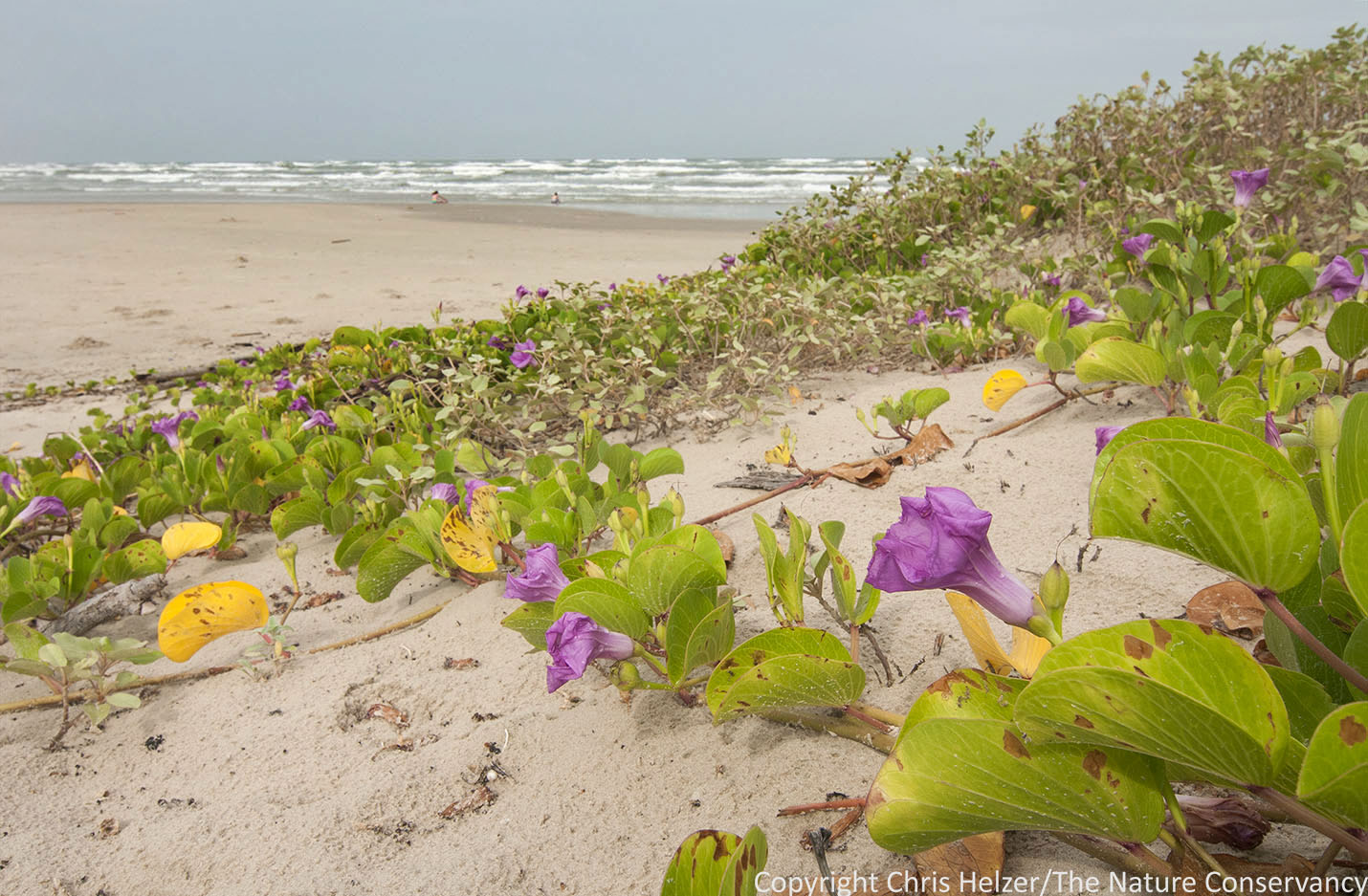
Photo of the Week – June 19, 2015

I’ve been on a family vacation to the Corpus Christi, Texas area this week.  It’s been a great week, with pleasant weather and lots of beach exploration.  I’ll have more photos to share next week, but today wanted to share a plant that I very much enjoyed photographing down here.

Railroad vine in bloom at Padre Island National Seashore, Texas.

Railroad vine in bloom at Padre Island National Seashore, Texas.

Railroad vine, or beach morning glory (Ipomoea pes-caprae) is a native vine that sprawls across many of the dunes along the beaches of the Gulf Coast of Texas.  Although it is in the same plant family as the bindweed I’m fighting in my home garden, it wasn’t hard to appreciate its color and character.

ENPO150617_D011

We spent Thursday at San Jose Island, just north of Port Aransas, Texas.  Railroad vine was common on the beach dunes there as well.  Also abundant on those dunes were grasshoppers of many colorful species.  The two interacted in at least some cases, with the grasshoppers feeding on the flowers of the vine.

Grasshopper feeding on railroad vine flowers.  San Jose Island, Texas.

Grasshopper feeding on railroad vine flowers. San Jose Island, Texas.

It turns out that photography (at least for me) along the beaches of the Texas Gulf Coast is much like it is in the prairies of Nebraska.  I walk through the vegetation and appreciate the scenery, but mostly focus in on the small creatures (like grasshoppers) living there.  More on that next week…

ENPO150618_D037