
Early in my career, I felt pretty strongly that only native plants should be in the prairies I managed. Pretty quickly, I realized I didn’t have enough time to eradicate the worst invasive plants from our sites, let alone worry about some of the more innocuous non-native plants. In fact, I found some of those non-native plants could be pretty valuable (e.g., dandelions and their early season resources for pollinators).
I began to take a much more pragmatic approach to managing plant communities, working to suppress species that tended to form monocultures or become dominant enough to suppress the diversity of plant communities. Some of those dominant/aggressive species included non-native invasive grasses and woody plants, but also some native species such as big bluestem, eastern redcedar, smooth sumac, and rough-leaved dogwood. A plant’s status as native or not became less important than how it affected the diversity and function of the plant community it was part of.
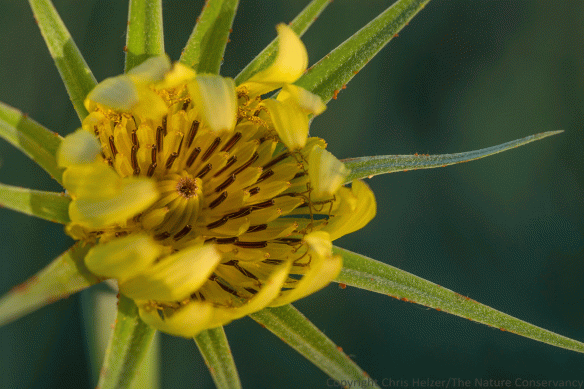
A goatsbeard flower opening at sunrise. Niobrara Valley Preserve.
One non-native plant I’ve always gotten along with pretty well is goatsbeard, aka western salsify (Tragopogon dubius). Sure, it wasn’t here before European settlement, but it isn’t aggressive and has simply added itself to the plant diversity of many of our prairies. Also, it’s really pretty (though so are many nasty invasive plants). Both when it flowers and when it goes to seed, goatsbeard makes an attractive photography subject.
It’s fun to stick a macro lens into a goatsbeard seedhead, which resembles a fist-sized dandelion head, and try to create interesting abstract images. Goatsbeard seedheads were one of my favorite subjects when I first started playing with close-up photography about 25 years ago, and they still attract me today. I never get tired of looking at those big fuzzy parachute-style appendages attached to the seeds.


Becoming less of a snob about the native status of plants has made my life a little less stressful. There are plenty of plant species that require serious attention in order to maintain healthy, diverse, and resilient prairies. Worrying about whether a plant was here 200 years ago is the least of my worries. Now when I walk around a grassland, I’m comfortable greeting species like dandelions, goatsbeard, and lamb’s quarters as friends (while still trying to eliminate problematic non-natives such as crown vetch, Siberian elm, and Canada thistle).


 The Prairie Ecologist