
Photo of the Week – February 12, 2015

Last week, Jasmine (one of our two Hubbard Fellows) and I spent a morning at the Derr Wetland Restoration here in the Platte River Prairies.  We wanted to get some photos and video of the site before the latest snow melted.

…Ok, to be honest, we were mostly hoping to test out the capabilities of our new drone (UAV).  Two of our Nebraska board members, Jim and Nancy Armitage, donated the funds to purchase the drone as a way to help us better capture our sites and the work we’re doing here in the state.  We’re just starting to figure out the potential for drone photography, but I sure like what I see so far!

Here is a short 3 minute video of footage shot from the drone, followed by some still photos from the same morning.  Both the aerial video and still photos provide powerful images, but the video certainly captures the context of the site in a way that’s not possible for me as I walk along the ground with my camera.  I think the drone is going to be an awesome complement to the other ways we photograph and monitor our sites – it’s going to be exciting to keep exploring the possibilities.  Stay tuned for future videos!

Click here to see the video on YouTube.


Tracks of a river otter sliding across the ice/snow.  No, I didn't see the otter.  Thanks for asking.

Tracks of a river otter sliding across the ice/snow. No, I didn’t see the otter. Thanks for asking.

Canada goose tracks were all over the site, along with coyote, mink, rabbit, and many others.

Canada goose tracks were all over the site, along with coyote, mink, rabbit, and many others.

Photographing from the surface of the ice provides a neat perspective of the wetland, but a very different one from the drone's aerial view.

Photographing from the surface of the ice provides a neat perspective of the wetland, but a very different one from the drone’s aerial view.

A final ice-level photo.
A final ice-level photo.

Photo of the Week – January 23, 2015

There are a few subjects I can’t seem to keep from photographing.  Milkweed seeds, for example.  Patterns of ice on frozen wetlands.  Dew-covered insects.  And sunflowers.

What flower is more distinctive?  Their bright yellow color and big round flowers stand out, even in the most showy of flowery prairies.  Insects seem to find stiff sunflower attractive too, based on the number of insects I’ve found and photographed on them.

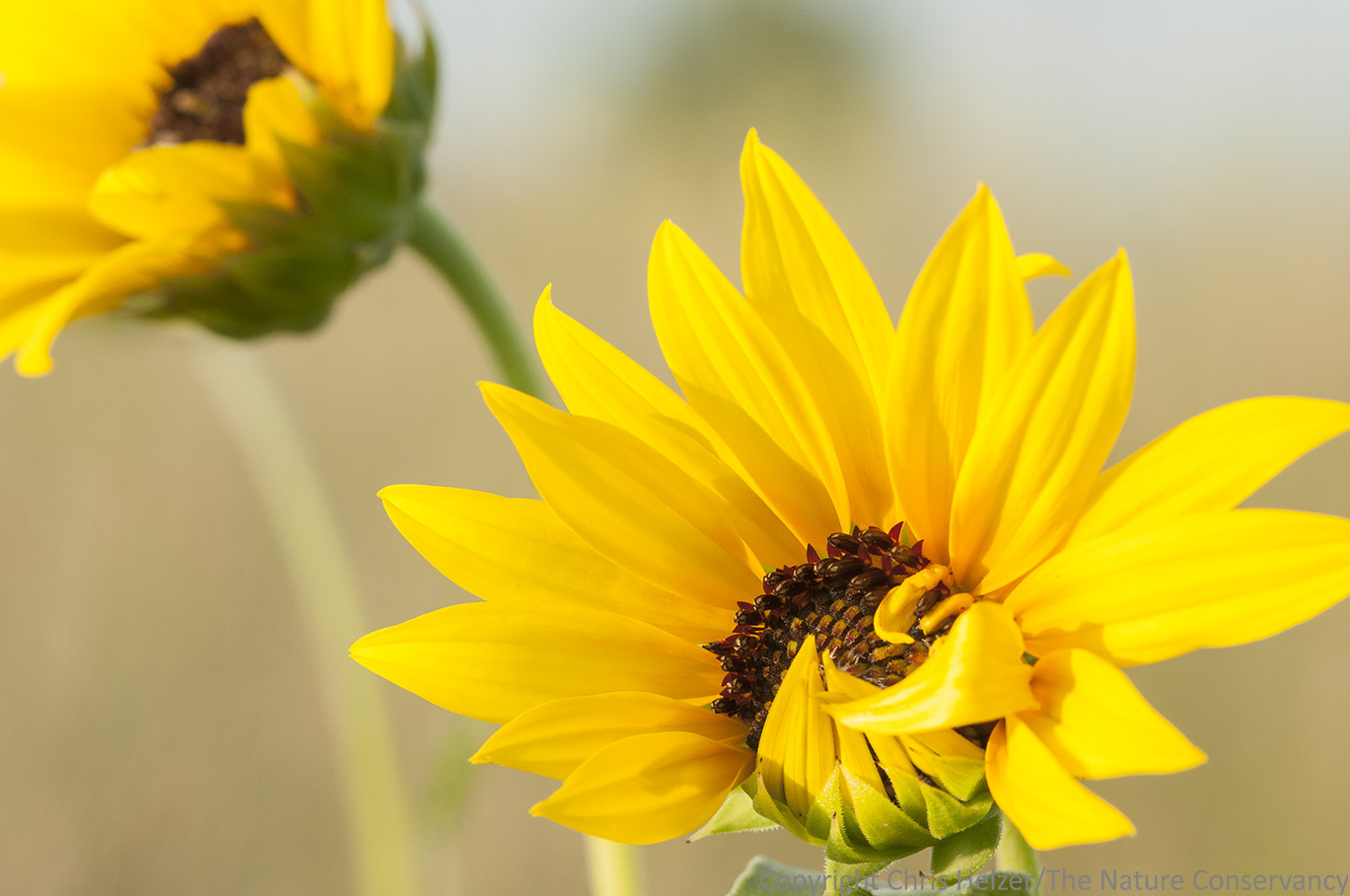
Plains sunflower (Helianthus petiolaris) in restored sand prairie.  The Nature Conservancy's Platte River Prairies, Nebraska.

Plains sunflower (Helianthus petiolaris) in restored sand prairie. The Nature Conservancy’s Platte River Prairies, Nebraska.

We’re fortunate to have seven different species of sunflower in our Platte River Prairies, five of which are perennials.  The above photo is of one of the two annuals, plains sunflower, which inhabits the drier sandy uplands of our sites and is very abundant in the Nebraska Sandhills to our north.

I have plenty of sunflower photos I like, but this is one of my favorites from last year.  I like the overall composition, but I also like that the sunflower in the foreground is atypical.  Something has prevented the petals (ray florets, for you botanists) from developing completely.  It’s interesting (and not unattractive), and also stimulates questions about what happened, and why.

I like mysteries…