
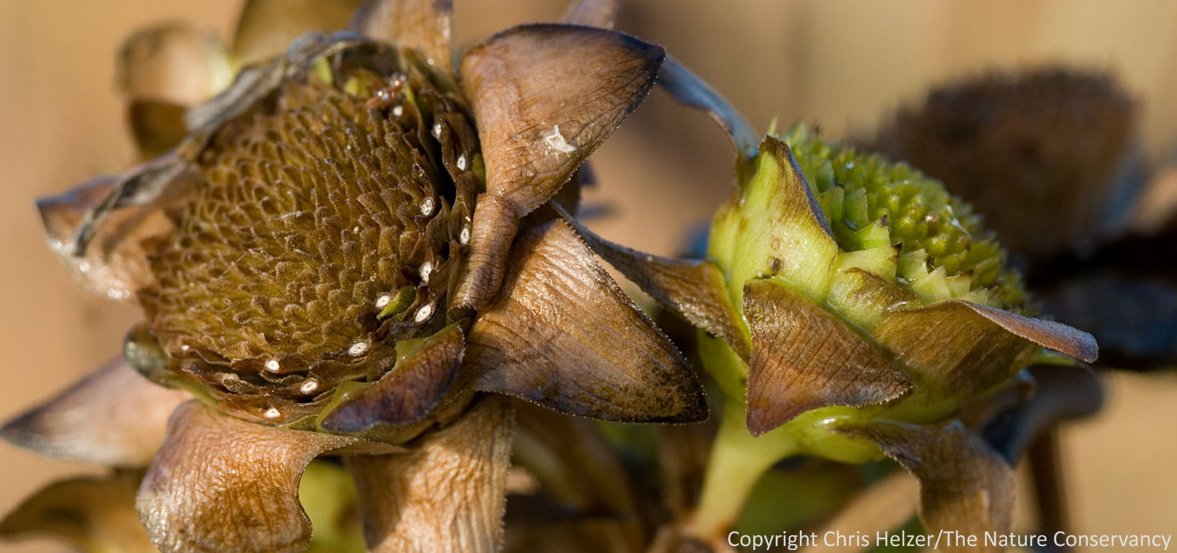
Entire-leaf rosinweed seed heads in late September, 2011. Lincoln Creek Prairie - Aurora, Nebraska.
Entire-leaf rosinweed (Silphium integrifolium) looks much like a sunflower when it’s blooming, but it and its close relatives are actually pretty different from sunflowers. One major difference is the shape and location of the seeds. Sunflowers produce seeds in the center of the flower head, but rosinweed, compass plant, and other Silphiums have seeds that are located on the outer border of their flowers. In this photo, the white dots on the left flower are the tips of those seeds.
Rosinweed seeds are built differently than sunflower seeds as well. Everyone is familiar with the kind of sunflower seeds sold as snacks – with a two-part shell covering the “meat” of the seed inside. Prairie sunflowers all have variations on that same structure. Silphiums, however, produce very large seeds that are encased in a kind of papery sheath about the size and shape of a fingernail. The photo below shows another rosinweed head on which the seeds are exposed.
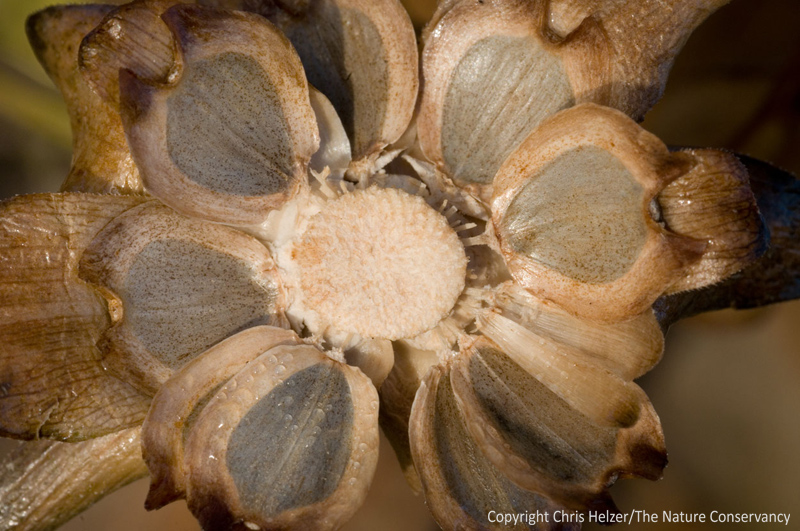
This rosinweed seed head shows the ring of seeds around the center of the flower.
The size and shape of the seeds of rosinweed (and other Silphiums)make them easy to identify in our restoration seed mixtures. They’re also a good example of why it can be challenging to use some kinds of seed drills when planting diverse prairie seed mixtures. Large flat seeds like those of rosinweed can’t squeeze through small tubes or other small openings. Combined with other seeds that are fluffy, smooth and hard, or just plain tiny, it can be difficult to get all the seeds to feed smoothly, or at consistent rates, through some kinds of equipment. Because of this, many of our older prairie restorations were seeded by hand -which works just fine – though now we mainly use a drop spreader (a fertilizer spreader such as an EZ-Flow that is essentially a long box with holes in the bottom and an agitator inside).
 The Prairie Ecologist