
Photo of the Week – January 22, 2016

Just as I did last week, I’m posting a few more winter photos from my archives.

gh

Frosty plants on the frozen Platte River, Nebraska.

Laying flat on one’s stomach on a frozen river might not sound like much fun to you, but it does give  you a neat perspective on the world.  (Plus, it spreads body weight to help prevent falling through the ice!)  The photo above was taken on a very cold day when frost had formed on vegetation along the river – especially right above the frozen river surface.
nouse

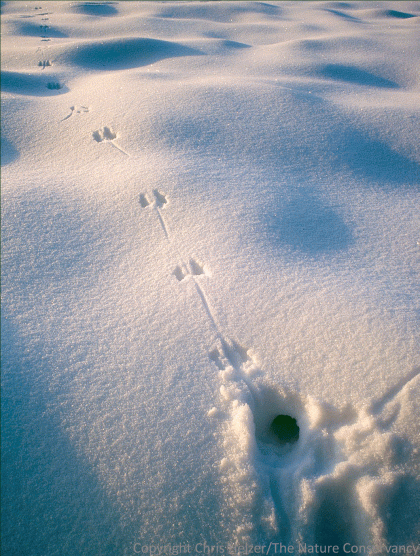
Mouse tracks in the snow.

The above photo shows mouse tracks leading in and out of a hole in the snow.  Winter is a great time to see small mammal activity – especially when snow is on the ground and the temperature is relatively moderate.  Speaking of small mammals, our Hubbard Fellow Evan Barrientos wrote a fantastic blog post for the Platte Basin Timelapse project about Master Naturalist Mike Schrad and his work to help us evaluate small mammal use of restored grasslands here in the Platte River Prairies.  I urge you to click here to read that post, which includes some beautiful photos.

gh

Frost on ice formation.

Ice patterns are always a favorite photo subject for me.  The freezing and melting of water creates endless fascinating shapes and patterns that are fun to explore and photograph.

Photo of the Week – February 12, 2015

Last week, Jasmine (one of our two Hubbard Fellows) and I spent a morning at the Derr Wetland Restoration here in the Platte River Prairies.  We wanted to get some photos and video of the site before the latest snow melted.

…Ok, to be honest, we were mostly hoping to test out the capabilities of our new drone (UAV).  Two of our Nebraska board members, Jim and Nancy Armitage, donated the funds to purchase the drone as a way to help us better capture our sites and the work we’re doing here in the state.  We’re just starting to figure out the potential for drone photography, but I sure like what I see so far!

Here is a short 3 minute video of footage shot from the drone, followed by some still photos from the same morning.  Both the aerial video and still photos provide powerful images, but the video certainly captures the context of the site in a way that’s not possible for me as I walk along the ground with my camera.  I think the drone is going to be an awesome complement to the other ways we photograph and monitor our sites – it’s going to be exciting to keep exploring the possibilities.  Stay tuned for future videos!

Click here to see the video on YouTube.


Tracks of a river otter sliding across the ice/snow.  No, I didn't see the otter.  Thanks for asking.

Tracks of a river otter sliding across the ice/snow. No, I didn’t see the otter. Thanks for asking.

Canada goose tracks were all over the site, along with coyote, mink, rabbit, and many others.

Canada goose tracks were all over the site, along with coyote, mink, rabbit, and many others.

Photographing from the surface of the ice provides a neat perspective of the wetland, but a very different one from the drone's aerial view.

Photographing from the surface of the ice provides a neat perspective of the wetland, but a very different one from the drone’s aerial view.

A final ice-level photo.

A final ice-level photo.