
I saw these two moths in a restored prairie in eastern Nebraska last spring. They formed a mirror image that was too perfect not to photograph.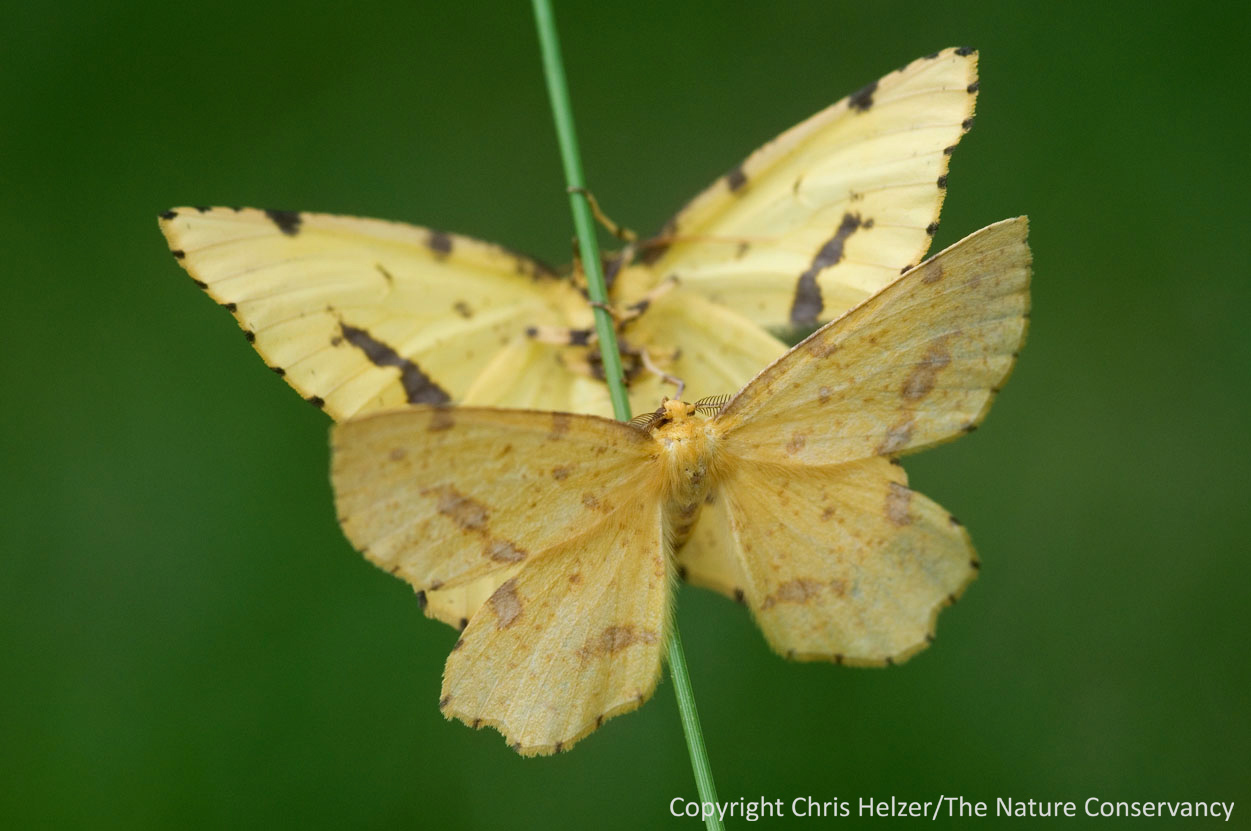
While butterflies are typically more showy and get much more attention from biologists, moths make up a much larger part of the taxonomic family (Lepidoptera) the two share. While these two are are exceptions, most moths are typically less colorful and better camouflaged than butterflies. Because coloration is not always a dependable cue, the most reliable characteristic for telling a moth from a butterfly is that moths have fuzzy antennae and butterflies don’t.
 The Prairie Ecologist
They are beautiful! One thing that makes this not quite a “mirror image” are the antennae. While all moths have feather-like antennae, those of males (such as the one in the foreground) are broader and are highly adapted for sensing female phermones. Females (like the one in the background) have more slender antennae.
These are one of the crocus geometer group, with nearly indiscernible species:
http://bugguide.net/node/view/252/bgimage
No matter, it’s a fortuitous and lovely image!
Thanks James! Nice to have people willing to do my bugguide searches for me!