
Introducing: The Prairie Word of the Day

I’m sure many of you are as tired of this blog as I am.  The same old nature photos, natural history, prairie management/restoration information…  It just drones on and on.  Honestly, I don’t know how you manage to drag your eyes through most of my posts.  How much prairie stuff can one person read about, after all?

(…Yes, I’m kidding – there is no limit to how much prairie information one person can read about.  And I am not at all tired of this blog… though you certainly might be, I don’t know.)

Well, the blog isn’t going away anytime soon (why, what have you heard??)  But in an effort to keep it from growing stale, I’m introducing a new feature called “The Prairie Word of the Day.”  …Yes, I know –  a titillating title, isn’t it?  It ought to be, it took me about three months to refine it.  It’s pithy, catchy, and descriptive all at once.  Or at least descriptive.

As with any field, prairie ecology is full of jargon; words that make sense to those of us who spend most of our waking hours thinking about prairies but make no sense to anyone else.  I try hard not to use to much prairie jargon in my posts, but I slip up now and then.  Sorry about that.  There are a lot of fun, but confusing, prairie jargon words out there, so I thought I’d highlight one now and then and try to explain what it means.  I would love to hear nominations from you as well – what undecipherable words do I or others use when talking or writing about prairies?

Ok, without further ado, the inaugural Prairie Ecologist Blog Prairie Word of the Day is:

Tiller

Sure, everyone knows what a tiller is, right?  You use it to prepare your garden for planting.  Or, if you are a pirate, you might use it to steer your ship.  (If you are a pirate and read this blog, PLEASE let me know.  Prairie-loving pirates is a demographic I would love to reach out to.)

However, if you are REALLY into prairies or botany, you might be familiar with a third definition; one that is related to grasses.
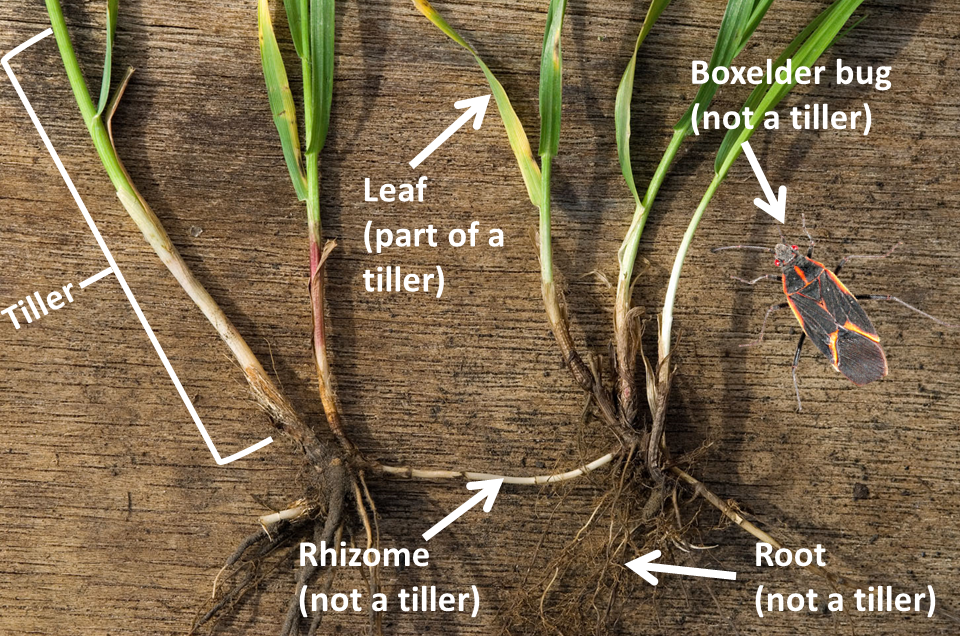
Tiller

Although it is used somewhat inconsistently, a tiller usually refers to the aboveground shoot of a grass.  In other words, if you were to look closely at a grass plant you’d see that most of them have multiple stems at their base.  Each of those stems is a tiller.  Usually, the term tiller only applies to shoots that emerge from buds at the base of other tillers, not from seeds.  Thus, when a grass seed germinates and starts to grow, the first shoot that pops out of the ground is not a tiller.  It’s just a shoot.  I guess.  But after that, every new shoot that comes out of the ground from that plant is a tiller.

Tillers are primarily important, as far as I can tell, because professors like to make graduate students count them.  As in, “Hey Sara, take this 1 x 1 meter plot frame out to that prairie, lay it down and count the number of grass tillers inside it. (snicker)  Then do that 99 more times. (guffaw!)  Then we’ll move on to the next prairie.”
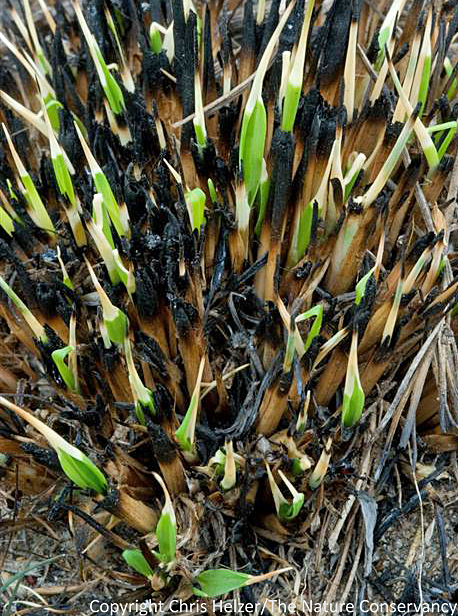
Grass greening up in the Derr Sandhills about a week after a prescribed fire.

The tillers of this bunchgrass are all bunched together.


A related botanical prairie word is “sward” which basically means a bunch of grass.  Well, not really a “bunch” because that’s its own term (grasses like little bluestem are called bunch grasses because they grow their tillers tightly together and look neat and tidy, as opposed to grasses such as prairie sand reed that across the prairie like they own the place).  A better way to describe a sward, then, is that it’s an area of grass.  However, I don’t think there’s any restriction on how big that area of grass has to be, which makes the term less useful.  That’s probably why you don’t hear it used very often.  Except by grassland poets trying to rhyme something with “charred”.  As in, “Lo, the land was black and charred.  No trees remained throughout the sward.”
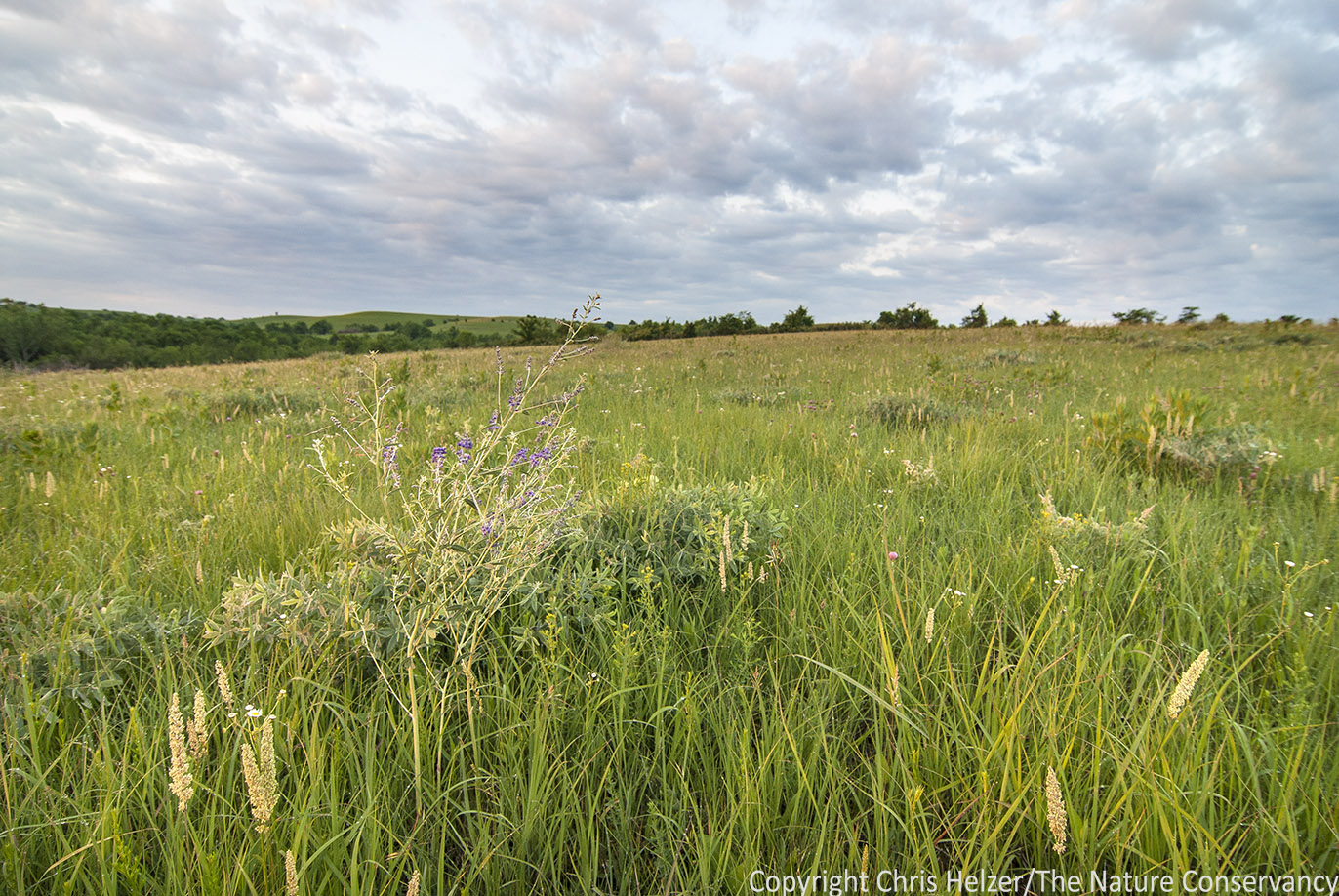
There are an awful lot of tillers in this sward.  Too many to count - even for a graduate student.

There are numerous tillers in this sward. Too many to count – even for a graduate student.

If botanists were funny, they might say something like, “Arrr, Matey!  Take over the tiller smartly while I decide whether to shoot this lubber or run him through with my sward.”

(I’m kidding, of course.  Botanists can be very funny.  Sometimes on purpose.  Also, many are quite hirsute.  Except on top, where some are pretty glabrous.)

Well anyway, that concludes the first ever installment of The Prairie Word of the Day.  I hope it was instructive.  Please nominate terms (in the comments section below) you’d like to see included in future Word of the Day posts and I’ll try to use as many as I can.

Pretty but Powerful

Because they can’t run away, plants may seem helpless against the many large and small herbivores that like to eat them.  Nothing could be further from the truth.

This caterpillar may appear to be chewing on a helpless plant, but most plants are not as helpless as they seem.

The plant this caterpillar is chewing on may not be as helpless as it appears.

Many plants have physical defenses such as thorns or stiff hairs to deter animals from eating them.  Grasses contain varying levels of silica, which can increase the abrasiveness of their leaves and help make them more difficult to eat and digest.  In addition, the chemical makeup of many plants helps make unpalatable or toxic to potential herbivores.  While herbivory is certainly a major threat, plants also have a variety of defenses against pathogens (diseases).  If you’re interested in more background on this topic, here is a really nice overview of plant defenses against both diseases and herbivores.

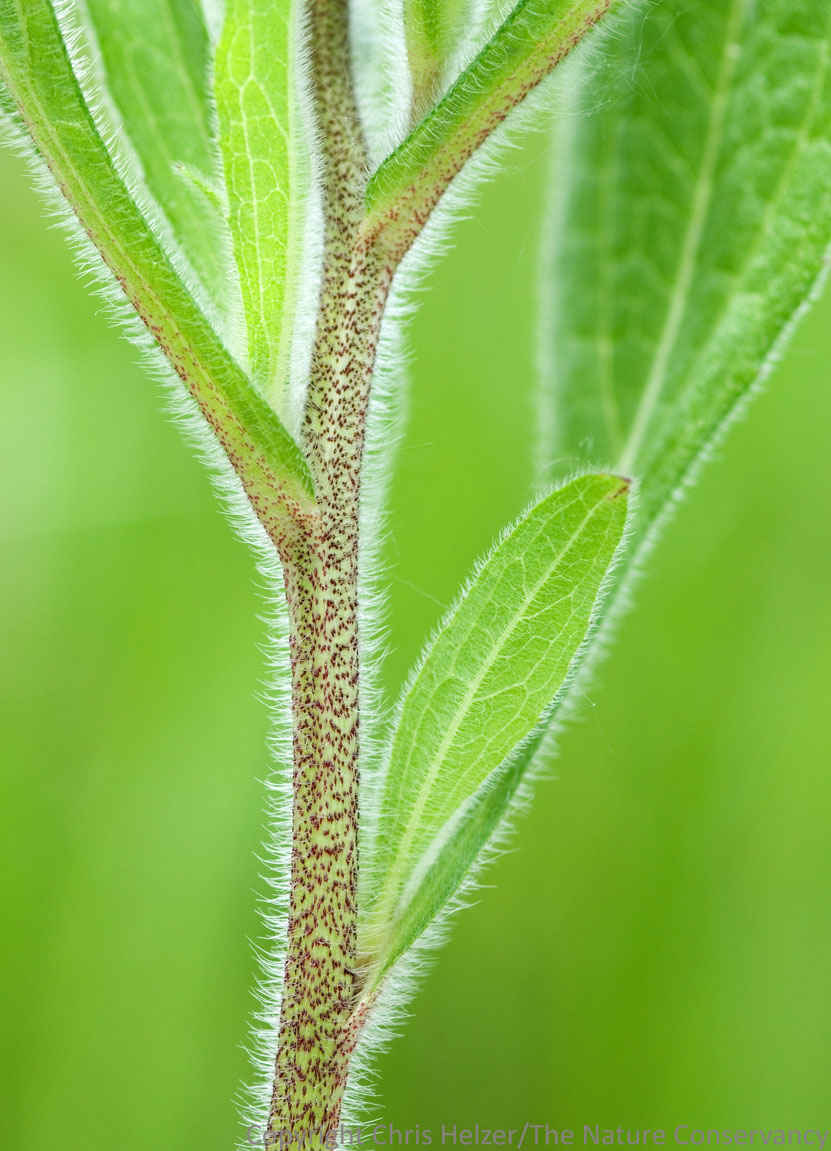
A the stiff hairs on plants such as black-eyed susan (Rudbeckia hirta) can make them more difficult for some herbivores to eat.

A the stiff hairs on plants such as black-eyed susan (Rudbeckia hirta) can make them more difficult for some herbivores to eat.

Within the last couple of years, there have been a couple of published studies that highlight some fantastic strategies plants use to defend themselves.   In the first of those, German scientists studied a wild tobacco plant and found that when it is attacked by a caterpillar the plant releases a chemical that, in turn, attracts a predatory bug to eat the caterpillar.  The production of the bug-attractant is triggered by the caterpillar’s saliva.  Essentially, then, the caterpillar sets off an alarm that calls in predators to eat it.  How cool is that?

A second study, done at the University of Missouri-Columbia, found that a species of mustard plant could detect the vibration signature of a caterpillar chewing on one of its leaves.  When the plant identified that signal, it increased production of chemicals that make its leaves taste bad to herbivores.  Researchers were able to replicate and reproduce the vibrations and trigger the response in the lab.  They also showed that other kinds of vibrations did not cause the plants to defend themselves, so the chemical production appeared to be a direct response to herbivory.

Cattle and other large herbivores have to deal with a number of plant defenses, from silica and other compounds that make plants difficult to eat and digest to chemicals that make them bad tasting or toxic.

Cattle and other large herbivores have to deal with a number of plant defenses, from silica and other compounds that make plants difficult to eat and/or digest to chemicals that make them bad tasting or toxic.

These and other research projects help show that plants are not at all defenseless.  Not only do they have strategies to make themselves more difficult to eat (toxins, spines, etc.), they can also respond when they are attacked.  In prairies, there are numerous examples of plants defending themselves in interesting ways, including sunflowers that produce sweet stuff to attract predatory ants and grasses that increase their silica content under intensive grazing pressure.

Of course, herbivores have evolved their own tricks to counter all those plant defenses. Several insect species, for example, have developed ways to deal with the toxins produced by milkweed plants and happily munch away on leaves that would kill other insects.  Now its the milkweed’s turn to (through natural selection and over many years) come up with a response to that response.  The world is pretty fascinating, isn’t it?

So, the next time you’re walking through peaceful-looking prairie on a pleasant morning, remember that those little plants you’re crushing beneath your feet may not be as helpless as they appear.  Sure, those plants are mostly fighting back against animals trying to eat them, but you may still find yourself an accidental victim of their defense strategies.  Experienced hikers are well acquainted with the abrasive edges of grass leaves and the sharp spines on species such as roses and cacti.  At one time or another, most of us have blundered into a patch of nettles or poison ivy.

No, plants are certainly not helpless.  Let’s just be thankful they haven’t (yet) figured out how to chase us down.