This post was written by Evan Barrientos, one of our Hubbard Fellows from June 2015 through May 2016. He’s working for Montana State University Extension now, but has returned to write a follow up post on the topic of his Hubbard Fellowship independent project. You can see what he’s up to in Montana by following his personal blog.
Hello again! I’m writing from beyond the Fellowship because my final month as a Hubbard Fellow was a whirlwind and I didn’t find time to write a blog post that did the experience justice. First, I want to say that it was the best career-building experience that I could have possibly had. The Fellowship taught me diverse and useful job skills, taught me how to network within a wide conservation community, and transitioned me from a recent graduate to a young professional. Second, I want to summarize what I learned from my fantastic experience working on the Platte River Prairies’ volunteer program.
Phone Interviews: During my fellowship I conducted 11 phone interviews with other land stewardship volunteer coordinators, mostly in prairie ecosystems. Overall, these coordinators were impressively competent and offered lots of wise advice and great ideas. Here is a very summarized list of what I found.
- Word-of-mouth is the best form of recruitment, which means volunteer events really need to be enjoyable and meaningful if you want volunteers to bring their friends.
- Trainings allow volunteers to take on more advanced tasks such as herbicide application and chainsaw use, thereby accomplishing much more work. Several programs also train their volunteers to lead workdays and offer the opportunity to volunteer independently outside of formal workdays. Trainings also promote retention by providing learning opportunities and showing volunteers that they’re valued. Pairing new volunteers with experienced ones is also an efficient way to train.
- Communication between staff and volunteers is essential. The volunteer coordinator must provide clear and specific instructions and locations and always be reachable by phone to answer questions.
- Retention is crucial for building efficient volunteers and a productive volunteer program. The longer a volunteer has been volunteering, the better he/she knows the site and tasks. This takes time, but regularly offering quality workdays is the first step towards identifying and developing dedicated volunteers.
- Ways to promote retention:
- Treat committed volunteers with the same levels of respect and expectations as paid staff.
- Integrate staff and volunteers as much as possible.
- Build a sense of community through formal and informal social opportunities.
- Provide opportunities to gain skills and knowledge.
- Express gratitude regularly and at formal events.
Volunteer Survey: I also sent out a survey to collect feedback on our volunteer program. Here are a few things I learned:
- Helping prairies was the strongest motivation for volunteering, followed by learning and getting outside.
- More satisfied volunteers were more likely to volunteer in the future and had higher past attendance.
- There was significant interest in volunteering independently on their own schedule (78%).
- Distance was the factor discouraging attendance most frequently mentioned (37%).
My own conclusions:
Working with volunteers was the most rewarding work I’ve done in a long time. There are many excellent conservation organizations that significantly expand their stewardship capacity by effectively engaging volunteers, but it takes time, dedication, and the right personality to do so. Regularly holding enjoyable and meaningful workdays is the first step; creating opportunities to grow into new responsibilities is often the second. Last, it is almost always necessary for there to be at least one staff person dedicated to managing the volunteer program in order for it to flourish. With time, it’s possible to create programs that accomplish a lot of work while inspiring a passion for conservation in many people.
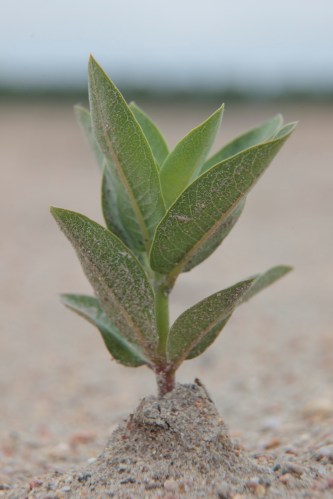
A milkweed sprouts from the prairie that volunteers helped seed last winter.


 The Prairie Ecologist