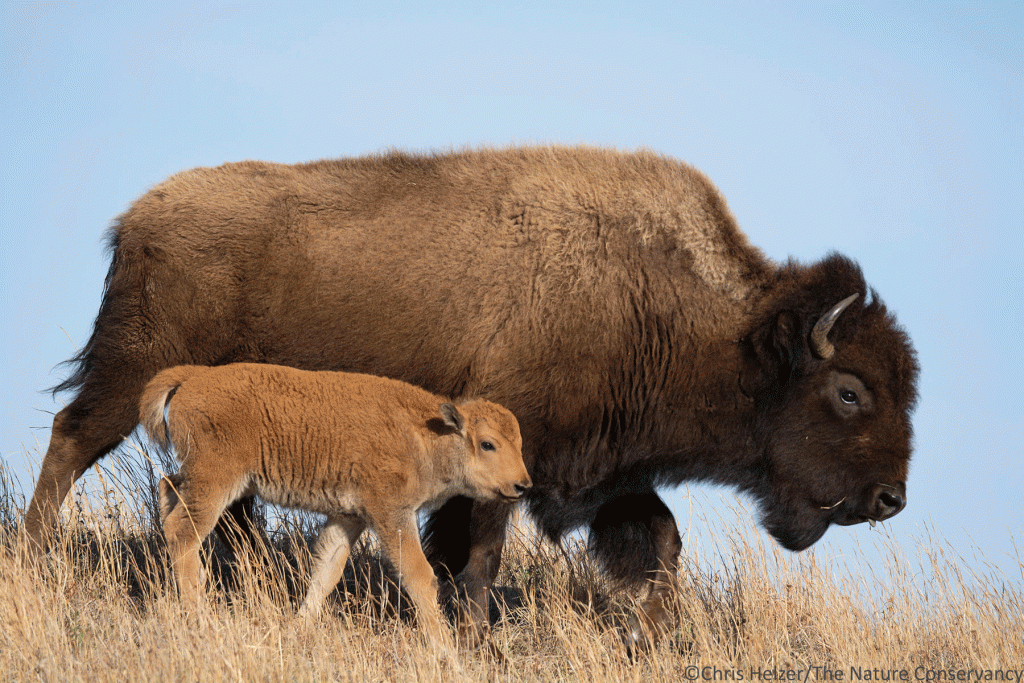
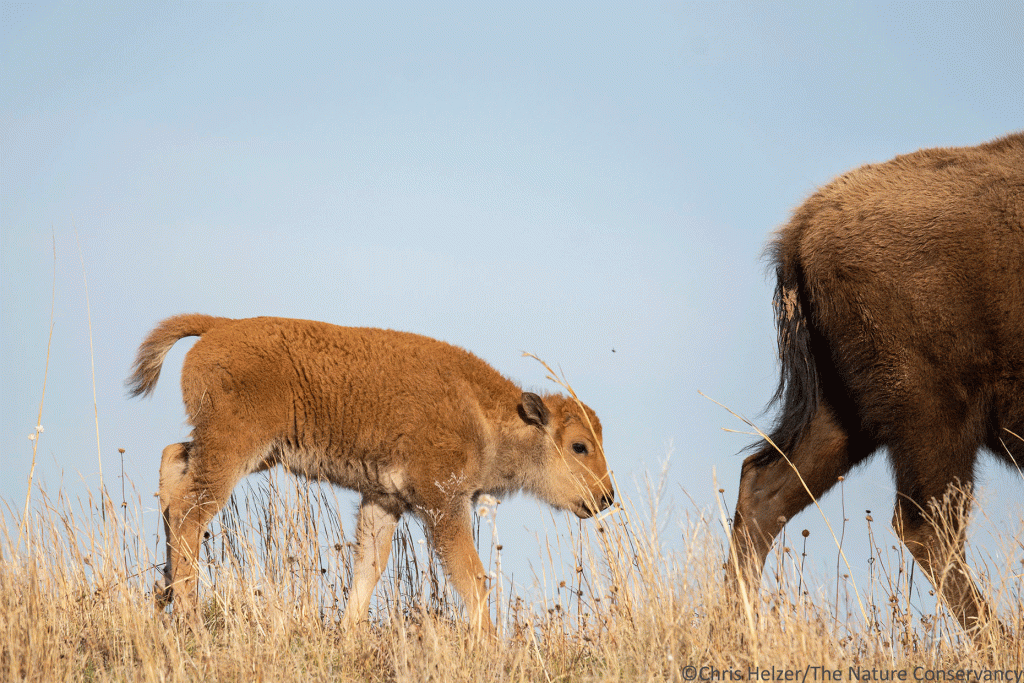
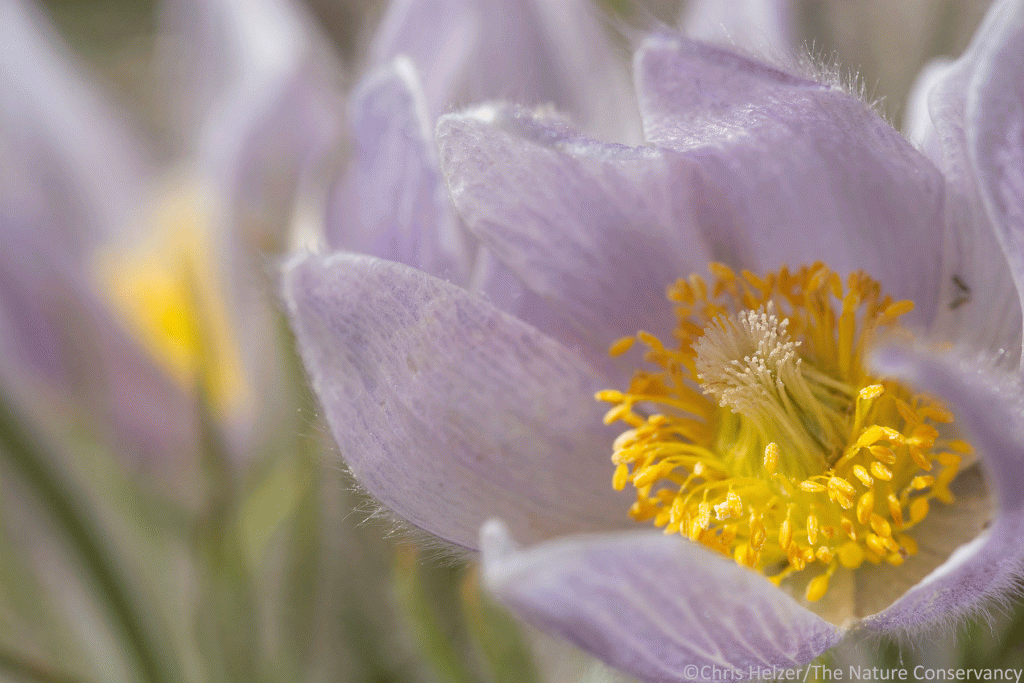
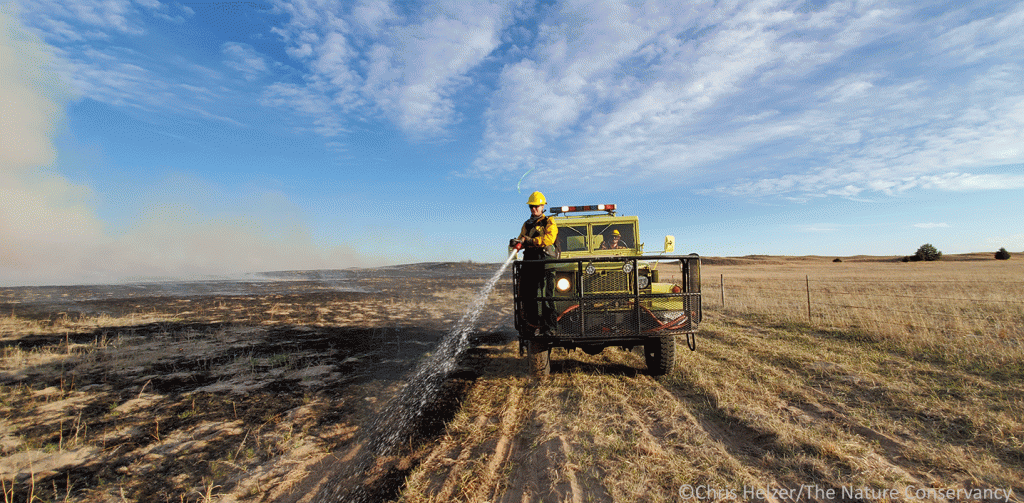
The Fellows, Nelson, and I are spending the last three days of this week helping with prescribed fire up at the Niobrara Valley Preserve. As I write this, we’re a few minutes away from needing to help prep equipment for our third day of fire, so I’m just doing a very quick post. Most of our time over the last couple days has been spent either prepping for or conducting prescribed fires, but the Fellows and I managed to sneak out to look at baby bison and I spent a little time capturing pasque flowers in bloom as well. Have a great weekend!
New bison calfNew bison calfPasque flower.Fire in the Sandhills – widening the backfire (downwind side of the unit).Hubbard Fellow Sarah Lueder has a smiler on her face as she lights the final stretch of a unit.Former Hubbard Fellow Ashley Oblander sprays down some last smoldering bits of dried manure along the edge (truck driven by Carson Schultz).
As we near the celebration of National Arbor Day in the United States, I think it’s worth reflecting a little on our relationship with tree planting here in central North America. The simple practice of planting a tree, of course, is perfectly fine. Putting trees around a house for shade or protection from wind can be eminently sensible, and there are plenty of important efforts going on to reforest areas where woodland habitat has been lost. When the right trees are being put in the right places, everything’s great.
Trees around farmsteads, yards, and towns make great sense and provide lots of benefits.
However, as someone who has dedicated his career to prairie conservation, I’m painfully aware of the way tree planting and its aftereffects can create problems in grasslands. I don’t need to detail those impacts here. If you need a refresher, you can read one of my previous posts on the topic (this one or this one.)
As regular readers of this blog have probably noticed, I spend a lot of time thinking and writing about the relationship between people and prairie. After all, prairie conservation will only be successful if people see grasslands as valuable. To the uninitiated, prairies often seem empty, in part because the elements of nature most people are drawn to (especially mountains and trees) are missing. This is not a new phenomenon. In fact, there are strong ties back to the origins of Arbor Day in 1872 and the culture that spawned that holiday.
Trees are obviously valuable for firewood, building materials, and other resources. It’s not completely surprising that European settlers in the Great Plains would see tree planting as important. However, their desire for trees went far beyond their simple utilitarian values.
J. Sterling Morton, the creator of the first Arbor Day, was not a fan of treeless prairies. Instead, he shared the view of many peers that the Great Plains was in need of dramatic transformation. Planting trees was a crucial part of the plan.
Fifteen years after originating Arbor Day in Nebraska, Morton gave a speech about its importance and impact. During the speech, he bemoaned (with justification) the way ancient eastern U.S. forests had been rampantly cleared. He then intimated that the prairies of the Great Plains were a kind of deserved punishment for those westward-spreading woodland destroyers.
“So these treeless plains, stretching from Lake Michigan to the Rocky Mountains, were unfolded to the vision of the pioneer as a great lesson to teach him, by contrast with the grand forests whence he had just emerged, the indispensability of woodlands and their economical use. Almost rainless, only habitable by bringing forest products from other lands, these prairies, by object teaching, inculcated tree planting as a necessity and the conservation of the few fire-scarred forests along their streams as an individual and public duty. Hence out of our physical environments have grown this anniversary and the intelligent zeal of Nebraskans in establishing woodlands where they found only the monotony of plain, until to-day this State stands foremost in practical forestry among all the members of the American Union.”
There is no apparent recognition of irony in Morton’s proposal to destroy prairies after bemoaning the similar destruction of forests. That, alone, is a particularly significant indicator of how prairies were viewed by many at the time – not as an ecosystem or resource, but as a barrier to progress or, at best, raw material from which something of use could be created.
Prairies like this were seen as empty wastelands by people like J. Sterling Morton.
Tragically, Morton and others with his beliefs didn’t just want to convert the prairie into forest – or, more accurately, an agrarian paradise with a mixture of rowcrops and neat rows of trees. They subscribed to the concept of manifest destiny, which promoted and justified the inalienable rights of white settlers to conquer and occupy the continent. Here are Morton’s own words on that subject, from an 1859 speech in which he shares his thoughts about prairies and the people he felt were destined to transform and inhabit the plains.
“Everywhere these rich and rolling prairies, which had lain for unnumbered centuries as blank leaves in the history of the World’s progress, were being written upon by the hand of toil, snatched from the obscurity of uselessness, and forever dedicated to the support of the Anglo-Saxon race. The sunshine seemed brighter, and the rains and the dews more beautiful and refreshing, because they descended upon the earth and found it not all a wild and desolate waste. Seed had been sown, farms opened, and every energy had been taxed to make the Territory of Nebraska self-sustaining. It was the first genuine effort in the right direction.”
“The Anglo-Saxon race are being driven by the hand of God across the continent of America and are to inhabit and have dominion over it all. These prairies, which have been cleared and made ready for the plow by the hand of God himself, are intended for the abiding place of the pioneers in the progress of the world.”
Morton then goes on to talk about indigenous people in such a vile way I can’t even bring myself to quote him here. You’re welcome to read his thoughts yourself if you like – they’re in the same speech (page 211). Let’s just say he didn’t have a high opinion of Native Americans.
This is not a blog post about bashing J. Sterling Morton, by the way. I’m just holding him up as a prominent and outspoken example of a common attitude toward prairies among white people in the 1880’s. If you’re interested in a thoughtful essay on Morton and racism, I suggest this blog post by Nebraska historian David Bristow.
Getting back to tree planting, the strong desire to transform Nebraska’s grasslands into woodlands continued beyond J. Sterling Morton’s lifetime. Charles Bessey, a prominent botanist who did a lot of great things for science for education, was also somewhat obsessed with proving that the Nebraska Sandhills could support trees. He and his colleagues experimented with pine plantations in that sandy grassland landscape and eventually planted huge blocks of trees that totaled about 30,000 acres by the early 1900’s. Those wooded areas still exist today and are promoted as the largest hand-planted forest in the U.S.
In 1907, a combination of those tree plantations was designated as the Nebraska National Forest, something many Nebraskans were and are proud of. I’ve always seen that whole process as a kind of sad appeal for respect (‘See, we DO have forests in Nebraska!’) It’s like an accomplished and popular actor, musician, and philanthropist feeling inferior their whole life because they’re not good at basketball – and repeatedly (and unsuccessfully) trying out for teams.
Some of Nebraska’s natural woodlands – and grasslands – were added to the National Forest System in the 1950’s, including portions of the Pine Ridge in the Nebraska panhandle. However, it’s particularly ironic and frustrating that the tree plantation portions of our National Forest sites are located in the Nebraska Sandhills, the largest intact grassland on the continent and of the most important prairies in the world. Fortunately, the wooded portions of those designated lands make up a relatively small proportion of the total area. Those sites are actually a great place for the public to experience and explore Sandhills prairies, since the majority of that landscape is in private ownership.
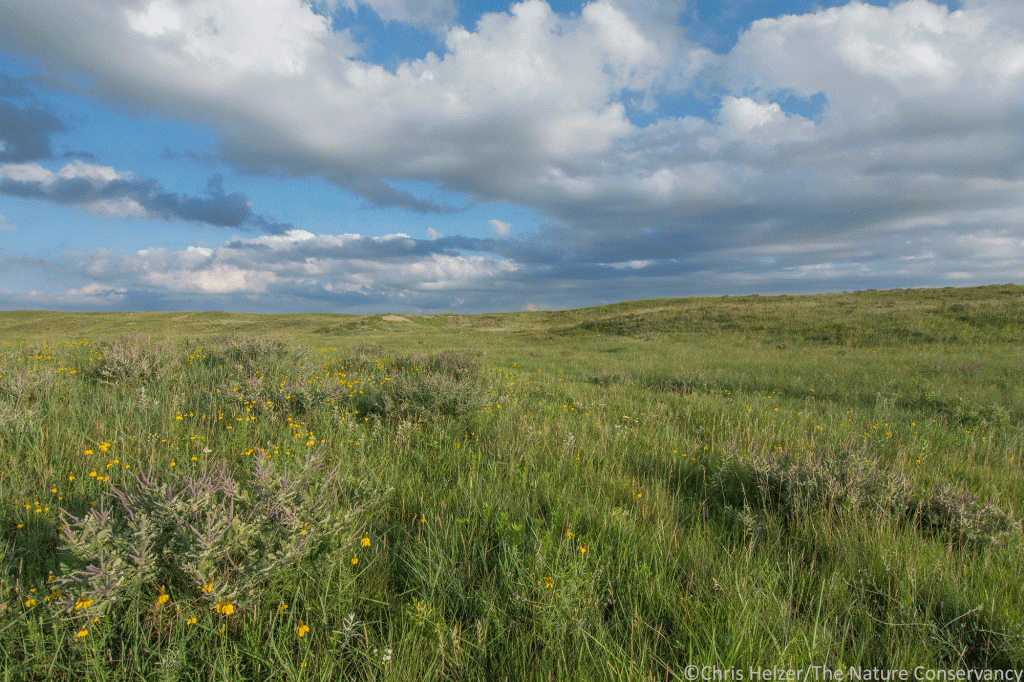
Pretty, isn’t it? But wouldn’t it be even better if you added trees? (Please say no.)
Many Nebraskans today still feel a lot of pride in being ‘The Tree Planter State’, even though that nickname was officially changed in 1945 to ‘The Cornhusker State’ to honor the University of Nebraska football team. Beyond Nebraska’s borders, the legacy of J. Sterling Morton, Charles Bessey, and others like them persists across much of the prairie landscapes of North America. Instead of feeling proud to live in a state and region of incredible grasslands, many people pine (eye roll) for landscapes full of forests and mountains.
Over and over, I watch people buy small parcels of prairie and immediately plant trees around the borders. Grassland acreages invaded by eastern red cedars or other trees are often appraised at a higher real estate value than uninvaded grasslands because of their ‘recreation value’. People who write angry letters about trees being cleared to make way for a shopping center don’t bat an eye when a prairie is plowed under or allowed to be overtaken by Siberian elms. Prairies represent the long boring part of the drive from Omaha to the Rocky Mountains.
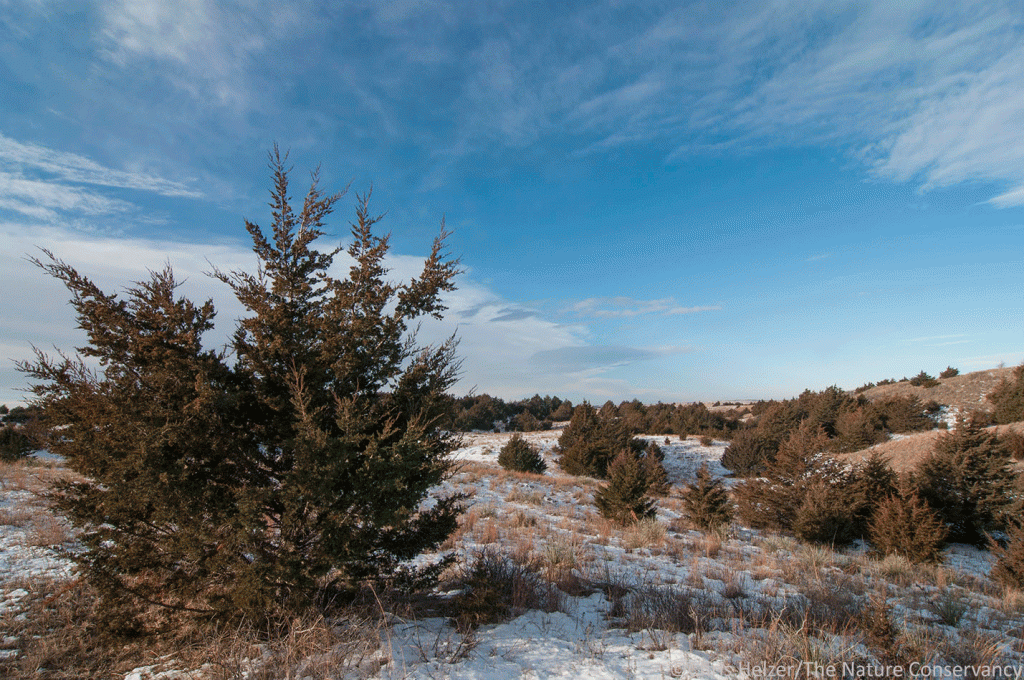
Invasive trees like these eastern red cedars are devastating to prairie habitats and livestock production but can still increase property values because of a perceived recreational value tied to hunting and aesthetics.
We have a lot of work to do if we’re going to get the public to support prairie conservation. Tree planting isn’t the problem, and neither are the people and organizations who advocate for it. Trees are very nice. Some of my best friends have trees.
The problem is that tree planting is linked to an unsavory and unfortunate legacy in the Great Plains that still colors perceptions today. We need to separate the reasonable practice of planting a tree for shade, shelter, or fruit from the concept that white Europeans have a God-given right and duty to convert barren prairie wastelands into neat rows of corn and trees. I’m sure most people aren’t consciously making that connection as they dig a hole for their new apple tree seedling, but that doesn’t mean the cultural influence isn’t lurking in the background.
National Arbor Day falls at the end of April because that’s a good time to plant trees in Nebraska and much of the rest of the country. Late April also happens to be a great time to watch queen bumble bees gathering pollen and nectar from the nascent blooms of prairie wildflowers. Migratory birds, butterflies, moths, and dragonflies are returning from the south and many other animals are emerging from their winter burrows in the thatch or soil. Bison are suckling their tiny red calves, meadowlarks and chorus frogs are singing, and harriers are coursing silently back and forth across grasslands, hunting for mice.
May I suggest that National Arbor Day is a great time to introduce a friend to your favorite prairie? Or to buy some native prairie plants from your local nursery. Volunteer your time cutting invasive trees out of a nearby grassland. Heck, if the weather is nice – you can go practice your jump shot if you’re still holding on to that dream.
You can even plant a tree if you really want to. Just please – pretty please – don’t plant it in a prairie.




 The Prairie Ecologist