
It’s an injustice. And it’s lazy. Is it the biggest issue facing society today? Nope. But it’s one we can take care of quickly and easily. Join me – it’ll be fun.
For some reason, biologists sometimes name plants, animals, and other organisms because they bear resemblance to something they already knew. Whomever came up with the name for false boneset thought it looked kind of like boneset plants. Instead of coming up with a cool name that was descriptive of the new plant itself, they just called it “false boneset” and moved on with their life.
An even bigger travesty exists with another plant and the insect that relies on it. I don’t know which was named first, but both were maladroitly named and we need to do something about it. I’m talking, of course, about the plant currently known as “false sunflower” and the insect named the “false milkweed bug.”
Ridiculous.

Let’s start with the plant. It sure does look like a sunflower, but it’s apparently not enough of a sunflower for taxonomists to lump it in that austere group. As a result, it ended up in the genus Heliopsis, along with 17 or so other similar species.
I don’t really have a problem with that. What I don’t like is that the given Latin name for the species is (Heliopsis helianthoides). The suffix -oides means ‘resembling’. Because of that, it was given the common name, “False Sunflower”.
Totally uncalled for.
(False boneset, by the way, is Brickellia eupatoroides because Eupatorium is the genus for boneset plants.)

Fortunately, for those of us willing to take up the cause of this plant, it has a second common name, which has been given to most (all?) of the other species in the Heliopsis genus. That name is ‘oxeye’. It’s a little weird, but it’s at least distinctive, and not just a name that compares it unfavorably to something else. So we have a starting point. Can we all agree to stop calling the poor plant false sunflower and make sure we call it oxeye?
Of course, oxeye is tricky because there are 17 other species also called that, so we should make the name a little more specific. Some have tried. Unfortunately, the common names for this plant include both “smooth oxeye” and “rough oxeye”, according to the premiere source for plant taxonomy information (Wikipedia). Which is it? Is it smooth or rough? No one knows, apparently.
Given what this poor plant has lived through with its nomenclature history, I propose a different adjective for its first name. How about “fabulous”? It think it looks pretty dang fabulous. Who’s with me?
Great. “Fabulous oxeye” it is. Or, just to have fun, the alternative, “Fabulous ox-eye” because no one can seem to agree about when to put a hyphen in the common names for plants. Or maybe “Fab-u-lous ox-eye” for extra emphasis and to compete for a new record for hyphen use. If you like, you can snap your fingers between each syllable.
Well, then. We’ve settled the first half of my cause.
Now let’s address the poor false milkweed bug.
The small milkweed bug, shown below, is a charming little insect that feeds on milkweed plants. It’s called the small milkweed bug because there’s another milkweed bug called the “large milkweed bug” (seriously, who gave these people the responsibility of naming organisms??). The large milkweed bug is in a completely different genus (Oncopeltus) but is at least in the same family as the small milkweed bug and does look sort of like it. But bigger.

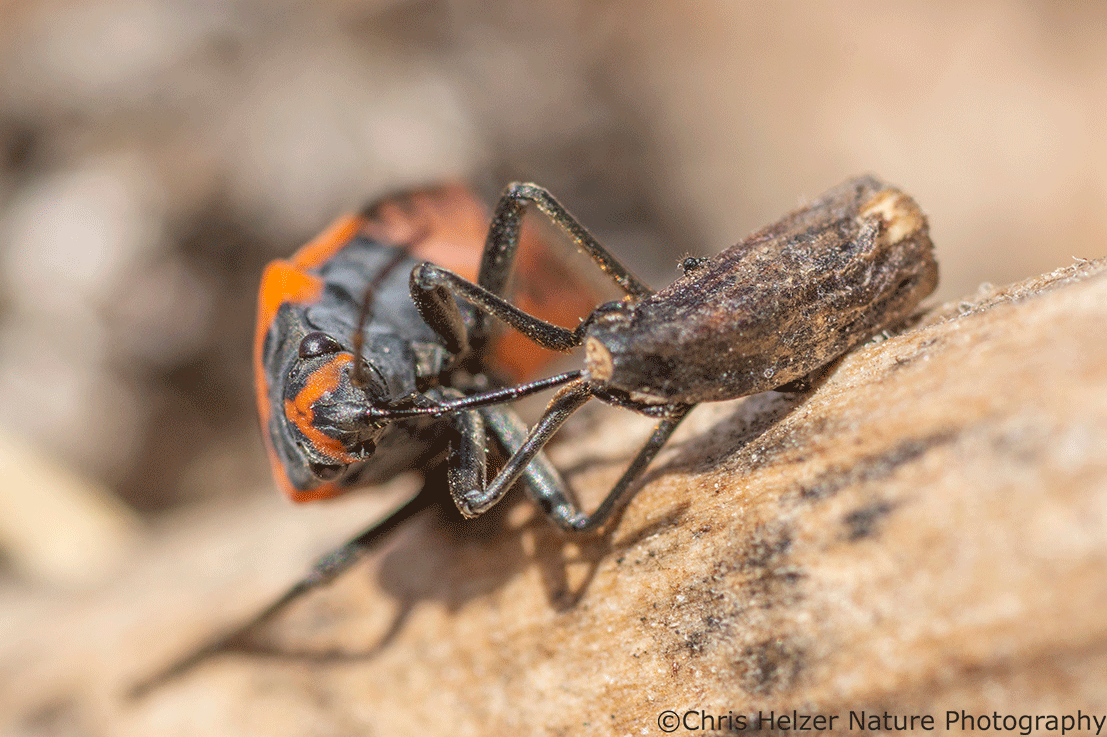
The so-called false milkweed bug is in the same genus as the milkweed bug, but it doesn’t feed on milkweed. It feeds on fab-u-lous ox-eye, previously known as false sunflower. You’d think they could have gone with “false sunflower bug”, except that then people would think it was an insect that resembled a sunflower bug, which – as far as I know – isn’t an actual kind of bug.
So maybe they could have called it “real false sunflower bug” to clarify it.
Ok, probably not.
Alternatively, and stick with me here, they could have called it ANYTHING ELSE IN THE WORLD. They could have called it a skunk if they’d hurried. Then some poor slob would have had to come up with a different name for skunks when they discovered them. I shudder to think what they might have come up with. Probably something appalling like “stink weasel” or “false polecat”.
Now that we’ve come up with the updated name for the plant it depends upon, we could call the previously-named “false milkweed bug” the “fab-u-lous ox-eye bug”. But it’s a little long. Plus, what if the bug doesn’t want to be named for what it eats? I bet biologists wouldn’t like being called “fry folks” just because they like eating fast food.
I think we can challenge ourselves to come up with something unique and better. I’ll throw out a few ideas and then you can join in.
It’s a seed bug that with a distinctive orange and black pattern. The gives us a few things to work with. Also, “turcicus”, its specific epithet (second part of its scientific name) apparently means “from Turkey” in Latin.
So the default name might be “Turkish seed bug”. We’d already better off than we were, but it seems unfair to give one country all the credit. Canada geese, for example, don’t all belong to the perfectly-nice country of Canada. Canada didn’t invent that particular brand of goose, as far as I know. (Did they?)

What do you think about “spark bug”? It’s orange-colored, after all, which connotes flames or sparks. I kinda like it. It’s succinct, snappy, and memorable.
Yes? No? What are your suggestions?
Thank you for your attention to this important matter. Together, we can make a difference. If we all band together, the spark bug and its fab-u-lous ox-eye host plant will get the names they deserve!
 The Prairie Ecologist
This is hilarious, Chris! I especially like the word maladroitly!
Chris, I grew up calling it ox-eye daisy, just to muddy the water even further. Never heard of false sunflower until 10-15 years ago.
I love this post, even though my brain is spinning. :) What a fun way to start the day with a laugh and an added bonus of learning something new.
Thank you!
Great thoughts Chris. However, I think we should invest our time in righting a truly egregious wrong, all the lovely plants that have the term “weed” in their name. Those plants are doomed from the start to be hated by misinformed folk who demand that they be eradicated from the face of the earth. Thanks for being a champion for all these misunderstood species.
Totally with you Chris…and ANY native plant with the word “weed” in it! Great post. We need to be marketing these plants…like when the nurseries elevated the “alternate leafed dogwood” to the elegant “pagoda dogwood”…hey, sounds like it came from Asia!? Hmmm.
You’re not alone. Look at this Texan’s recent post.
Well, not surprisingly, the first five comments pretty much covered most every thing I wanted to say….and better said than I could. So I started to think about the name “Chris”. Decided to let that go😇.
Harold
Good post! I ill sign the petitions for spark-bug and fab-u-lous oxeye.
A couple additional thoughts.
I have another suggestion for spark bug: oriole bug. Because it is orange and black.
And, think about this. We call it an ox-eye daisy, but why not call it after something else that is big, bovine and native: bison-eye daisy.
A few thoughts from the peanut acorn gallery!
Tom Carpenter | Editor Pheasants Forever | 1783 Buerkle Circle | Saint Paul, MN 55110 p. (651) 209-4940 | tcarpenter@pheasantsforever.orgtcarpenter@pheasantsforever.org [cid:image001.png@01D9B952.27301660]
Tell me about common names!
I rather like the name early sunflower, I think it is the earliest blooming, and it does not look like a rudbeckia. Why ox-eye? I cant see a resemblance of an ochses eye. The ox-eye daisy in England is Leucanthemum, I remember that plant from my childhood in Germany as Margerite, as we know it is pretty invasive in the US. I pull it when it raises its head in my yard.
Here is something else I found
“The name ‘ox-eye’ was a flattering name affectionately given to Hera, the queen of Olympian gods in Greek mythology, in the Illiad.” That name goes way…back.
Very funny post though, thanks
Angela
Love this!!
I myself can only come up with stupid names!
Probably won’t sleep tonight.
bovine flower beetle
There’s certainly some validity in remedying this whole ‘false’ naming. We locally call ‘False Garlic’) Notoscordum) Savanna Cream Stars.
Good luck, Sir.
I also have a problem with “false xxx”. One way to approach this is to promote names that have been used historically. Since ox eye, ox-eye, and oxeye (and even oxe eie) have long been used, one of these should work. (See Historical Common Names of Great Plains Plants.) I find it helpful if the English name reflects the scientific name: Tradescantia ohiensis is Ohio spiderwort, while T. virginiana is Virginia spiderwort.
For non-weeds like butterfly weed, Asclepias tuberosa, pleurisy root is probably not too helpful anymore, but “butterfly flower” or “orange milkweed” would work.
Thank you for making me laugh!
Love it.
Fab-u-lous article about the Spark Bug!!
I agree. There is nothing false about heliopsis. Or false Solomon’s Seal or any of the others.
I attend a natural history lecture the second Tuesday of each month at my local public library. The lecture is delivered by a gifted and experienced local naturalist in northern Colorado. He occasionally gets “wound up” like you, Chris, about ridiculous common names–and his “rants” are as engaging, interesting, and enlightened as this one.
I’m just amazed at how many What-Do-You-Mean-That’s-Not-A-Boxelder-Bug bugs you keep finding. Pretty sure I knew what those were, even though I called them the Why-Are-They-Called-Boxelder-Bugs-When-They’re-Never-On-The-Boxelder-And-Always-In-My-House-Bugs. Then of course there’s the How-Much-Time-Do-You-Even-Spend-Looking-At-The-Boxelder-Tree-To-Even-Know-What’s-Crawling-On-It-So-Maybe-Get-Out-Of-The-House-More-Bugs. My subconcious might be just making things up now…along with a whole lotta hyphens…
So thank you for all of your shared knowledge, and I will continue to look for all of the things living on the things!
It was also wonderful to meet you at the North American Prairie Conference – keep doing what you’re doing! :)
Thanks Cari! I hope you have a tremendously-awesome-discovery-filled day.
I’ve had this same conversation many times with co-workers. Fortunately I got to enter all the names into our computer so I tried not to use “false” in the common name. Not a big impact on society but the 50 or so workers who’ve harvested for us say Smooth Oxeye or “Smox”
Smox is excellent!
I have been irritated for years by the way scientists pronounce Latin-derived scientific names. I studied classical (not vulgate) Latin for four years. Classical Latin scholars have maintained that Romans did not assign “hard” sounds to individual vowels. When I hear how Latin-based scientific names are pronounced, I react internally as I do to the sound made by dragging fingernails across a slate chalkboard. I suspect that the horrid pronunciation is due to our British friends who still, for example, pronounce pater (father) and mater (mother) as payter and mayter rather then as pahter and mahter.
Well. all humor aside, this post contains some of my thoughts over the past years. I have issue with some of the naming. As I am an outdoor person with my feet on the ground, I like the common names, as confusing it can be, and cringe at this false this or that. Take some of our common mammals with colorful names of Muskrat or Opossum. None one, I would hope, would change those to suit some current theory.
Pingback: Grasses and Wildflowers Can Live Longer Than Trees (But We Can’t Prove It) | The Prairie Ecologist
Pingback: Photos of the Year – 2023 (1) | The Prairie Ecologist
Pingback: Bugs – Flora and Fauna of Washington, DC and environs
Pingback: Photos of the Week – August 20, 2024 | The Prairie Ecologist
I am intrigued by your article and also enjoyed it! False milkweed bug is a contradiction in addition to an insult. The false milkweed bug is a true bug in reality! Well in the taxonomic world. So I looked up false Solomon seal and “true” Solomon seal. It really must depend on who gets named first! It turns out there are many species of “true” Solomon seal and some are native and some are not!! Which brings us to a whole other kettle of fish. Umm. Thanks for you thought provoking article!! Alice Hallaran akhallaran@gmail.com
Pingback: Even More Photos From The Same Square Meter of Prairie – Mid-Late September (Part 2 of 2) | The Prairie Ecologist
Pingback: The Dumbest Valentine’s Day Quiz Ever | The Prairie Ecologist
Coming from urban Alaska, I was largely unprepared to recognize true milkweed, let alone milkweed bugs. My soil conservationist neighbor introduced me to milkweed cultivation to support the Monarch butterfly. She misidentified false milkweed bugs as the real thing, but those hundreds of little buggers proliferating on my bushes sucked all the energy from my milkweed bushes anyway. Or maybe it was all the aphids. This year, I got a bigger soapy water sprayer so knocking them down should be easier.