
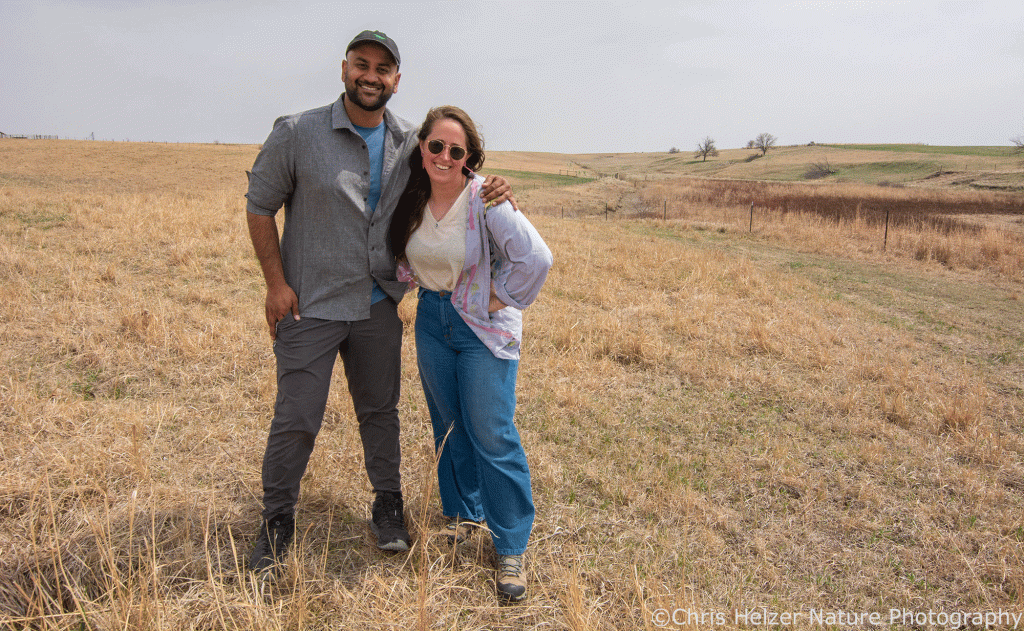
Jojo Morelli joined the Hubbard Fellowship in February 2023 and her joy and enthusiasm have illuminated our lives ever since. Her drive to learn and her work ethic have made her a crucial part of our conservation team in Nebraska. All of those same traits have also earned her a new job, which she’ll be moving to next month. As of September, Jojo will be a Grassland Stewardship Assistant with The Nature Conservancy at Ordway Prairie Preserve in South Dakota. Unfortunately, that means we lose her before her Fellowship is over, but I guess the good news is that the Fellowship did its job of helping to get her the career position she’s been dreaming of!
Jojo is multitalented in conservation, but has an artistic side as well – not that artistic talent isn’t also an important attribute in conservation. In this blog post, Jojo shares some of her conservation jouney, as well as a couple excllent poems she’s written about prairies and land stewardship. Enjoy!

I didn’t always want to be a Hubbard fellow.
When I started college, I was a journalism major, bright-eyed and hopeful to report on impactful topics.
After a few years of coursework, I pivoted in a different direction: I wanted to work in conservation and do purposeful work to protect any portion of the natural world that I could. Spending time in nature has always been something that has brought me happiness and fulfillment, as I’m sure many readers of this blog can relate.
When I transitioned into field-based biological work, I was encouraged by family and friends to document some of my experiences for others, something I stubbornly protested (“I want to be thought of as a scientist now”). I was intent on changing my image and washing away my past experiences to be taken seriously.
Imagine my surprise when I understood that the conservation field and journalistic writing often intersect and create a huge impact. By then it was too late: the specific details of stories had washed away with a few years, and I wouldn’t be able to illustrate stories from my biological field work experiences with much accuracy.
Thankfully I came to my senses as I began to transition into a new realm of conservation: habitat management, specifically in prairies. Previously I had worked on species-specific monitoring projects or as a technician for graduate research projects. I wanted to move to larger-scope conservation work, focusing mainly on the ecology of habitats, instead of the needs of a particular species or group of species.
This time I wouldn’t forget to document my memories in the field, but still not in the form of an article or essay. I decided to go back to my favorite form of expression: poetry.
Poetry is something a lot of people have misconceptions about or simply don’t know much about. There’s a certain outdated mystique that comes with the expression style that attracts odd eccentrics (like myself). Of course, the art form has become more mainstream with digestible “Instagram poets” becoming popular (e.g., Rupi Kaur).
I like to describe poetry as my way of painting. I’ve always been awful at visual art (and never invested much time in it, this is true), so poetry was my way of making sense of the world around me growing up.
Now, I use it to recall and treasure some of my favorite memories working outside for a living, often intersecting with the strange political setting of conservation. I’ve written about topics from the interesting dynamic of a past military base now a wildlife refuge full of albatross to the experience of being bitten by a harvester ant stuck in my pants (and, regretfully, killing it).
The coinciding of conservation work and art to me was not something I had considered early in my career. I figured if I was going to write about my experiences, it had to be educational and for a larger audience. I didn’t realize that artistic writing could be a part of this relationship, and still reach an audience. Braiding science into art is another way to encourage everyone to feel welcome and included in the conservation field. This collaboration is another way of asking: This is how I see the natural world, but how do you see it? and actually listening to someone else’s answer.
In this way, I feel that if even one person reads a poem of mine and it encourages them to spend more time outside, I will feel thankful. If not, though, at least I can remember some of my favorite experiences with a little bit more color.
End note: For those looking to read great nature-themed poetry, I highly recommend Mary Oliver. It is an easy transition into poetry for anyone.
.
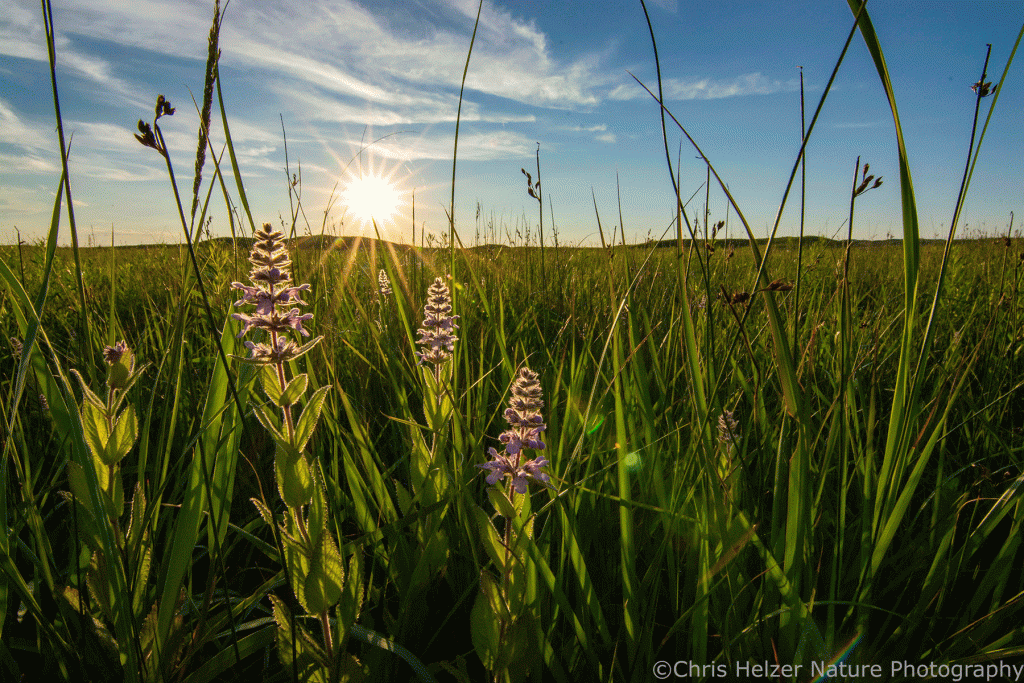
I wrote “Grass of Us” while at a survey job and while frustrated with coworkers who scoffed at the plant identification work we had to do, preferring only to focus on wildlife work. Largely, this piece is in reference to human’s long connection to the grassland habitat, and how we need it for the future, just as it needs us. It will help us if we protect it.
GRASS OF US
You can cut, tarnish, rip
and all will be new, flower and pollen
in half a season.
Burn me and my past skins and seeds will feed.
I have always loved you.
My spidery fingers hold your platform
tight and safe.
I have heard you dance all these centuries.
I have fed your food.
Do you think I falter? My bones weak?
I have knit this world for you. A perfect cacophony
you pretend to understand.
Where are your trim rows? Your oaks you collided?
Awns of awe
glumes protectant
racemes, spikes, inflorescences
A glowing herald
I thought you knew?
This frenzied prayer, oath
There was no me or you
Now the wind shakes us in drought and invaders camouflage.
There is only us in this fractured dirt.
This forgotten communion, a cursed ancient.
.
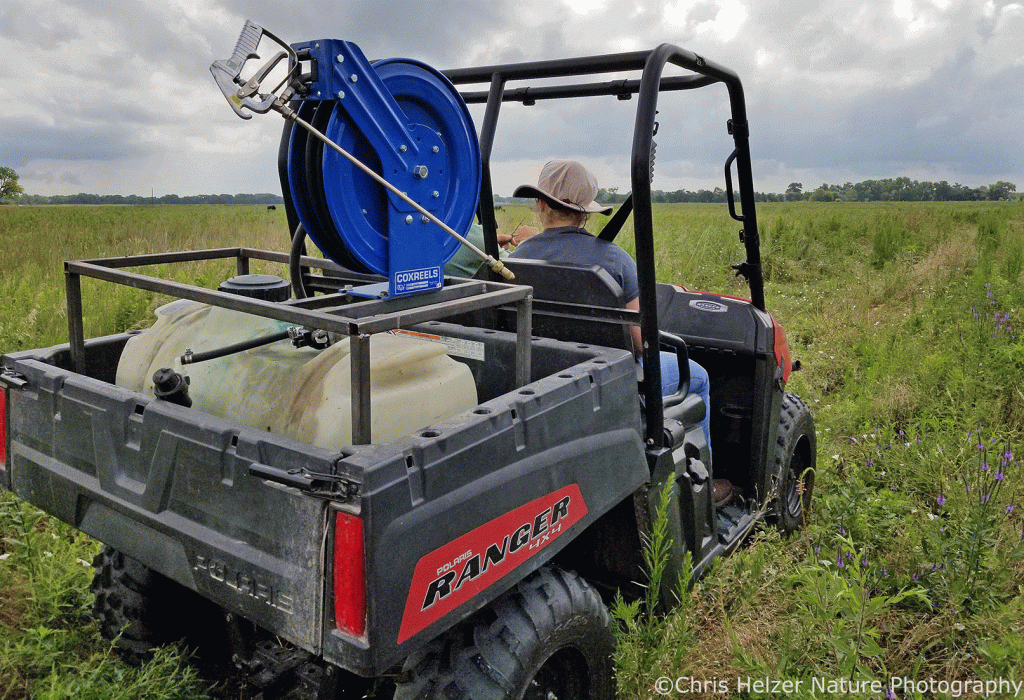
“Weeds” is about the evergreen fight against invasive plants. I wrote it while it was invasive plant spraying season at the preserve I was working at. This piece describes the process of going out as a team to spray “weeds” from ATVs/UTVs as quickly as you can, even when you know there is no way you’ll be able to call the job complete.
WEEDS
Aboard a bucking machine, burning a jostled sheen of exhaust into the drought, we perch
as sentinels or dreaded messengers, liquid with this metal Bess Beetle.
The tracks wilt in, tired, as if this is the last ounce left. As the arrogant yellow sucks away
what little moisture is left, as they watch with clammy hands the rest of the plants
turn, roll over, recoil. Digging down
To a hybrid state or a misty webbing of roots, unrestricted in the loamy dark, that lonesome fade.
Sunscreen burns my eyes again. The thick, sour scent of our blue-soaked solution
is visible, viable. Enough?
To quell the pounding burst of catalytic life, to quiet the rough spreading stains.
Here we are, crouched and waving royal blue flags.
Eyeing two paper photos to find the difference, and tuck into a scrapbook.
 The Prairie Ecologist
These are beautiful and poignant! Well felt images. Thank you Jojo, and congratulations on the new position!
JoJo – Thank you for sharing these poems. For 40 years in conservation I argued, that if people don’t understand or appreciate what we do, ultimately it will mean failure. They don’t have to like it or fully want to pursue it, but conservation must be appreciated by people everywhere, and they aren’t going to read science publications, nor skim ID books…
but they might take note of a poem. We’re going to need it all.
Thanks again.
Very good. DEI at its finest. Good luck in the new job!
Wonderful! Good luck, JoJo!
Jojo,
It has been a great pleasure to meet you and spend time with you however briefly. Good luck on your new job and future endeavors. Please come back and visit us at the Platte River Prairies.
I think you are quite possibly another Mary Oliver in the making. I hope to see your poetry published someday.
Karen Hemberger
I taught for many years and found that when people combine what they initially perceive as separate disciplines they have truly learned.
Good luck with the new position and keep writing.