
This is a post I’ve wanted to do for a long time. Bison, of course, are one of North America’s most iconic and revered species, and for good reasons. As well-known as they are, however, there are a lot of misconceptions about both their current and historic roles in prairies. After several years of helpful interactions with Dr. Chris Widga, I asked him if he’d be willing to share his research and perspectives with this audience through an interview. Fortunately for all of us, he said yes.

Chris Widga, originally from central Nebraska, is a distinguished paleontologist, ecologist, and archaeologist known for his research in bison evolution, ecology, and human-animal interactions. With a career spanning decades, Widga has delved into the evolutionary history of bison, shedding light on their ecological adaptations and responses to changing environments. His work lies at the intersection of paleontology and ecology and attempts to unravel the intricate relationships between bison populations and their habitats through time.
Widga’s archaeological research has focused on interactions between ancient humans and bison and offers a nuanced understanding of prehistoric societies and their reliance on these animals. Widga currently serves as the Director of the Earth and Mineral Sciences Museum & Art Gallery at Penn State University, where his research focuses on the evolution and ecology of North American megafauna.

.
Prairie Ecologist: So, how do you study historic bison behavior?
CW: Over the last 20 years, I’ve been working on techniques to reconstruct bison behavior from bones and teeth. This interest started in my graduate work at the University of Kansas where my research focused on understanding how bison utilized a landscape during the warmest and driest part of the last 12,000 years in the eastern Plains. It has since expanded to an interest in fossil bison wherever and whenever they occurred in North America, from California to Virginia and Alaska to Mexico.
The fossil record of bison is one of abundance and diversity. It is one of very few animals where preservation of the record is rich enough that it samples almost the entire pre-modern range. And because bison are a herding animal, we usually have good sample sizes of individuals within the herd, as well. This robust record has been the target of North American archaeologists and paleontologists for over a century, so we have lots of collections that are curated in museums, both inside and outside of the Great Plains.
In the archaeological record, bison “kill” sites can be considered culling events that are tagged with space/time information. So we have developed a number of techniques to reconstruct local behaviors in a fine-grained way. We use tooth eruption and wear schedules to understand the age structure of the herd. We reconstruct body size through measurements of long bones to look at ratios of males to females and to gauge the nutritional status of these wild herds. We pay attention to developmental and traumatic pathologies to understand the life history of individual animals. And importantly, we examine the role of bison within Indigenous foodways through the analysis of hunting, procurement, and butchering decisions.
After many decades of research by a community of dedicated zooarchaeologists and paleontologists, the pre-modern record of bison behavior and ecology has been fairly fleshed out. We know a lot about the status of bison populations in different places, at different times.
The large sample size of bison sites has also shown a lot of potential for testing models of climate-driven, landscape-level changes in North American ecosystems. Last year, using a dataset of over 2000 bison sites, we looked at the relationship between climate and the geographic range of bison since the coldest part of the Ice Age (~20,000 years ago). We found that winter temperatures and hydroclimate-driven changes in forage conditions were strongly correlated with expansion and contraction of the Bison range through time. Although these were not, perhaps, astounding insights to range managers and wildlife experts, there were additional take home messages that were new.
First, there were periods when the geographic range of bison expanded dramatically into spaces (eastern US, northern California, northern Florida) that were abandoned at the end of the Pleistocene. Did these expansions correspond to climate change? Or something else? Despite the large sample sizes, the answers were ambiguous. This is something we’re still trying to find out.

We’ve also made progress in understanding how individual bison utilized a landscape during their life. Starting in the early 2000s, we developed techniques to reconstruct the diet and mobility patterns of bison based on the chemistry of bison tooth enamel. The relative abundance of stable isotopes of carbon in bison teeth track the amount of cool-season and warm-season plants in an animal’s diet, and the ratio of different isotopes of strontium reflect the provenance/location of these plants.
Stable isotopes of oxygen are a good paleothermometer, so we can seasonally “calibrate” this record. As teeth form, these chemical signatures of diet, location, and temperature are ‘locked in’ to the enamel structure. In the lab, we can sample small windows of enamel to understand the ecology of an individual animal at different periods in its life.
This is a powerful way of looking at how bison adapt to different ecosystems, or to different climate regimes. We’ve learned that it is very difficult to generalize about the basics of bison behavior. Their diets reflect their local environment, they weren’t particularly choosy. Large-scale movement was rare. Winter was a tough time all around.
.
Prairie Ecologist: Based on all that, then, what’s known about historic North American bison populations in the Great Plains and the Midwest?
CW: For the last 12,000 years, the Great Plains has definitely been the core of the Bison range. However, they were present outside of this core as well (prairie-forest, Basin and Range, Closed Forest, etc.). There are few places where we have a good understanding of the timing of these expanding populations–but in places like Illinois, we know that bison were present in the state as early as 9000 years ago and increase in frequency after 2500 years ago.

The fossil record of animals in this region is different. Rather than large bison kills, we see bison culled as individuals or in very small groups (<10), their bones are occasionally mixed in with village food waste. We still aren’t sure what is driving expansion of bison into this periphery, but climate probably has something to do with it. Questions we still haven’t answered include the impact of people, non-human predators, and fire on these systems.
Bison of the midwestern prairies and forests had a lot in common with their counterparts on the Great Plains. There are no significant differences in size or body proportions between the two groups and the idea that a fossil sub-species of bison specially adapted to eastern forests has not withstood the test of time (or larger datasets).
However, from what we can glean about their behavior, the life histories of bison east of the Mississippi were potentially very different. Although they were common in prairie areas and had diets dominated by Big Bluestem tallgrass, they also occupied the heavily forested environments of the Ohio River valley, eating shrubs and browse.
.
Prairie Ecologist: What are some common misperceptions about historic bison behavior?
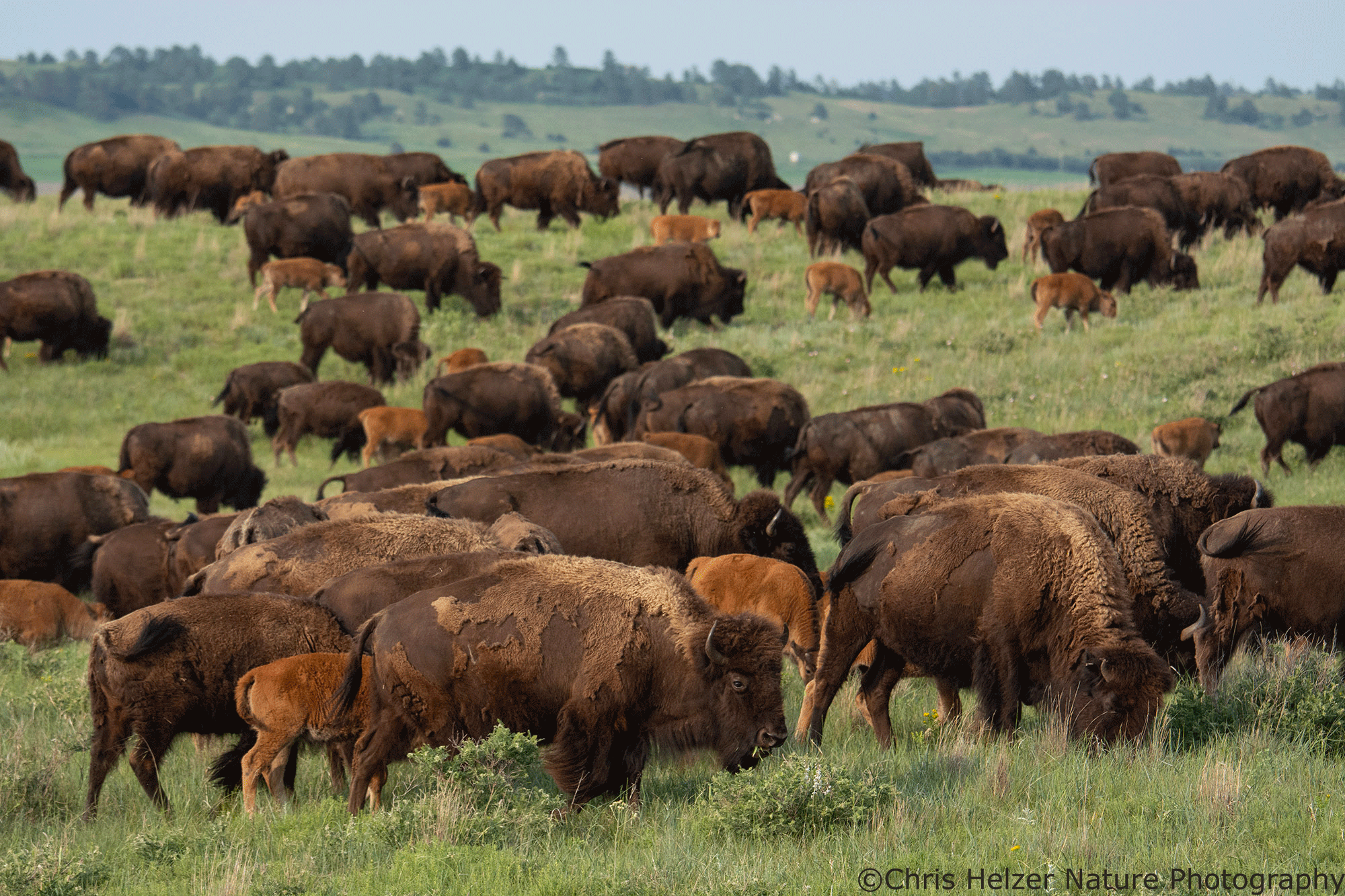
CW: Myth #1: Bison are obligate grazers. When we think of bison, the image that most of us have is of a majestic animal in a shortgrass landscape. Over the last 20,000 years bison were certainly very happy within this niche. However, they are so much more than creatures of the steppe. At certain times, they were successful in the Grand Prairie of Illinois, the mosaic forests of the prairie forest border in Minnesota, the Great Basin, the Ohio Valley of Kentucky, even northern Florida. None of these environments were shortgrass plains, some of them weren’t even grasslands!
The more we dig into these ‘atypical’ bison populations, the more intriguing they get. For instance, the diet of late Holocene bison at Big Bone Lick in northern Kentucky consisted almost entirely of plants growing under a closed canopy forest. These included herbaceous forage and maybe some cool season grasses, but also shrubs and browse.
We know this from the chemistry of their teeth, as well as trends in how their teeth wear. Teeth of grazing bison wear down to a flat surface, usually by the time they are ~5 years of age. The molars of Big Bone Lick bison, however, retain a peaky shape well after their first decade. The fossil record of bison shows us they are very adaptable to a wide range of different environments.
Myth #2: Bison are migratory. Many of the first Europeans to observe vast bison herds of the 19th century Great Plains remarked on their unpredictability. Sometimes bison were where you expected them, sometimes they weren’t. Many people attributed this to random local movements within an area. But sometimes it seemed like bison abandoned an area entirely, suggesting that they might have migrated somewhere else. This was pretty important to travelers because bison were a good source of travel food–as well as a critical food resource for Native communities!
Back in the early 2000s we started developing a method to look at bison mobility that used chemical fingerprints (isotopes of Sr) in their teeth to track them across a landscape. We started with the goal of reconstructing prehistoric migration patterns. However, when the data started coming in, we were surprised to see that, by far, the most common values for bison tooth enamel were the same as the place where they were found! In other words, these bison were not migratory.
Since then, we’ve analyzed dozens of individual bison from very different places (Ohio, Nebraska, Kansas, Minnesota, and others) and from very different time periods spanning the last 15,000 years. Every once in a while, some enamel samples suggest that an animal might have moved from a natal herd to the place where it died (dispersal), but there is no evidence that bison seasonally migrated long distances.
.
If you’d like to read more, here are a few of Chris’ academic publications on the topics mentioned here:
 The Prairie Ecologist
That was very interesting, informative and the questions were answered so clearly. I’m amazed at the improvements in techniques and data sets yielding so much more information, that bodes well for continued advancement of learning!
Thank you for this interesting information!Julie
Thanks for this information, Chris. I give talks at Soapstone Prairie Natural Area north of Fort Collins, CO about the bison herd there and the ice age Folsom culture, so this is of interest to me. Regards, Gary
Awesome blog entry. I’m unfamiliar with Dr. Widga’s work and thank-you for linking to some of his publications. I’d like to know how the newer, older dates for human occupation in north America affect ideas about the causes of late Pleistocene changes in landscapes and megafauna.
Thanks Chris. Widga touched on nearly all the controversial topics I encounter.
Thanks, i found it useful, esp current scientific inquiry about how much disturbance (fire or bison) was needed to maintain non-woody landscape
One question I had about the perhaps surprising “non-migratory” lifestyle of the bison is how far would they have to migrate to see a different isotope signature? This would give some idea of the potential size of the home range of a herd.
Awesome post! Thank you for sharing this information.
Pingback: Welcome new readers! (And thank you to the rest of you!) | The Prairie Ecologist
Excellent info. Came across this in a search — you know, Native gal, writing a book with a joke about bison and a museum docent in it. The point about migration myth is gonna fit well. Thank you for the research and writing!