

Fire has been part of prairie ecosystems for as long as prairies have existed. In many parts of North America, prairies both came into existence and then persisted because of intentional and thoughtful application of fire by Native peoples. Forces such as drought and lightning, intertwined with human management, have helped maintain prairie habitat for millennia. Fire, people, and prairies are inextricably linked.
Great! So how often should I burn my prairie? And what time of year should I burn it?
Ok, hang on.
While those questions are reasonable in the right context, they’re almost useless on their own. You’d never ask an experienced baker, “hey – how much flour should I use and when do I add it?” The obvious response would be, “I don’t know, what are you trying to make?”

There is no set recipe for good prairie management. If prairies are anything, they are dynamic. That dynamism necessitates an adaptive approach to management. Burning, like all other management treatments, should be part of that approach. Every fire should be planned and conducted on its own merits, not as part of a pre-planned schedule.
Weather fluctuations, alone, can strongly influence the growth and flowering of plants. Insect populations are directly tied to weather as well, but also linked to what happens to plants. Because so many other species eat, or are eaten by insects, anything that affects them ripples through the entire ecosystem.
The fickleness of the weather can make a prairie act very differently from one year to another. On top of that, the behaviors of invasive species, disease organisms, herbivores, pollinators, predators, and other members of prairie communities are also driven by complex, interconnected, and unpredictable forces. It’s a big, glorious mess.
As a result, the answer to how a prairie should be burned depends on lots of factors. What is your overall objective for your prairie management? What has the weather been doing? How did prairie communities respond to recent management treatments (fire or otherwise)? What are the significant invasive species threats and what influences their ability to become dominant?
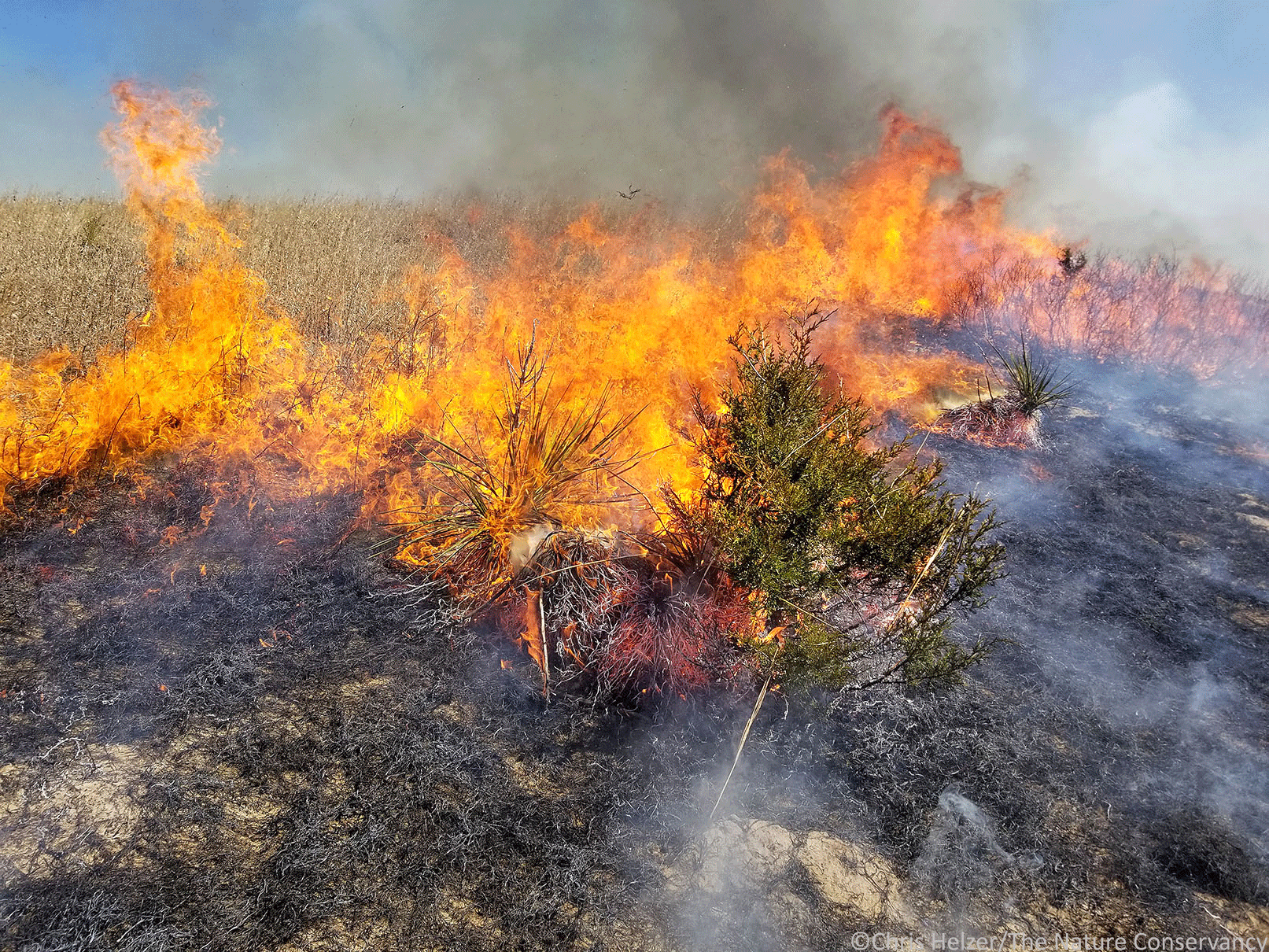
Even bakers don’t always follow a fixed recipe. Based on how the dough is shaping up, they might add a little extra flour – or not. Factors like humidity and altitude cause ingredients to act and interact differently and it’s not always possible to accurately predict those responses. As a result, bakers are constantly testing, learning, and adapting.
Prairie management has to be even more flexible and adaptive than baking. Knowing what the average historic fire frequency was in your area is instructive, but it shouldn’t necessarily dictate how often you burn your prairie. You should be burning when/if it will help you achieve your broader objectives, and if your recent observations show that it would be helpful.
Scientists and historians have estimated historic fire frequencies for most prairie regions. That’s interesting information, but remember that those are based on long-term averages, which smooth over a lot of variation. You can be sure the people setting fires centuries ago weren’t gridding out the landscape and deciding when to burn a patch based solely on a regimented schedule. They burned when it made sense for their objectives, which means some areas surely burned more frequently than others. Lightning fires, too, would have ignited on irregular schedules, driven by the capriciousness of forces like thunderstorms, drought cycles and grazing.
Historic fire frequencies are mathematic syntheses of irregular events, they’re not instruction manuals. At their best, they can help us understand the kind of world prairies evolved in. That’s definitely useful, but the world is significantly different than it used to be, so what might have been appropriate in the past might not always apply today. Use history as context, not as a template to be blindly followed.
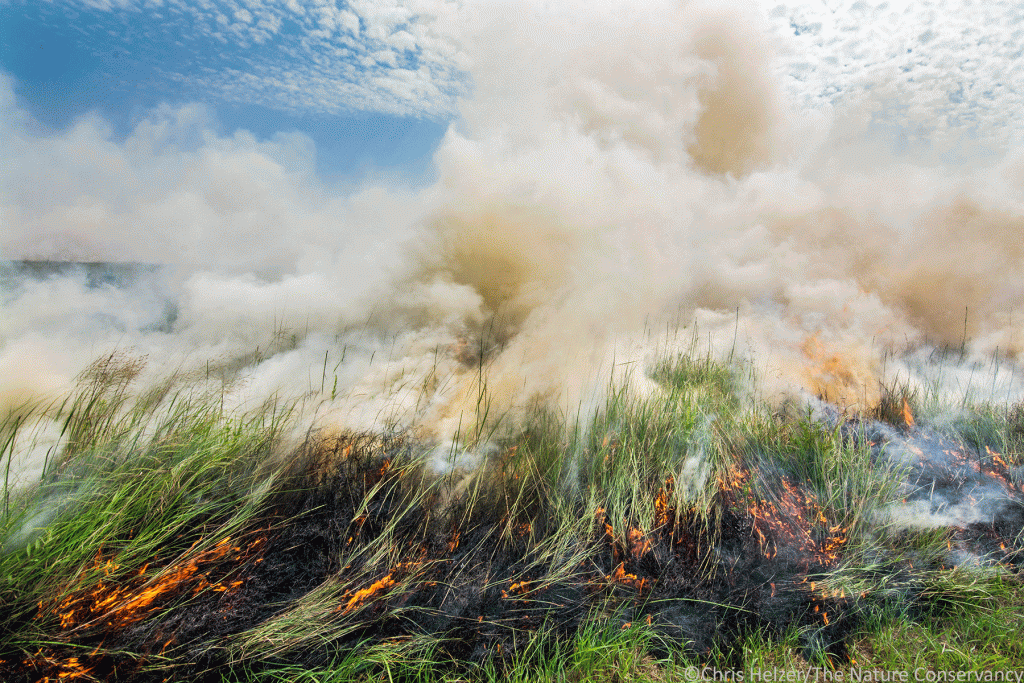
Similarly, the optimal seasonal timing for a burn should be based on what you want to accomplish with that particular treatment. What timing will make the most sense for your objectives? What are the potential negative consequences of that timing? The predominant season of fires hundreds of years ago helped shape today’s prairies, but – just as with fire frequencies – that history shouldn’t be the only guide to what we do now.
With regard to both the seasonal timing and frequency of fires, it can also be important not to get locked into a rigid pattern. Every fire has both positive and negative consequences. If you always burn at the same time of year, the same species will always be negatively impacted, and that will surely include some species you don’t want to suppress. Mixing up the seasonality of burns now and then can help ensure you don’t drive any species to local extinction.
Burning on the same schedule over many years in a row can also cause problems. Regardless of what frequency you choose, there will be some species that thrive in that regime and others that don’t. If you don’t ever vary the pattern, you risk losing the species that aren’t suited to it.
Most importantly, be sure there are adequate unburned refuges available any time you burn so you don’t eradicate whole populations of animals (especially invertebrates). Again, every fire has negative consequences, no matter the timing. Populations of some species will likely be wiped out, or nearly so, within the burn footprint.

In landscapes with lots of prairie, affected species can probably recolonize from nearby unburned areas – though that process may take more than a year or two. That recolonization works much less well in fragmented landscapes. If you burn the only 40 acres of prairie within miles, populations of animals that perish in the fire are unlikely to re-establish. Even if there is other grassland habitat around, you might have invertebrates in your prairie that are tied to plant species not present in those neighboring habitats. That will put those invertebrates at risk of local extinction if a burn snuffs out their entire population.

Prescribed fire is a powerful force in prairies. Every fire has both positive and negative consequences, driven by the timing and frequency (as well as its intensity) of its application. Prescribed burning should be used as part of an adaptive management approach. Every management treatment (fire, grazing, mowing, herbicide application, etc.) should be applied when it will help achieve objectives and in response to observation and evaluation of what’s happening on site. After all, smart bakers and prairie managers both know it’s risky to rely too much on a set recipe.
You might say they both knead to be adaptable and roll with the punches.
…Or you might not. You might not say that at all.
Hey! Some of you might remember Evan Barrientos from when he was a Hubbard Fellow about six years ago. Evan’s doing great work these days as a conservation photographer, videographer, and storyteller. His latest personal project is called Fireforest. It’s a terrific examination of the role of fire in Colorado forests – I encourage you to check it out!




 The Prairie Ecologist