
This post is written by Kim Tri, one of our two Hubbard Fellows for this year. Kim is an excellent artist, as well as an ecologist, writer, and land steward. As you can see, her drawings of animals are exceptional.
A Swainson’s hawk takes wing not 30 feet from me, and I feel vindicated. It rises from a patch of ground which I’ve just disked, and answers the idle question I had when I began disking that day. I wondered whether the turning under of vegetation and hence the cover of the little critters living there would attract hawks in search of an easy-to-spot snack. I’d seen it happen on a prescribed burn which I’d sat in on last year, in the property just across the creek. Once the flames and smoke died down, we counted at least 20 hawks—most of them Swainson’s—soaring overhead. They were attracted by the aftermath, the ground cleared of protected cover for the disoriented prey. The black earth left in the wake of the disk plow reminded me of the fire, and got me wondering.
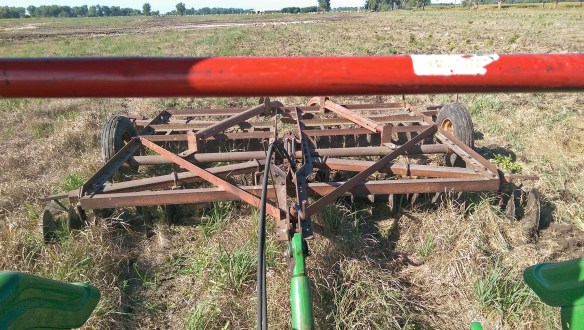
For those of you not familiar with the practice of disking, it involves plowing using a disk plot (pictured above) pulled behind a tractor. Picture by Kim Tri
I should have kept a tally of how many voles, mice, rabbits, and lizards I saw clearly fleeing across the worked ground as I plowed. Creatures visible to my weak human eyes would be easy pickings for a (much) sharper-eyed hawk.
Sure enough, a hawk showed up after an hour or so and answered my question. The neighbor was haying in his field just across the fence, which I’m sure was turning up quite a bounty of prey as well. I don’t have enough agricultural experience to know whether the hawks usually show up around haying time, but the intent circling of the hawks above the neighbor’s tractor made me think that they’ve cottoned on to it as well as they have to burning.
While disking later that week, also I kept (slowly) chasing groups of killdeer. A contractor had come in with an excavator only a few weeks before to reconstruct wetlands on the property. The killdeer scuttled around the newly excavated wetlands, where before they had not seemed to give this property much of their time. They, too, appeared attracted to the open ground where they might find prey. After all, the wetland excavation as well as the disk plowing had suddenly provided them with some quite preferable habitat.

A group of startled killdeer flee alongside the track left by an excavator. Graphite drawing by Kim Tri
It got me thinking about the consequences of our actions as land stewards – the whole ecology of it all. So often, during a day’s field work, we focus on the plant community. This makes sense, since it’s really the only thing about our prairies that we can directly manage, and where the effects of our work are most easily observable. The larger aim, though, is to create a diverse ecosystem with quality habitat for as many faunal species as possible. We do this intentionally through a variety of practices, such as seeding, prescribed burning, invasive species control, and grazing.
There are plenty of unintended beneficiaries to these. I did not set out that day with the disk plow to provide a meal to the local Swainson’s hawks. The objective was actually to clear the remaining vegetation of a low-quality “failed” restoration in order to create a blank canvas for seeding it into a high-quality prairie. It had been recently sprayed completely to clear out the brome invasion that was its major fault, and since then I’d come to view the area as kind of a dead space. While looking ahead to what the tract could be, I’d forgotten about all of the things that it still was. It was still habitat for a wide variety of animal life, judging by the creatures I was seeing. The cleared ground of the excavated wetlands showed trails of deer and coyote tracks, and even now, after the ground has been completely cleared, the deer and coyotes still keep leaving tracks.
I’ve noticed, too, while mowing fire breaks around our burn units, that there are creatures benefitting. While making a third pass around with the tractor to widen the line, driving alongside the line I’d already mowed, I noticed many voles and mice scampering out of the clippings left behind. They seemed drawn to the mowed line, and I felt that I’d just created dream foraging habitat for them. As well as laying down a dense layer of cover to protect them, I’d just brought down to ground level a cornucopia of seedheads that had previously been out of reach for the little critters.
I acknowledge that there are also species negatively impacted by some of the things we do, but that is a thought for another time. The mice were definitely not happy about the disking or the hawks, but I hope that we balance this out by working to improve their habitat.
We’ll reseed the disked tract with the seed we’ve collected this year, and in the spring a new prairie will grow, bringing with it an influx of creatures back to the property. In another few years, it will be burned, and then likely the Swainson’s hawks will come again, drawn by the promise of bounty on the black earth.
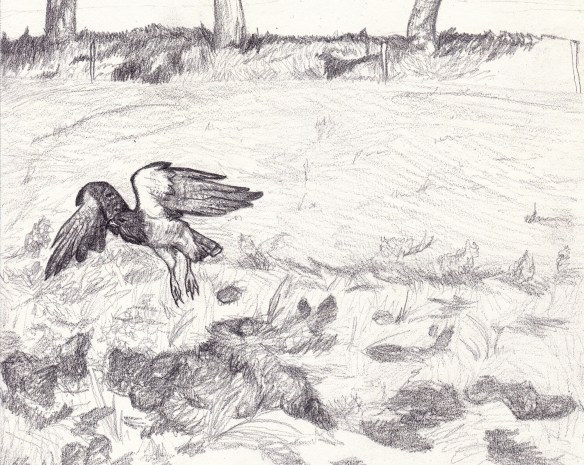
A Swainson’s hawk takes flight from a disked field. (Yes, the ground does look that messy) Graphite drawing by Kim Tri

 The Prairie Ecologist