Hubbard Alumni Blog: Platte Meditations

This post was written by Evan Barrientos, a Hubbard fellow during 2015 and 2016.  Evan is currently working for The Nature Conservancy in Oregon.

(This is a post that I wrote in January 2016 while during my Fellowship but didn’t get around to publishing before winter passed.) On a sub-zero Saturday morning I got up early to catch some photos of the sunrise. I had planned to go to a prairie, but as I was driving I noticed a line of steam rising on the horizon like the trail of dust a pickup makes as it races down a dry gravel road. Curious, I headed towards the steam and realized that it was coming off of the Platte River. When I arrived at the bridge I was stunned; all along the river, vapor was rising from the surface and glowing in the sunrise. An endless procession of ice chunks slowly floated by, quietly scraping against the snow on the bank. I spent almost two hours photographing, filming, and recording audio, and I never even felt cold (which is saying a lot for me). There was something special about that morning, something about the stillness that made me feel content and peaceful. I wanted to share that feeling with other people, so I created a short video of how I saw the Platte that morning:

There’s really something special about the Platte and I don’t know if I can explain it. Maybe it’s my instinctive attraction to water. Maybe it’s the languid pace of the Platte that relaxes me. Maybe it’s simply the change in scenery and stark contrast between river and prairie. Or maybe I’m surprised by how beautiful it is each time I make a visit because no one ever seems to talk about it. It’s hard to take a trip in Nebraska without driving over the Platte, yet how often do we stop and explore what’s below those bridges?

01172016_nebraska_1768

Part of the problem is that there’s so little public access to the Platte. I know of a few observation decks and one tiny trail along it, but the vast majority is private property. Even if you set foot on the middle of the riverbed you’re trespassing! This is such a shame because in my opinion the Platte is one of the greatest recreation opportunities in southern Nebraska. On a sunny weekend it is my favorite place to sit and read, and every time a friend visits I make sure to bring him or her to a sandbar for a picnic. As an employee of The Nature Conservancy, I have the luxury of being able to access a couple sections that we manage.

08192015_nebraska_3605

Fortunately, even if you don’t have access to a section of the Platte the best option is still available to you: kayaking. I did this with a friend twice during the summer and it remains one of my favorite Nebraskan memories. When there’s enough water for a decent flow you can cover 20 miles in an afternoon while hardly paddling. And boy was I surprised how beautiful the scenery was! I expected the river to be bordered on both sides by corn fields, but the section between Minden and Wood River is actually surrounded by trees, creating the feeling that you are far, far away from it all. No place other than the Sandhills has given me that feeling of isolation in Nebraska. Kayaking the Platte requires two cars to shuttle and renting kayaks if you don’t own them, but it is well worth the trouble.

10112015_nebraska_8198

The Platte River has a long history of abuse, and now it is often taken for granted, in my opinion. But if more people had a meaningful connection to it maybe we would treat it better. I challenge you to find your own special place or activity on the river, if you haven’t yet; get to know this wonderful feature if you haven’t yet. The Platte deserves it.

08192015_nebraska_3596

Public Access to the Platte:

  • Platte River State Park, Louisville
  • Louisville State Recreation Area, Louisville
  • Two Rivers State Recreation Area, Waterloo
  • The Crane Trust Visitor Center, Alda
  • Alda Rd. and Shoemaker Island Rd. (observation deck), Alda
  • Audubon Center at Rowe Sanctuary, Gibbon
  • Lowell Road and Elm Island road (observation deck), Gibbo
  • Riverside Park, Sottsbluff
  • Platte River Landing, Valley

Hubbard Fellowship Blog – Scaling Up the Emotional Impact of Prairies

This post was written by Eric Chien, one of our Hubbard Fellows.  Eric comes from Minnesota and brings great energy to our prairie stewardship work.  He’s also very bright, and an engaging writer, as you’ll see in this and other posts.

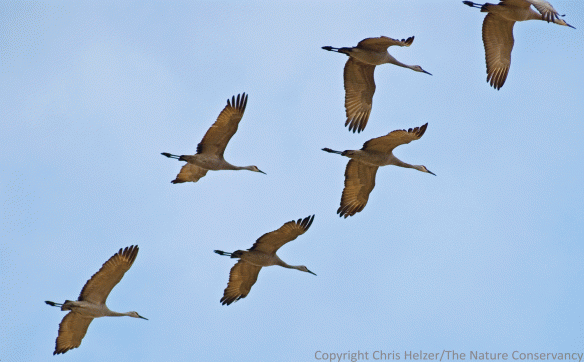
I recall vividly the moment I was swept up by prairies; when what had only been a textbook description of geography was sparked into a fidelity to place. The view of sandhill cranes swirling over a starkly beautiful late-spring prairie had an immediate impact on me. It was the first time I felt what I was seeing.

Sandhill cranes.

Sandhill cranes.

I have been recalling this moment lately because I have been thinking a lot about impactful experiences. I was there that blustery Spring morning for work. There was no one there to interpret or inspire. No learning objective or deliberate takeaway. Yet, that experience sits amongst the foundation of where I am now and the path I continue to take.  Impactful, emotionally rich experiences are the touchstone for action and commitment, and in prairies, in relation to other landscapes, they seem a little harder to come by. Prairies just don’t give themselves up easily. Identifying those places, characters, and moments that bridge the gap between knowing and caring could be a powerful tool for the achievement of conservation goals, and enriched human lives.

I have often struggled to facilitate powerful prairie experiences for others. Deep appreciation always seems to end up relying on the context of my own knowledge and memories, and thus unapproachable to my companions. One of the few places where prairies do not play hard to get is the Niobrara Valley Preserve (NVP). It has long been a place that confers experiences capable of tying together people and prairies. Its reference list is long and diverse. Somewhere within the consistent transfer of emotional weight that NVP delivers is an important guide and mold for reaching others.

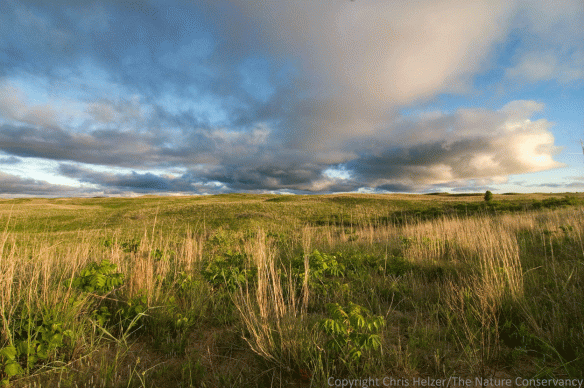
Sandhills prairie at The Nature Conservancy's Niobrara Valley Preserve in northern Nebraska.

Sandhills prairie at The Nature Conservancy’s Niobrara Valley Preserve in northern Nebraska.

On a recent evening, I found myself sitting quietly beneath a cedar in Niobrara River valley prairie at dusk. Within minutes of my settling in, a small group of bison had quietly foraged their way down from the hills, and into this football field prairie flanked by oak-cedar woodland and the river. They were unhurried, only the occasional soft grunts accompanied the sound of little bluestem, cured wine red, being clipped off. I felt lucky that from the 12,000 acres of prairie on which they could wander, this small group had happened to choose this minute pasture for the evening. They were soon joined by a large flock of Merriam’s Turkeys. Their white tipped tail fans flashed as they scratched at the ground, flipped bison paddies, and bantered with purrs and clucks. A young whitetail buck also joined the evening stage. You can see him inquisitively wander towards me in the video below.

Before it became too dark I walked up and out of the river valley, cresting the hills, and was confronted with the stretching upland prairie of the Sandhills. A spooked pair of young bison bulls thundered off the river ridge and into the hills out of sight. I walked the sandy, two track back to the bunkhouses in the dark. These are not uncommon moments at NVP. The source of gravitas in these experiences may seem obvious, filled with charismatic wildlife, but I think it is more than that. The widely shared appreciation of NVP says a lot about where we are coming from in prairie conservation and where we want to be.

Young bison bulls at The Niobrara Valley Preserve.

Young bison bulls at The Niobrara Valley Preserve.

Conservationists will accurately tell you that a 54,000 acre preserve is still far from a whole system. The Nature Conservancy does not control the entire Niobrara River Watershed, our bison herds need to be fenced in, and invasive plants still find their way onto the preserve. However, it is one of an elite few locales that feels whole. I believe it is this sense of wholeness that beckons people to deeply connect with it in a way that is difficult in most other prairie landscapes. When I am showing people prairies, I often find myself asking them to imagine. Imagine if this highly diverse, visually stunning, 80 acres of prairie stretched to the horizon. Imagine if a herd of bison lay hidden behind that low swale. Imagine if you did not know what else might be out there. At NVP, one does not have to imagine, and in that lies its power to move us.

Large, intact, productive grasslands, like the Niobrara Valley Preserve let us transcend the conservation context in which much of our work takes place. We can escape the long road of restoration in the human dominated landscape, characterized by fragmented, degrading, homogenous, biologically depauperate prairies. We can see the prairies and landscapes we are driving at. As prairie professionals and conservationists, we should and do spend most of our time on this long road, but as we seek to bring others into the fold we should strive to impart them with a vision. Head off the question about why prairies are important; the one that often seems to accompany a trip to some isolated remnant in a sea of cropland. Take them to somewhere where the importance of prairies is unspoken and self-evident. Seek to move our potential prairie allies from “is that all?” to “what else is out there?”. I know that is harder for us here in the prairie than for those sharing other ecosystems. It is especially hard in the eastern tallgrass prairie where we have been left with nearly no truly large prairies. That said, the hard work of many (Nachusa Grasslands IL, Midewin National Tallgrass Prairie IL, Glacial Ridge National Wildlife Refuge MN, Kankakee Sands IL/IN) has made it more of a possibility than ever.

For some, the beauty found in small prairie patches is sufficiently captivating. For others, however, a sweeping landscape of prairie

For some, the beauty found in small prairie patches is sufficiently captivating. For others, it is the sweeping sea of grass that triggers a love of prairie.

There will always be those who will come to prairies more subtly; those who are innately curious about the details of plant communities, who can discern and explore the intricacies of prairie ecology that happen at the smallest of scales. I will happily continue to walk with anyone who shows enthusiasm for finding fritillary caterpillars on rare prairie violets. Prairie conservation and restoration by necessity has been built on the backs and through the sweat of those who can delight in our valuable remnants, and push forward from there. Let’s also begin to work from the other direction. Recognize that there are those who will only come to prairies through experiences of grand space and wildlife. Bring them to the end, let them see what else prairies can be. After that we can walk them back to where we are, and begin the work of the return journey to wholeness with the expanded support of more “prairie people.”