
Hubbard Fellowship Post – Community-Based Stewardship and Long-Term Management

This post is by Eric Chien, one of our 2016-17 Hubbard Fellows.  Eric hails from Minnesota, with an undergraduate education from Bowdoin College in Maine.  He has a strong background in prairie management, and hopefully a bright future in that field as well. 

The most compelling experience of the North American Prairie Conference was on a sweltering Tuesday afternoon on a winding path through the Nature Conservancy’s Nachusa Grasslands. While I was beaded with sweat from just walking in the Eastern Tallgrass humidity, I saw three people, laden down with seed bags, hand harvesting seed and ripping problem plants from the ground. Jeff Walk, Illinois TNC Science Director and our guide for the walk assured us that these volunteers were not planted. Furthermore, he noted that this was a fairly regular sight at Nachusa.

Three people. Tuesday morning. Maybe I come from a different community context, but for me, seeing three, independently working, non-professional, unpaid, human beings engaged in land management is akin to seeing a prairie chicken drum on a buffalo’s back under a wildfire sunset. Okay, maybe not quite that, but my point is that intensive, regular community engagement and participation in land management is a rare phenomenon. It was a sight that made me wonder how we plan to achieve our restoration goals for individual sites beyond the immediate future. My predecessor, Evan Barrientos, had begun the work of pulling on this loose thread, and I encourage you to read his post on volunteer stewardship if you have not, but I think it begs further unpacking.

These volunteers helped plant prairies and wetlands on our Platte River Prairies.  It can be more difficult to recruit long-term volunteers to help manage restored (and other) sites.

These volunteers helped plant prairies and wetlands on our Platte River Prairies. It can be more difficult to recruit long-term volunteers to help manage restored (and other) sites.

It is a great feeling to stand in a big tract of prairie knowing that it was once cropland. It is a crushing feeling to stand in a big tract of prairie overrun and choked by invasive plants. And it is unfortunately not an uncommon feeling to have both experiences on the same prairie, just a couple years apart. Many prairie restoration sites have found out what happens when management capacity does not match the scope of their restorations: a seemingly endless game of catch-up with invasive plants ever threatening to swallow a new prairie. Addressing the pitfalls of that disjunct approach was one of the Grassland Restoration Network’s primary prescriptions for restoration success (here is the link to that report). However, I want to think beyond even the 5-15 year timeline to the idea of management in perpetuity. In the reality of a fragmented landscape, it appears likely that even the best restorations (well planned and executed) will require regular management for those lands to continue to achieve our respective management goals for them.

It leads us to important questions: As the acreage of restored prairie grows, have we invested in the organizational groundwork to ensure the continuity of our achievements? Is there a need for innovation in stewardship structures as we seek to move to an increased scale of work? Or should we aim to increase funding for professional management staff augmented with whatever traditional volunteer programs that we have?

Invasive species control is a critically important part of land management, both on restored and remnant sites.

Invasive species control is a critically important part of land management, both on restored and remnant sites.

As someone who is seeking a professional stewardship career, more money aimed at increasing the capacity of professional resource management sounds awesome. As someone who has seen the scope of need for stewardship, I have a hard time envisioning that approach rising to the challenge on its own. So then the big question- what does effective community-based stewardship look like?

I think it sort of looks like Nachusa Grasslands. In a talk at the conference, Bill Kleiman, the Nachusa Grasslands land manager, said, “we don’t just produce grasses, flowers, and wildlife, we also produce people.” I don’t know if steward production is part of their long-term management plan, but they seem to approach it with an intentionality that suggests it is. From the little glimpse I saw of it, Nachusa Grasslands has produced a stewardship structure that draws heavily on a capacity that is less tied to The Nature Conservancy, and more attached to the place. The stewards there love the land they work on. That trait gives it a unique resiliency. Organizations come and go over the short and long-term. If we want the successes we have in places to be maintained then we need to make sure we are building stewardship structures that have some independence from the organizations that own the land on which they work. Private lands conservation has focused on empowering non-professionals by necessity. Yet, I think if we take stock of our public and NGO-owned stewardship needs, there is a similar necessity for involving community stewards in a significant way looming on the horizon. I think for many of us it is already here.


Hubbard Fellowship Blog – Welcome to the Fourth Class of Hubbard Fellows!

Many of you have followed this blog enough to be familiar with our Hubbard Fellowship program and the experiences they’ve had with us during the last several years.  In June, our fourth pair of Fellows, Katharine and Eric, joined us here in Nebraska and have been quickly and enthusiastically learning about prairies and conservation.  Both of them have written a brief introduction of themselves, and you’ll hear much more from them over the next 11 months.

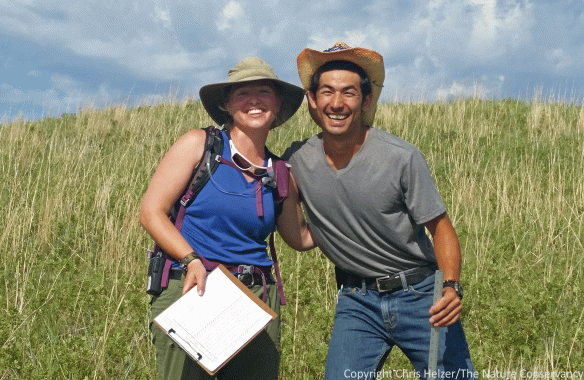
Katharine Hogan and Eric Chien are the 2016-17 Hubbard Fellows for The Nature Conservancy in Nebraska.

Katharine Hogan and Eric Chien are the 2016-17 Hubbard Fellows for The Nature Conservancy in Nebraska.

From Katharine:

Greetings! I’m Katharine Hogan, and I am very excited to join The Nature Conservancy in Nebraska for the 2016-2017 Claire M. Hubbard Conservation Fellowship. I’m coming to this opportunity as a northeasterner who developed her love of nature while growing up in the mountains of Vermont. My summers and free time were spent horseback riding in the woods, swimming, gardening, forming what was then an unconscious but deep attachment to the natural world, and building the foundations for my future professional passions.

I am part of the fourth generation of my family to choose conservation as a profession. Whether this is generational conditioning or some genetic preference not yet understood, I’ll probably never know. What I do know is that I’ve always gravitated towards any science that required spending long hours outdoors studying nature directly. I remember as a teen deciding in part to pursue environmental science over other science fields due to a fear that they might require spending too much time indoors! This isn’t necessarily a fair summary of those fields, but ultimately I completed a B.S. and in 2014 an M.S. in Environmental Science from Taylor University in northeastern Indiana.

As a lifelong northeasterner relocating to a strikingly different ecosystem and culture, my interest in exploring more of the country post-college was piqued, leading me after graduate school to work first performing native plant restoration at North Cascades National Park in Washington state. Here, I learned firsthand how the world of conservation and land management far eclipsed what I could have possibly grasped in school, fell completely in love with the unforgiving wilderness, and essentially felt like I’d stumbled upon an entirely different world than I expected. However, it still provided everything I had been looking for in my hopes of developing a career in which I could do work that was both needed by the world and fulfilling for me to complete.

The lessons learned in Washington and at subsequent opportunities in vegetation monitoring in Nevada, New Mexico, and Idaho created individual and collective experiences I couldn’t have dreamt of if I had chosen any other profession. I’ve been lucky enough to have learned and seen more of this beautiful country than I would have thought possible even three years ago. But here is where we come to the beauty of this Fellowship! Even having learned so much about different ecosystems and aspects of conservation, here in Nebraska there will be countless other opportunities to expand my knowledge of and appreciation for nature, all while contributing to the conservation of the beautifully intricate prairies on the Platte River and across the state. There will be new challenges around every corner, I’m sure, and I can’t wait to take them on, and see what I can contribute and accomplish by the end of the year. I have a feeling it will fly by and leave me looking for more at the end of it, so I suppose I’d better get busy! Thank you all for reading!

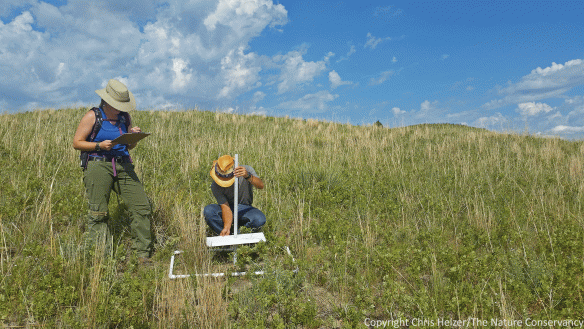
Among many other things, Eric and Katharine have been helping to collect data as part of a process to evaluate our land management. Here they are collecting data on vegetation structure at the Niobara Valley Preserve.

Among many other things, Eric and Katharine have been helping to collect data as part of a process to evaluate our land management. Here they are collecting data on vegetation structure at the Niobara Valley Preserve.

From Eric:

It is great to finally have arrived at the Platte River Prairies. I can still distinctly remember leaning over my chainsaw last December, the snow and cold driving though my face shield, wondering how I was going to find work that kept me on the prairie. The evening I pulled in earlier this June to begin a year as a Hubbard Fellow, a warm Great Plains wind swirled the grasses, cattle stood staring at the fence line, the bobolinks and bobwhite whistled away. With a change from the cold unknown to warm, welcoming opportunity, you can rightly imagine I am happy to be here.

I am from Minnesota; subjectively, but to my mind irrefutably, God’s country. I have basked in the state’s diverse, and rich natural heritage my entire life, living and recreating in and around our iconic waters and forests. It has only been relatively recently that I was enlightened to the wonder of the prairie. After returning home from Maine where I received my undergraduate degree from Bowdoin College, I worked for the Conservation Corps of Minnesota. Over the last couple years I have been blessed to work in some incredible restored and remnant prairies in Western parts of the state. (If you haven’t, check out Chris’s blog post from the Grassland Restoration Network last year at the Bluestem preserve in Hawlsey, MN to get a taste of the region and the work being done there.) As a result of weeks of work in the grass, long days spent cutting back woody plants and trees, wrestling with invasive grassland plants, and harvesting prairie plant seed, I am now a prairie person.  I can’t say exactly what it was or is that ties me to prairies, and the components of that interest seem to be changing day by day, but it’s there.

With my interest in prairies firing on all cylinders, I eagerly look forward to this upcoming year in Nebraska with the Nature Conservancy. I anticipate and aim to make it an opportunity that can help me translate my interests in grassland restoration and management into a portfolio of skills and knowledge that can be applied pragmatically and effectively for prairie conservation. With several weeks under my belt, I can already report that I have learned a great deal both about prairie ecology, and how we, as prairie scientists and enthusiasts, can begin to tackle the complex, and entangled issues that threaten the species, places, and livelihoods we care about.

Whether it is at volunteer events, conferences, or a chance encounter somewhere between some bluestem, I look forward to meeting many of you over the course of the next year. One of the things that has struck me most over the last couple years is the uniquely intense passion that people who work and/or have an interest in prairies possess. It has and continues to inspire me. So even if we never meet, I hope we can find ways to connect, and continue to find ways to learn about and work for prairies.

Finally, I just want everyone to know how welcoming the neighbors have been. On the first morning of being at the Platter River Prairies I opened my front door, and standing at the base of the steps was a hen turkey. That bird stared me right in the eye and clucked a couple notes before strutting off down the driveway- a great Platte River Prairie welcome.