Photo of the Week – January 19, 2018

Let’s talk for a minute about the plains spadefoot and their awesome vertical-pupilled eyes.  You might think the spadefoot is a toad.  If so, you’re wrong  …kind of.  Also, you might think the word “pupilled” isn’t a real word, and anyway it should only have one ‘L’.  Wrong again – (I just looked it up).

The plains spadefoot (Spea bombifrons).  The coolest toad, or whatever it is, you’ll ever meet – if you’re ever lucky enough to meet one.

Toads, you see, have dry skin with little “warts” (no,they aren’t really warts, and don’t cause you to get warts).  Spadefoots have the kind of moist, slightly slimy skin that is more typical of frogs.  In addition, the plains spadefoot is missing the raised parotoid glands behind its eyes that are typical of true toads (see photo below).  So, clearly, the spadefoot is not a toad, it’s a frog.

True toads have dry warty skin and big parotoid glands behind their eyes, as seen in this boring, but useful, photo of a Great Plains toad (Anaxyrus cognatus).

Well, wait just a second, Herp-a-long Cassidy.  It’s not that simple.  As it happens, Anurans – the taxonomic group that includes frogs and toads – is a kind of spectrum, rather than two distinct types.  There are “true frogs” and “true toads”, but there are a lot of in-between species too, which don’t really fit either category.  Spadefoots don’t really identify as either frogs or toads.
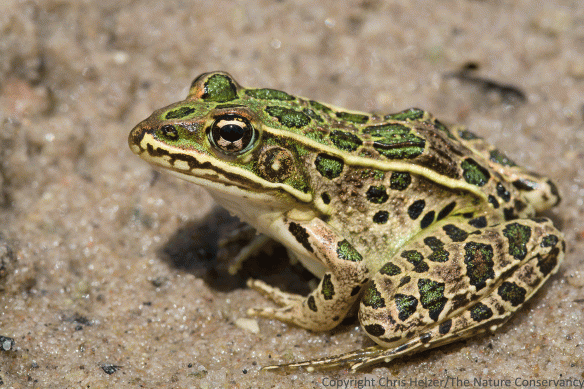
The northern leopard frog (Rana pipiens) is one of the “true” frogs. If you watch them carefully, you might notice that they carry their noses just a little higher in the air than other so-called frogs.

Regardless of labels, the plains spadefoot is a fascinating creature, and one that is rarely seen, even in states like Nebraska where it is considered to be common.  In fact, despite the fact that it’s a grassland animal, and I’ve been exploring and studying grasslands for about 25 years, I’d never seen one in person until last summer.  (Thanks to Keith Geluso, by the way, for finding one at The Niobrara Valley Preserve and allowing me to photograph it!).

The reason they’re rarely seen is that plains spadefoots spend the vast majority of their lives underground, emerging only during and after heavy rains between April and July.  They are known as “explosive breeders” because they have to breed and get their offspring to maturity very quickly.  It’s a race between tadpoles and the temporary rain-filled ponds.  To help ensure survival, there are two types of spadefoot tadpoles; herbivores and carnivores/cannibals.  If the tadpole’s pond comes and goes so quickly that no algae or other vegetation has time to grow, at least some tadpoles can still find food – even if that food consists of siblings.  Spadefoots can go from egg to mature in around two weeks if they have to, which is pretty impressive.

Except for the brief periods when plains spadefoots make an appearance to breed and feed, they basically live their lives underground, in a kind of dormant state.  Their “‘spadefoot” moniker comes from a dark hard “spade” on their rear feet, which they use to quickly burrow down into loose soil.  While it might seem crazy that spadefoots live almost all of their lives in dormancy, there are a couple nice perks associated with the strategy.  First, it’s a pretty slick way to avoid predators.  Second, it allows spadefoots to colonize areas of grasslands far from permanent water – they don’t need access to streams, ponds, or lakes like their other Anuran cousins.  Instead, they just sit in quiet solitude until a good hard rain, and then party down.  All things considered, that might not be a terrible life.

Spadefoots are stinking cute.

Many thanks to Dan Fogell, both for his excellent book, “A Field Guide to Amphibians and Reptiles of Nebraska”, and for helping me better understand the frog-toad-etc spectrum this week.
Prairies as Placeholders

Ecologically speaking, grasslands might be considered a “transitional community”.  In the absence of fire and/or drought, grasslands tend to progress toward a shrubby, and eventually woody ecological community.  For as long as prairies have existed in central North America, they have been restrained from making that transition to woodland by periodic drought and frequent fires ignited by both lightning and people.  While I consider prairies to be their own distinct ecological community, the fact remains that they are always trying to turn into something else.

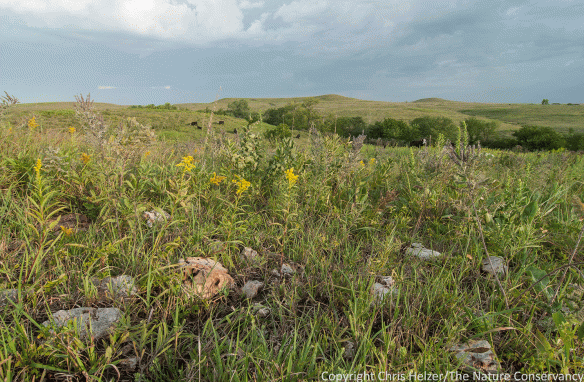
Flint hills prairie in Kansas is constantly moving toward shrubland, held back largely by frequent prescribed fire.

Maybe it’s not surprising, then, that modern human society also seems to view grasslands as transitional.  During a lecture here in Nebraska this week, Dr. David Briske, professor of rangeland ecology at Texas A&M University,  highlighted this phenomenon as part of his (much broader, and excellent) presentation.  If you think about it, humans are always trying to turn prairies into something else.

Prairies tend to be a placeholder until we can come up with something more useful to do with land.  We can plow up the prairie and raise crops in the soil.  We can cover the prairie with asphalt and concrete and create places to live and travel.  We can plant trees in the prairie to make it look better and provide better habitat for the wildlife species we most value.  We can come up with all kinds of replacements for prairie.

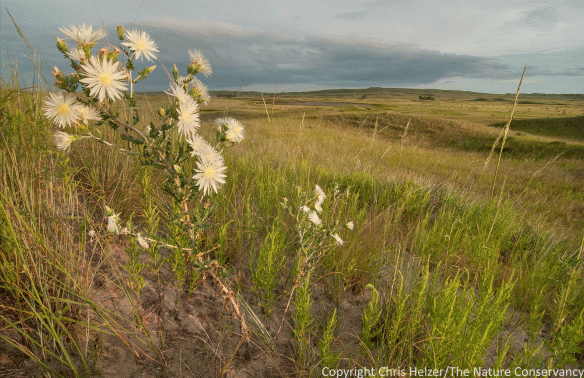
Mentzelia and Sandhills prairie.  The Sandhills is a great example of the subtle beauty of prairies, but also a landscape with a strong emotional pull for those of us who appreciate grassland.

There is certainly a need for cropland, and for houses, roads, and other developments that allow us to inhabit prairie landscapes.  I guess it’s even ok to plant a few trees around those developments to provide shade, shelter, and fruits/nuts (though we tend to take that WAY too far.)  However, I think it’s clear that the reason most prairies are “transitioned” to something else is that we don’t really see them as important in their own right.  “Surely,” we say, “we can come up with something better than THAT.”

So how do we change people’s minds about prairie?  We can make lots of arguments about carbon sequestration, water filtration, and pollinators, but we’ve been making those arguments for a long time and haven’t made much progress.  In fact, we continue to lose prairie at an alarming rate – not just here, but around the world.  Helping people understand the functional value of prairie is one thing, but we’re always going to be competing against the functional values of the alternatives (cropland, housing, roads, woodland, etc.) and so far, those alternatives are clearly more popular.  We’ve got to get people to appreciate prairies for what they are.

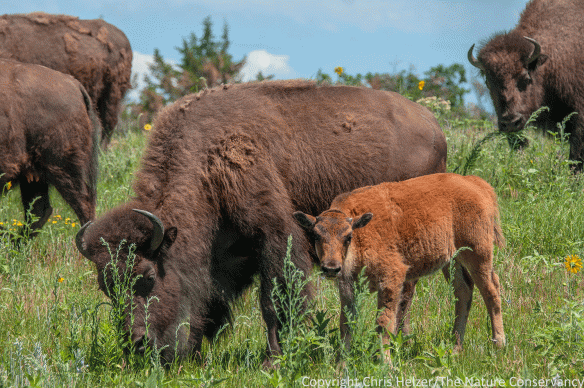
Bison are charismatic creatures and can be great ambassadors for prairie.  Unfortunately, only a small percentage of publicly-accessible prairies have bison, and they aren’t creatures you can easily (safely) get close to.

Katydids are easy to find in prairies, but lack some of the overt charisma of bison – at least until you get to know them a little better.

Sharing photos that highlight the beauty of prairie is a great tactic (feel free to use these), but those photos are most valuable as the first component of a longer process that ends with people hiking out into actual prairies to learn about them personally. It’s easy to dismiss grasslands as unimportant when you only see them as wastelands of grass that stand between you and the mountains or forests you really want to see.  It’s harder to dismiss them once you’ve gotten to know them a little better.

If we’re going to save the prairie we have left, we’ve got to move beyond purely functional/utilitarian arguments and get people to also see the cultural and aesthetic values of prairie.  Because the beauty of prairies can be subtle, it often takes a while for those unfamiliar with it to understand and appreciate that beauty.  As a result, those of us that know and love prairies have a deep responsibility to spread that appreciation to as many people as we can.  I’m not saying we have to go door to door, though maybe that wouldn’t hurt…  (“Have you heard the good news?”)