
I walked around one of our newer prairie/wetland restoration sites yesterday morning. The sun was just starting to punch some holes in low-lying fog and everything was wet. A cool and wet summer morning is usually a great time to find immobile insects and photograph them, but I for some reason I wasn’t seeing much as I walked. Not a dragonfly, not a butterfly, not even a big ol’ beetle… I did eventually find some bees encased in dew drops, waiting for the sun to emerge to warm and dry them.
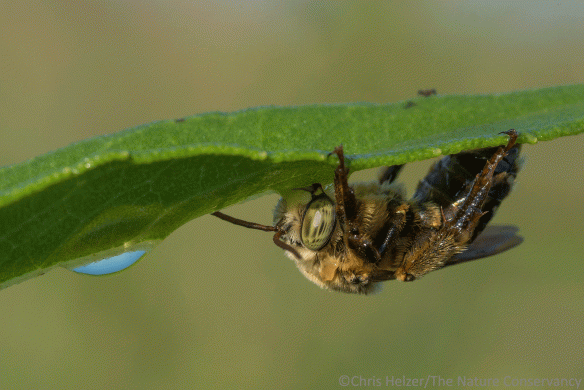
A sunflower bee (Svastra obliqua) hides beneath a wet sawtooth sunflower leaf while waiting for morning fog to completely disperse.
Unlike females, male solitary bees don’t have nests to defend and spend most of their days chasing around foraging females. When night comes, most species (except for a few night-feeding bees) just find a convenient place to shelter until morning. Many times, they seem to choose roost sites where they can be a little protected from potential predators, but other times they just end up on the exposed surface of a flower (the equivalent of falling asleep on their dinner plate, I guess). Most of the bees I saw yesterday were at least somewhat hidden- which is why I had to look pretty hard to find them, but there were a few out in the open as well, including the one pictured below.

This little fella (Melissodes agilis) looks like he fell asleep and became covered in dew drops while feeding on this rosinweed plant (Silphium integrifolium).
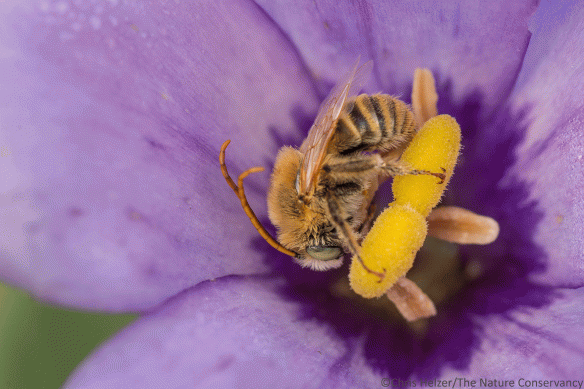
As I wandered along a wetland swale, I was admiring one of my favorite plants – prairie gentian (Eustoma grandiflorum) – when I happened to look down inside the blossom and spotted a fuzzy little bee. Because it seemed like a convenient and relatively safe hiding place for bees, I started looking into other flowers too, and sure enough, I found more bees.

An agile long-horned bee (Melissodes agilis) sheltering inside a prairie gentian blossom. The circular holes in the flower petals were made by a different kind of bee – a leaf cutting bee, harvesting materials for its nest construction.
All the bees I was seeing in the prairie gentian flowers looked like the same species to me, but I’ve become smart enough not to overestimate my ability to tell bee species apart, so I double checked with Mike Arduser. Mike confirmed that they are all male agile long-horned bees (Melissodes agilis), as was the bee I’d seen on the rosinweed flower. He said they appear to have just recently emerged, based on their fresh appearance. I’ll take his word for that and so should you.

There are actually three bees stacked on top of each other on this flower.
Mike also confirmed that the agile long-horned bees don’t have any particular tie to prairie gentian (they don’t specialize on its pollen or use it for nesting sites or materials). Instead, it just appears a number of them independently recognized the potential value of prairie gentian flowers as safe overnight roost sites. If I hadn’t been specifically admiring the gentian flowers, I’m sure I wouldn’t have noticed the bees. I’m guessing most predators wouldn’t have spotted them either, though if a smart predator had happened to find one then and decided to do what I did and check other flowers nearby, it would have had a pretty easy time filling up on bees for breakfast!
After hearing from Mike, I followed up with a series of questions I’m guessing even he can’t answer. Among those, I’m wondering if an individual bee returns to the same roost site night after night – assuming it isn’t disturbed while sleeping the previous night. If that hasn’t been studied, it seems like it would be relatively easy to do a mark and recapture study on them. The trick might be to catch the bees AFTER they leave their roost, though, so they don’t associate that roost site with being caught… Ok, maybe it wouldn’t be as easy as I was thinking. If you try it, however, let me know what you figure out!



 The Prairie Ecologist