
Pondering Winter Wildlife Cover From My Comfy Couch

It’s a good ol’ fashioned blizzard here today.  As I’m sitting snugly in my warm house, I’m feeling a little badly for some of wildlife out there in the snow and wind.  The boys went outside to play in the snow for a little while, and both of them spent most of their time building shelters from the weather.  Many wildlife species, of course, migrate to warmer places or find/build themselves underground burrows to overwinter in, but there are some animals out there in the prairie right now, and this has to be a bad day for them.
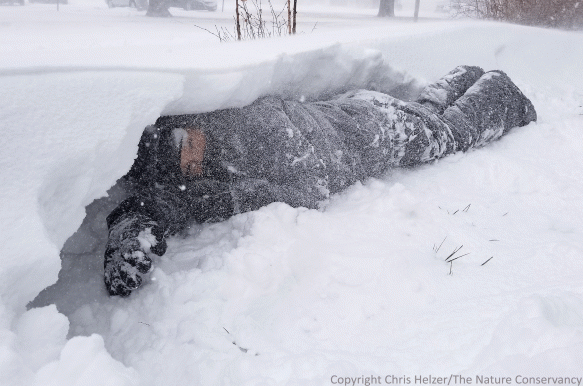
Calvin was able to dig out a little shelter in a drift. He was still pretty glad to come in and get some hot chocolate a few minutes later…

Sitting here on my comfortable couch, I’ve been thinking about the prairies I manage or help with, trying to remember what kind of cover is out there.  Overall, I feel pretty good about the situation.  Our shifting habitat mosaic approach involves providing a wide range of vegetation structure types in each of our prairies, including everything from short sparse vegetation to the kind of thick dense cover wildlife are probably seeking out today.  Nelson  (our Platte River Prairies land manager) and I have periodic conversations in which we try to envision ourselves as creatures that prefer various habitat types.  How far would we have to travel to find cover?  If we burn one patch of dense cover, where is the next closest patch of similar cover, and what would animals have to travel through to get to it?  We have a lot of factors to consider and balance as we discuss management plans each year, so it’s always helpful to see the world through the eyes of the various species that will have to live with (literally) the decisions we make.

To be completely honest, I probably don’t think enough about winter cover as I’m trying to consider the perspective of various creatures.  I’m more often thinking about nesting habitat for birds, breeding cover for small mammals, or sunning areas for invertebrates and reptiles that need to thermoregulate during the growing season.  Days like today are a great reminder that while all those considerations are important, at least some species will probably live or die based on what kind of shelter they can find during winter storms like the one roaring outside right now.
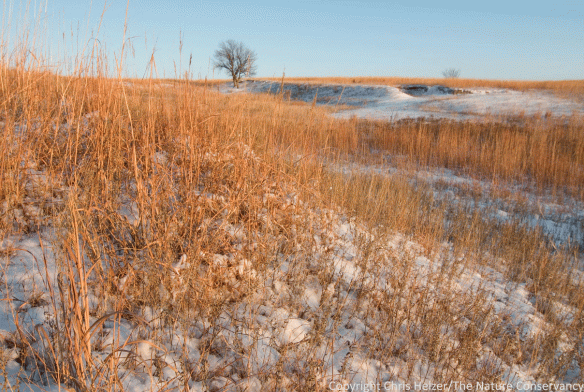
Many parts of our family prairie have pretty short vegetation structure during the winter, but we always try to leave some patches of taller grass as well.  This is kind of in-between.  It’s not really dense enough to provide great cover from the wind, but has places for small animals to hide while they’re out feeding.

I’m thinking today about meadowlarks, for example.  As I’ve walked our prairies during the last month or two, I’ve seen a lot of meadowlarks flying around in small groups.  My understanding is that meadowlarks that breed around here head south to Kansas or Oklahoma, and the ones we see during the winter come from up in the Dakotas.  In other words, meadowlarks don’t migrate en masse to one general destination.  Instead, each bird just goes a little southward from where they spent the summer.  I wonder if they each wait until they start seeing birds from the north show up and then head south to get away from the crowd…

Regardless, birds like western meadowlarks need some kind of shelter out in the prairie on days like this.  We know a lot less about the winter habitats used by grassland birds than we do about summer habitat use, and as far as I know, no intrepid biologist has yet gone out to see where meadowlarks or other birds are hanging out during blizzards.  (If you’re an intrepid biologist who HAS done this, please let me know!)  I think it’s fair to assume that most birds (and any other wildlife who aren’t underground) try to get out of the wind during this kind of storm.  It’d be interesting to know whether they stay in open grassland and look for tall dense vegetation or venture into brushy or wooded areas where they might not normally go.
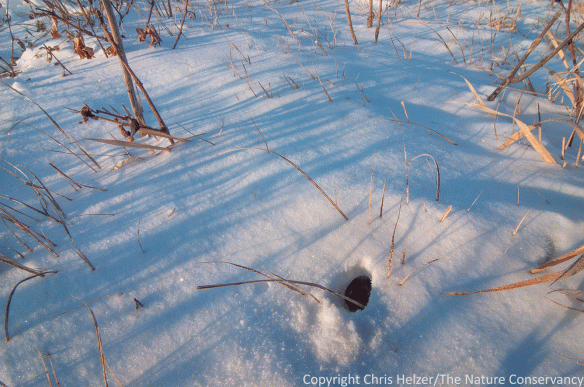
Somebody is apparently sheltering in place under the snow here.  Probably not a meadowlark…

Not knowing much about individual wildlife species and how they each choose to shelter from winter storms, I guess the best strategy is to provide as many habitat types as possible so they can all find what they need.  That way, meadowlarks can forage in short or “weedy” areas during pleasant sunny days, but move to a nearby patch of dense grass (or whatever other cover they like) when they need to nestle in thatchy vegetation and get out of the wind.

Here in our comfy house, we’ve been talking about trying to fix the drafty corner of our kitchen, where one of our walls needs a little better insulation.  Our poor little feet get cold when we’re making toast on windy winter mornings!  It’d be really nice to get that fixed.  On the other hand, it’s just the kind of hardship that helps me understand what meadowlarks are going through on days like this.  I bet their feet were cold at breakfast time too…
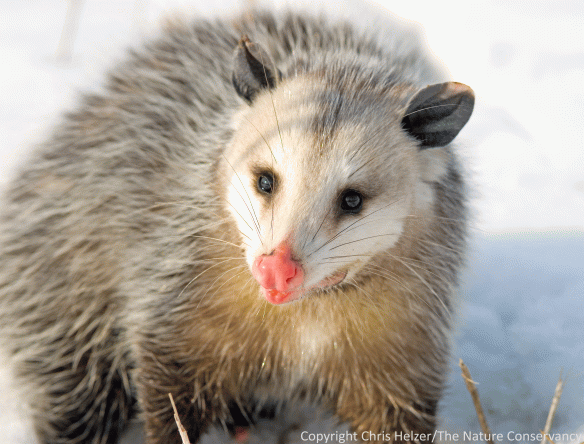
 

Meadowlarks could learn from opossums, who either take over abandoned burrows from other mammals or find a nice wood pile to shelter in during cold weather and blizzards.

Why Would Bison Have Done That??

I have an honest and earnest question:  What do we actually know about the movement and grazing patterns of historic bison herds in North America?

I’ve heard many similar versions of a story about the way in which historic bison herds moved across the North American prairie in pre-European days, but I’ve never been able to find someone who can substantiate it.  I’m not sure where the story (legend?) came from, but it seems to have become canon among many people in the grazing world.  It is particularly used by advocates of intensively managed grazing rotations, who say their grazing strategies mimic what bison did historically.

The most common variation of the story goes something like this: Back in the old days, bison herds were constantly on the move across the plains, grazing and stomping down the prairie as they went.  A bison herd would move into an area, stay briefly, and then move on – leaving behind short-cropped and trampled vegetation, which would get plenty of time to recover before another herd passed by.  The constant movement of bison was driven by humans, wolves, and other predators, who were constantly nipping around the edges of herds, picking off weak animals and keeping the herd moving.

I’m not saying the story is wrong, but I’m fairly skeptical.  Based on both observations and an impressive array of data from around the world, large grazing animals show a strong preference for recently burned and/or recently grazed vegetation.  The lush regrowth of grasses that have been recently burned or grazed is usually the easiest, tastiest, and most nutritious available, especially relative to undisturbed plants that are more mature.

This small area (a few hundred acres within a 12,000 acre pasture) of regrowth from a 2015 hay cutting became a predictable spot to find grazing bison during the remainder of that year and through 2016.  The animals visited the patch often, re-grazing many of the same plants over and over.  The Nature Conservancy’s Niobrara Valley Preserve.

In studies of patch-burn grazing, where cattle or bison are given access to both burned and unburned patches of vegetation, they graze spend something like 70% of their time grazing recently burned areas (and they stay on those areas most of the growing season), even when those burns make up a small percentage of the overall pasture.  The same pattern occurs in both small (a few hundred acres or less) and large pastures (10,000 acres or more).  These results are not coming from a few studies here and there; this is a large and comprehensive body of scientific research.  Bison and cattle are very good at optimizing their own diets, and when they are given the opportunity to regulate their own movements, without cross fences in the way, their optimal diet comes largely from recently burned and/or recently-grazed vegetation.

Given what we know about how bison and cattle (and many other large grazers) select their diets and grazing locations, how can that fit with the story I shared at the beginning of this post?  Why would bison have moved away from burned prairie into unburned/ungrazed grass that was more mature and less nutritious?  If they were forced to move from a particular place, why wouldn’t they have later circled back to graze the regrowth?  Many historic prairie burns, whether set by people or lightning, must have been of considerable size – probably plenty big to keep a herd of bison content for a full season, even if they were constantly bouncing around that burned area to stay ahead of predators.  No?  I just have a hard time imagining large areas of attractive, nutritious vegetation being sampled briefly by large herbivores and then abandoned and allowed to grow uninhibited for the remainder of the growing season.

I understand that much of our research on grazing patterns today is lacking the kind of predator pressure bison might have been under a few hundred years ago, and even a 10,000 acre pasture restricts the ability of bison to freely move across the landscape.  Given that, I’m open to the idea that movement patterns were different long ago than they are today.  Even so, I have a hard time imagining that bison wouldn’t have done everything they could to return to areas they knew contained high quality forage, even if they were being constantly pursued.  Can anyone provide some evidence to support that story?

In historic prairies, many patches of high-quality forage would have been transient (e.g., burned areas that were grazed for a season or so and then allowed to recover as bison switched to newer burns), but prairie dog towns might have represented a consistent supply of high-quality regrowth, and likely hosted fairly frequent visits from bison.

Even assuming (and I’m not) that bison herds were constantly on the move, never circling back to where they’d been earlier, it still seems unlikely that recently burned prairie would have been grazed for more than a few days and then just allowed to grow uninhibited for the remainder of the season.  Surely those burned areas (and later in the season, burned and previously grazed areas) would have been magnets for any other herd wandering nearby, and would have been grazed repeatedly (by a succession of nomadic herds) throughout the growing season?

Why does all of this matter?  In a way, it really doesn’t, other than for the sake of curiosity.  As I’ve discussed before, the way we design prairie management strategies should be based on today’s world, challenges, and objectives.  For example, it doesn’t make any sense to burn a prairie every three years just because we know that was the average historic fire frequency in that landscape.  The same is true with historic grazing patterns.  With increased levels of nitrogen deposition, woody plant encroachment, and habitat fragmentation, not to mention invasive species and climate change, today’s world is not the same as it was at whatever mystical point in history we might choose to try to replicate.  We have to manage today’s prairies in ways that make sense today.

Having said that, history does matter when it helps us understand how plant and animal species used to respond to the world around them, and what current adaptations and traits they have as a result.  That understanding can help us design and evaluate contemporary management strategies that fits with those adaptations.  It doesn’t mean we try to replicate history, it just means that we incorporate our understanding of it as we move forward.

Cattle seem to exhibit the same preferences for grass regrowth as bison.  These cattle are grazing in a burned patch in our Platte River Prairies this year.  That burned patch was grazed repeatedly and intensively all season while adjacent unburned areas were only lightly grazed.  The cattle were very selective, grazing mostly on their favorite grasses because of a moderate stocking rate.

If we’re going to incorporate a historic context into today’s strategies, however, we should make sure we’re as accurate as we can be about that history.  As I mentioned earlier, advocates of management-intensive grazing (and/or mob grazing, small cell grazing, and other similar strategies) mention the historic bison story often as a reason for managing cattle as they do today.  Because they contend that bison moved quickly across the historic landscape, never staying long in any one place, they propose that we manage cattle herds in that same way today.  I’m not saying those rapid rotation systems are right or wrong, I’m just wondering whether the historic context used to justify them is accurate.  I can’t understand why bison would have done what they’re supposed to have done, and would love to see evidence either way.

Even if bison were pushed off of areas they preferred, why wouldn’t they have returned later to take advantage of the nutritious forage?

I personally prefer the way prairies and wildlife respond to the kind of shifting mosaic approach we (mostly) employ on the sites I’m involved with, but that’s because I have a particular set of objectives, and I measure success based on those.  My personal guesses and extrapolations about how historic bison herds might have interacted with the landscape play a role in why I like our current approach, but they’re not really a major factor.  If I find out that historic bison acted very differently than I think they might have, I’ll appreciate that knowledge, but I’ll still evaluate our current strategies based on the objectives we have for today.  I will, though, pay closer attention to hints that species or natural communities might be showing stress due to exposure to conditions they’re not well adapted to.

Mostly, I’m just curious, and tired of listening to the same old story without knowing if it’s true.  Can anyone help me?

ADDENDUM:  Since writing this post a couple people directed me to this excellent article by Richard Hart that addresses my question fairly well.  Thanks to those of you who shared it!