
We are doing an intensive week of data collection at the Niobrara Valley Preserve this week. Yesterday, while I was leaning over to look at something, an insect landed on my clipboard. It looked like this (photographed later):
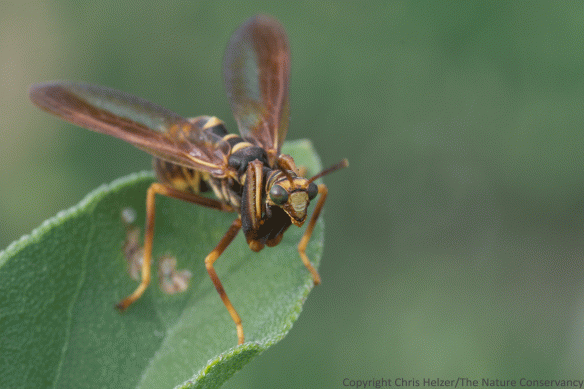
“Interesting,” I thought, “that’s an odd-looking paper wasp…”
Then I peered more closely at it and immediately decided I needed to capture it so I could take it back to the cabin and photograph it. Unfortunately, I didn’t have any bags or containers to put it in. All I had was my aluminum clipboard, which has a skinny compartment for storing extra data sheets. I very carefully nudged the insect inside and carried it back to the truck, where I transferred it to a nice roomy ziplock bag. When we got back to the cabin, I set the creature on a small sunflower plant and took about 230 (not kidding) photos of it. Here’s a nice one from the side:

Basically, I was looking at a wasp-looking insect with front legs like a praying mantis. I’m no entomologist, but I’d never heard of a wasp-mimic praying mantis in Nebraska, so I was confused. Also, mantids don’t have antennae, and this little critter had two of them, which it waved constantly and rapidly. What in the world…??
Fortunately, the modern naturalist has Google to fall back on, and once I got on the internet, it didn’t take long to figure out what this was. As it happens, it’s neither a wasp or a mantid. It’s actually a wasp mantidfly (Climaciella brunnea) which, by the way, is also not a fly! I’d heard of mantidflies, but I don’t think I’ve ever seen one in our prairies. They are fairly closely related to lacewings, and slightly more distantly related to antlions. Wasp mantidflies can be found throughout much of North America, but either they’re not super abundant on our prairies or I’ve fallen for their mimicry an awful lot.

As I photographed it, the mantidfly didn’t seem at all concerned with me, and started hunting ants – including this one, which it struck at but missed.
One of the constant themes of this blog is my sense of wonder at the kinds of discoveries I get to make just by paying close attention to the natural world around. me. Mantidflies are certainly no mystery to entomologists, and I’m sure numerous readers saw the first picture and knew immediately what it was. However, the wasp mantidfly was new to me, and has quickly added itself to the long list of amazing organisms I’ve gotten to know and admire. Perhaps the greatest joy of being an ecologist/photographer is that I keep finding new species to add to my list on a regular basis, despite having been a professional ecologist for 20 years and a nature enthusiast for my whole life.
What a tremendous world we live in!

 The Prairie Ecologist