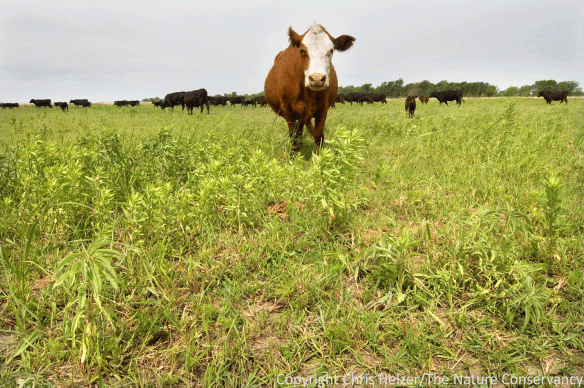
Photo of the Week – March 31, 2017

Prairie clover is a term that gets used pretty broadly among the public.  Ok, not necessarily the among the GENERAL public, but among people who have at least some idea what grasslands look like.  I’ve heard the term prairie clover applied to a number of different legume species, including sweet clover.  Botanically, prairie clover – as far as I know – refers only to plants in the genus Dalea, and including familiar species like purple prairie clover (Dalea purpurea) and white prairie clover (Dalea candida).

In Nebraska, we have eight species of prairie clover.  I finally saw large-spike prairie clover this past summer (though not in bloom), which means I’ve now seen all of them.  I’m still waiting for my certificate to arrive in the mail.  I’ve only been able to photograph five of the eight, but I’ll try to do better in the future.  Maybe I can earn the prairie clover photography patch someday.  (I’m just assuming that patch exists.  If it doesn’t, someone needs to answer for that.)

Purple prairie clover is well-known and well-distributed across Nebraska. It is a big favorite among bees, and while cattle will often eat it – especially under relatively high stocking rates – it survives periodic grazing very well in our prairies.

White prairie clover is also widespread across Nebraska and popular among pollinators. This one is hosting both a long-horned beetle and weevil.

While purple and white prairie clover are the best known of this group of wildflowers, the lesser known and more specialized prairie clovers are also worth seeing and learning about.  Golden dalea (Dalea aurea) has gorgeous yellow flowers, but you’re not likely to run across it unless you go searching for it in one of the scattered locations it occurs.  Hare’s foot dalea (Dalea leporina) is an annual prairie clover that is a real enigma to me, and I’ve only seen it in our restored prairies.  Silky prairie clover (Dalea villosa) might be my favorite of all.  It has beautiful long pale pink-lavender flowers and fuzzy sea-green leaves and is common throughout much of the Nebraska Sandhills, as well as other sandy places.

Golden dalea is a beautiful prairie clover found on prairie hillsides here and there around the state.
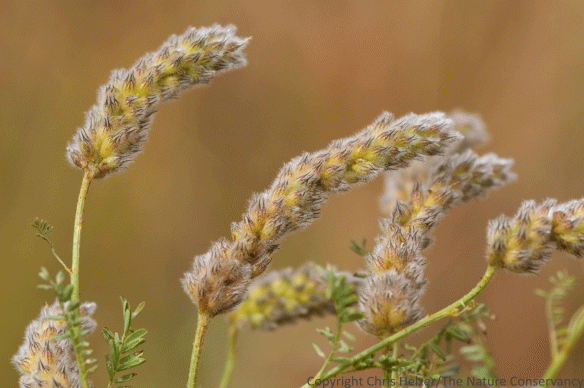
Hare’s-foot dalea, aka annual dalea, is not a showy prairie clover, but is still pretty. It comes and goes in our restored prairies, often responding positively during the recovery periods following bouts of fire and grazing.

Silky prairie clover has a subtle beauty that fits well in the sandy prairies it inhabits.

The remaining three species in Nebraska are large-spike prairie clover (Dalea cylindriceps), round-head prairie clover (Dalea multiflora), and nine-anther dalea (Dalea enneandra).  Round-head prairie clover just barely comes into the southern tier of Nebraska counties.  The other two are found in scattered locations around the state.

It would be hard to think of a group of wildflowers that contributes more to prairie communities than prairie clovers.  At least purple and white prairie clover provide very high quality forage for herbivores, including livestock.  Bees and other pollinators focus heavily on prairie clovers, and the pollen and nectar are abundant and easily accessible.  The seeds are big and nutritious, and eaten by birds, small mammals, and insects.  During drought years, purple and white prairie clover are among the wildflowers that are mostly still green and blooming, even when surrounded by brown crispy plants, so they keep contributing even in difficult times.  Oh, and of course, as legumes, prairie clovers are nitrogen fixers.  From a land manager’s standpoint, prairie clover is easy to harvest seed from, germinates easily in restored prairies, and survives well under our fire and grazing management here on the Platte River.

If you haven’t seen all the different prairie clovers in your area, I hope you get a chance to remedy that soon.  Personally, I can’t wait until summer wildflower season arrives so I can keep working toward earning that prairie clover photography patch.  Maybe I can talk my wife into knitting me a prairie clover-themed stocking cap to sew the patch onto!

(For you young people out there, a patch is a kind of decorative embroidered thingie folks used to sew onto their clothing to recognize an award or achievement, or to signify membership in a particular club or group.  Trust me, it was super cool.  Your friends would be impressed if you showed up to a party wearing one.)
Now You See Them, Now You Don’t (But They Might Still Be There!)

Grazing, especially by goats and/or sheep, is often promoted as a control method for weeds or shrubs.  Depending upon the life strategy of the weeds being targeted, grazing can be effective, but it’s important to set realistic objectives.  As you might expect, many perennial grasses, forbs, and shrubs have evolved strategies for surviving repeated defoliation.  In those cases, grazing may appear to effectively control plants while grazers are present, but the plants bounce back right after grazers are removed.

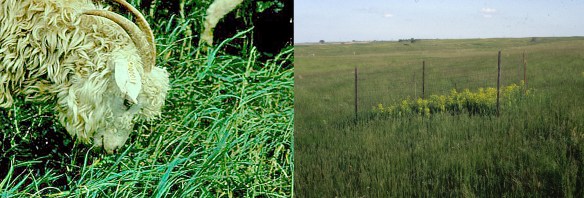
One of my all-time favorite research projects showcases this exact phenomenon at a site in South Dakota owned by The Nature Conservancy.  Back in the early 1990’s, an estimated 75% of the Conservancy’s Altamont Prairie Preserve was covered by leafy spurge (Euphorbia esula).  In 1994, goats and sheep were installed in separate pastures and spurge was treated by using periodic high-intensity grazing sessions during both early summer and early fall.  Both the goats and sheep were very effective at eating the spurge plants, and after five years, managers conducting walk-through inspections the site felt like excellent long-term control of spurge had been achieved.  Inside small exclosures, spurge was still abundant and vigorous, but outside the exclosures, almost no plants could be seen.  As a result, the goats and sheep were removed and everyone was happy.

One of the goats used at Altamont Prairie and an exclosure showing a dramatic difference between abundant and blooming leafy spurge in ungrazed areas and no apparent spurge in grazed areas. Photos courtesy of TNC’s Minnesota, North Dakota and South Dakota Chapter.

…Until the next season when spurge plants popped right back out of the ground and the pasture looked essentially as it had before the grazing treatment had started.  In dismay, the managers looked for another option and decided upon flea beetles (Apthona spp.), which ended up being a much more successful choice, greatly reducing the footprint of leafy spurge over the next several years.

You’d be excused for thinking the use of sheep and goats was a total waste of effort, but additional data collected at Altamont Prairie adds some interesting nuance.  As it happens, mean Floristic Quality (a kind of qualified plant diversity metric) stayed relatively stable within the grazed area during the five years sheep and goats were present.  During the same time period, mean Floristic Quality decreased significantly in exclosures.  In other words, while grazing didn’t eliminate the spurge problem, it may have stabilized some of its negative impacts for a while.

This, to me, is one of the best attributes of many grazing-for-weed-control efforts.  Even if grazing can’t eradicate many weeds/shrubs from a prairie, it might be a strategy that prevents further spread (eliminating flowers and reducing vigor for belowground reproduction) and/or reduces the weed’s ability to compete with desirable plants.  In a large site where more effective long-term strategies (such as selective herbicide application or biocontrol releases) aren’t feasible across the whole area, using grazing as a suppression tactic in some areas of the site while you kill it in others can make a lot of sense.  In other words, grazing might buy you time to work on a problem that would otherwise seem overwhelming in scope.  (However, it’s also important to remember that grazers will also be eating and suppressing the vigor and reproduction of desirable species with similar growth strategies to the invader you’re targeting.  If you do succeed in reducing populations of invaders, you might also reduce populations of those desirable plants.)

Grazing can sometimes provide effective control of short-lived plants if it prevents flowering and seed production and forces plants to die without reproducing.  Just remember that more seeds are likely waiting in the soil, so it will likely take repeated grazing treatments to reach your goal.  Here in Nebraska, we often use short-term intensive grazing as a tool to knock back the competitive ability of perennial cool-season grasses such as smooth brome (Bromus inermis) or Kentucky bluegrass (Poa pratensis).  We don’t expect the grazing to kill those grass plants (and it doesn’t) but we can allow other plants a chance to flourish for a few years until the invasive grasses regain their vigor.  By repeating the treatment periodically, we can maintain a more diverse plant community.

Periodic early-season cattle intensive grazing helps us temporarily suppress cool-season invasive grasses like smooth brome and reduce its ability to outcompete many native grasses and wildflowers.

Personally, I’ve never used goats or sheep to help with a management challenge.  In contrast with cattle, goats and sheep, feed preferentially on forbs, and I’m usually trying to suppress grasses and encourage forb growth.  However, I do think goats, sheep, and cattle can all play important roles in controlling invasives as long as you don’t expect them to do more than they can.  I worry that landowners and land managers can sometimes end up paying an exorbitant price to someone that brings animals in with the promise of weed control.  It’s important to remember that if you do that, you’re providing food for that contractor’s animals, and that should be factored into whatever price one of you pays the other.  When we use cattle for prairie management, the cattle owner always pays us.  That seems not to be the case with many goat grazing operations.  I’m not saying it’s wrong to pay someone to graze their goats on your land, I’m just saying it’s important to fully process what each party is getting from the transaction.  That includes the forage provided to the animals from your land, the time and expenses incurred by the owner of the animals, and  – importantly – the actual effectiveness of the treatment.

As long as you have clear objectives and a good understanding of the plant(s) you’re targeting, grazing may be a great tool for invasive species control.  Just remember one of the biggest lessons from the South Dakota spurge experiment: just because you can’t see the invasive plant anymore doesn’t mean it’s gone!