
Photo of the Week – December 9, 2016

Rocky Mountain bee plant (Cleome serrulata) is very pretty, for a weed.  It’s an annual plant that grows in disturbed areas like road edges and around livestock watering tanks.  In that sense, many people would call it a weed.  However, it’s also a beautiful native wildflower that can grow more than four feet tall and is a favorite among pollinator insects.
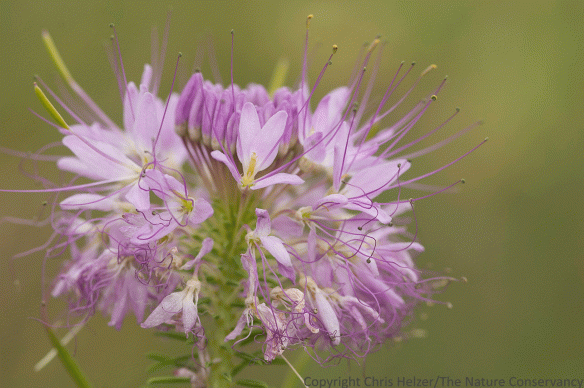
Rocky mountain bee plant in the Nebraska Sandhills.

Rocky mountain bee plant in the Nebraska Sandhills.

Around Nebraska, I see Rocky Mountain bee plant mostly in the western 2/3 of the state on sandy or loess soils.  It can colonize bare soil pretty quickly in young prairie restorations or after dirtwork projects, and also likes places where perennial vegetation is continually stomped down by cattle or otherwise severely weakened.  It doesn’t seem to withstand much competition, however, and usually disappears pretty quickly once other plants start to enter the scene.  In our Platte River Prairies, we see it often in the first year after we plant a restored prairie, but rarely after that.

More

Rocky Mountain bee plant with seed pods.

While it is not in the mustard family, Rocky Mountain bee plant’s long skinny seed pods that dangle beneath the flowers are certainly reminiscent of mustard plants.  (It is in the same order – Brassicales – as mustard plants.)  Interestingly, while the plant has an unpleasant smell and isn’t often eaten by herbivorous animals, there are many traditional uses by humans that include dyes, medicine and food.  It is also an extremely attractive plant to bees and other pollinators, and the seeds are readily eaten by birds.

Paper wasp

This paper wasp was feeding on nectar.
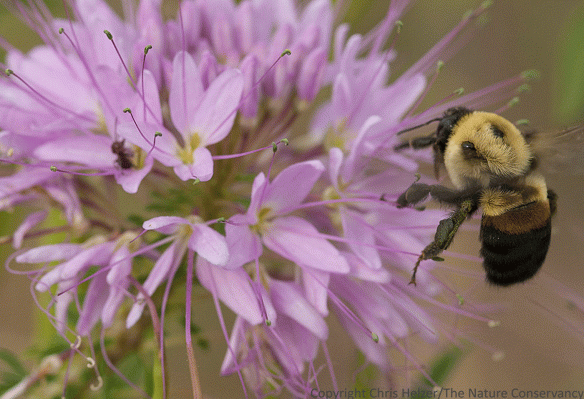
Bumblebee

Bees like this bumblebee (Bombus griseocollis) are particularly attracted to Rocky Mountain bee plant, as the name would suggest.

There are many plant species that colonize areas where other plants have been removed, weakened, or haven’t yet established.  It’s a really important role in nature, but one that is often underappreciated, and even denigrated – thus the label of “weed”.  Many colonizing plants lack pretty flowers, are spiny, or otherwise make themselves easy to dislike.  A few, though, are so attractive that even the staunchest weed haters might hesitate at labeling them as something bad.

Photo of the Week – December 1, 2016

Insect identification is unfair.

I came across this photo yesterday while looking through some images from last summer.  The photo caught my eye and I thought maybe I’d write a short natural history blurb about it and use that as my “Photo of the Week”.  My first task was to figure out what kind of butterfly is in the photo.  No problem.  I’ve got field guides and the internet.  How hard could it be?

A small

A small butterfly uses its long tongue to extract nectar from common milkweed at our family prairie near Stockham, Nebraska.  If you click on the photo you can look at a larger version of the image and get a better look at the tongue.

I’m no butterfly expert, but I spent parts of a few summers learning butterflies back in the late 1990’s and have held on to much of my knowledge from that time.  I can usually identify the more common butterflies by sight and narrow others down enough that I can pretty quickly use a field guide to finish the job.  Skippers can cause me some problems, but they can be difficult even for seasoned butterfly biologists.  (Skippers are like the sparrows of the butterfly fauna – little brown fuzzy jobs that all look about the same.)

My first thought was that the butterfly was a pearl crescent.  That’s a common butterfly species around here and it looks much like the critter in the photo.  I looked it up, but the spots on the underside of the wing don’t quite match up.  The butterfly in the photo has more white patches than those in the field guides and online.

Next, I looked at the Gorgone’s checkerspot, another species we see quite a bit here.  No luck there either.  The patterns on the underside of the wings are really different from the butterfly in my photo.  I looked at the “Butterflies of Nebraska” and “BugGuide” websites and browsed through a number of other choices, including some species that only show up occasionally in the state.  Still no luck.  Frustrated, I left for a meeting, figuring I’d try again later.

By complete coincidence, my meeting today was about pollinator monitoring strategies, and the first two people I ran into were both butterfly experts.  Aha!  Since we had a few minutes before the meeting started, I grabbed my laptop and pulled up the photo in question.  They both stared at it, but neither gave me a quick answer.  I felt both better (it’s not just me!) and worse (come on, man, this isn’t supposed to be this HARD!).

After some hemming and hawing, the conclusion was that it’s probably some kind of crescent (Phyciodes sp.) but they couldn’t do any better than that.  To be fair, neither of them had access to field guides and it was a surprise question.  Still…  One of the biologists pointed out that not only do male and female crescents have different patterns, there can also be significant differences in patterns between different generations within the same summer.  What??

As a result of all this, I’m stuck not being able to tell you much natural history about this pretty little butterfly other than it’s probably some kind of crescent.  Interesting, huh?  About 30 minutes of my poking around in books and online, two butterfly experts looking at my photo with me, and that’s the best we’ve got.  Well, that and one unarguable conclusion:

Insect identification is unfair.