
Former Hubbard Fellow Evan Barrientos came back for a visit last week and the two of us wandered around with our cameras for a couple hours on a wet foggy Saturday morning. (Quick reminder – applications for the next round of Hubbard Fellows are being accepted NOW – click here for more information.)
It was a beautiful morning, and we spent the bulk of our time in a prairie Evan had helped create while he was working for us. Despite its young age (3rd growing season), the prairie already has a lot going on. Plant diversity is looking good and invertebrates seem to be colonizing nicely. Among those colonizers are a lot of spiders, and a foggy morning is a great time to see and photograph spider webs. I spotted webs of several different species, but ended up photographing mostly webs created by a couple different species of (I think) longjawed orb weavers (Tetragnatha sp.). I photographed much more than just spiders during those couple hours, but some of the longjawed orbweaver shots ended up being my favorite images of the day.

A longjawed orb weaver sits poised on its dew drop covered web, warming itself in the sun.
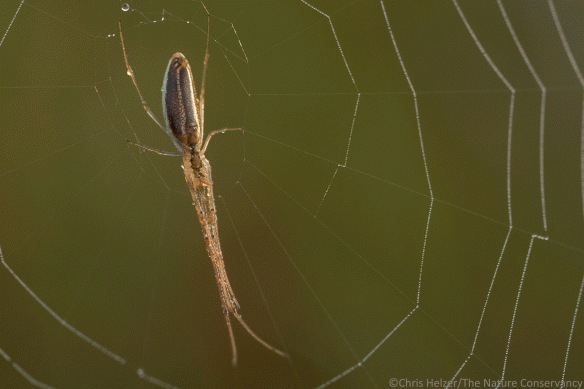
Early morning diffused light beautifully accented both spiders and their webs.
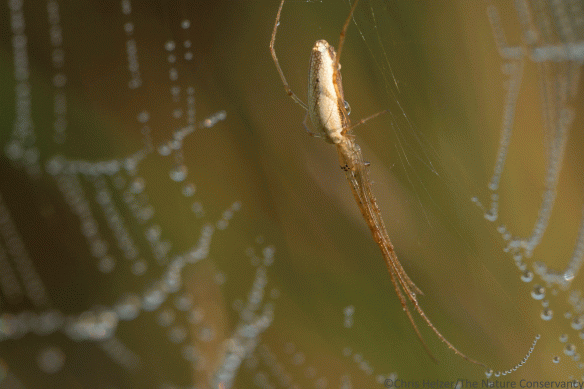
This is the same individual as in the first photo above, but from the other side of its web. The spider was being very patient with me – and I was being very slow and deliberate in my approach to it.
The following three photos were taken within a minute or so of each other. I couldn’t decide between them, so have included all of them. I’m curious to know if any of you have strong preferences between them. I think I like the first and third best, though the second is really nice too. See what I mean?

Spider 1
The pose of this spider is common among many skinny long-legged spiders. When inactive, or in the presence of a potential threat, they cozy up to a grass leaf or plant stem and almost seem to melt into it. This one was in its hiding pose when I first spotted it. Judging by the dew droplets still affixed to its legs, I’m guessing it spent the night in that pose, but I’m not sure.
Between the first and second photo, I carefully held out my hand near the web and the spider shifted slightly away from it, moving a little more toward my camera, and into the light. This is a really handy trick for slightly repositioning insects and other invertebrates for photos. It always works spectacularly, except when it fails even more spectacularly and the subject hops, drops, or otherwise flees.

Spider 2
As I was photographing the spider in its new, more illuminated position, it suddenly stretched out its legs – as if it was yawning. I squeezed off a couple quick shots before it returned to its original position.

Spider 3
The chance to photograph spiders on dew-covered webs always feels like a gift. The conditions have to be just right – including near-zero wind velocity. Late summer seems to be the time when an abundance of spider webs corresponds with an abundance of calm foggy/dewy mornings. On those mornings, I tread carefully through prairies, trying hard not to blunder through webs, but knowing I will anyway. I find most webs by looking toward the sunlight so that the glowing backlit dew-covered orbs stand out against a darker background.
Most webs are close to the ground, surrounded by tall vegetation, making them nearly impossible to approach without jiggling the web, and either breaking it or scaring the spider away – or both. To add to the difficulty, most spiders sit on the downward slanting side of their web, with their eyes facing down and away from the sun. I always like to feature the faces of invertebrates when I can, but it’s not always possible to find a camera angle that works with web-weaving spiders.
The first three photos above were taken of webs that were along a restored wetland swale, where vegetation was relatively thin and I could fairly easily slide my tripod close to the spiders. The last three were of a web that was placed at nearly head height – something I don’t see very often.
Oh, I did take photos of Evan too, but he wasn’t covered in dew and sitting on a glistening orb-shaped web, so he didn’t make the cut for this blog post.


 The Prairie Ecologist