
I’ve never had any formal visual art training, notwithstanding my elementary teachers’ efforts to show me how to color within the lines. When I started getting serious about photography, most of I what I learned was from books and photographers who were kind enough to offer helpful critiques of my work. In my early days as an insecure nature photographer, I spent a lot of time paging through magazines and how-to books, looking for photos I liked. Then I tried to mimic those compositions in my own work. I was also very earnest in my attempts to learn and follow the rules of composition mentioned in photography books and magazines.
One particular rule I remember reading about said that when photographing animals, you should always have them looking in toward the center of the photo rather than out toward the edge of the photo. For example, compare these two photos of an upland sandpiper (actually one photo that I cropped in two different ways for illustrative purposes).

In the top image, the bird’s eye is near one of the “power points” of the rule of thirds, so it conforms to that particular rule. However, because the bird is on the right side of the frame and looking toward the right, the photo seems unbalanced. In the lower image, the placement of the bird on the left side leaves it more space, and most people probably feel the bottom image is the better composition of the two. If nothing else, the top image creates a kind of mental tension, in which the viewer feels there’s something wrong, or at least uncomfortable, about the composition.
Creating tension or discomfort, of course, can sometimes be a powerful strategy for artists, and can set their work apart from that of others. As for me, though, I’m not really much of a risk taker when it comes to composition. In fact, I looked back through quite a few of my photos as I was thinking about this blog post, and couldn’t find many where I had intentionally created a visually jarring composition. For better or worse, my objective is usually to draw people into a natural world they might not otherwise become familiar with, so making them uncomfortable seems counterproductive.
I don’t do a lot of traditional wildlife photography; I spend much more time photographing insects and flowers. As far as I can tell, the aforementioned rule about having an animal look toward the center of an image seems often to apply to flowers too, which is a fascinating thing to ponder. As viewers, are our minds projecting an imaginary face onto flowers, driving our expectation of how those flower photos should be composed? Or is composition more driven by other factors, such as the curvature of the flower stems or the balancing of subject matter?

Consider the stiff sunflower image above, one of my favorite flower photos. It would look odd (wrong?) if the flower were moved over to the right half of the image, right? Is that because we ascribe a face to the flower and expect it to look in a certain direction relative to the photo composition? Or is it just because of the way the curving line of the flower bends pleasingly toward the center in this photo, rather than away into nothingness if it were moved to the right? Regardless, there’s something important about keeping the flower on the left side.

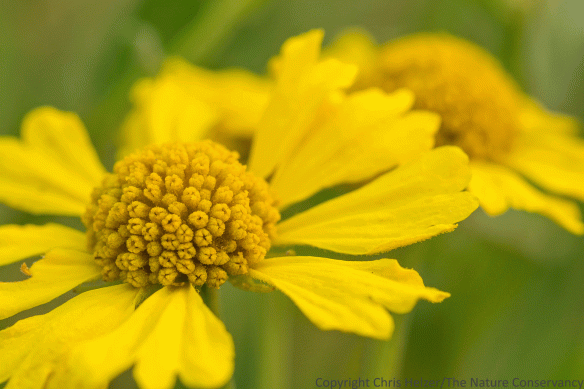
Now look at this photo of two Maximilian sunflower blossoms (above) I took last week. The closer flower is the focal point of the image, and its “face” is “looking” toward the center of the photo. The photo seems pretty balanced this way. Compare that to the photo below, in which that same focal flower is moved over to the left. It seems to be breaking the rules, yes? Both photos have a second blossom in the background to balance the one in the foreground, but the second photo is still a little jarring because of where the face of the main flower is pointing.

Here’s the thing, though… I think I like the second photo at least as much as the first, and maybe better. There’s a slight tension in the image that I don’t think is too distracting, but instead makes the image interesting. It makes me want to see more, to see what the flower sees. Am I crazy for thinking the second is the more captivating of the two images?
…Good grief, does this mean I’m moving toward becoming a provocative art photographer??
The next thing you know, I’ll be putting horizon lines right smack in the middle of photos solely because the rules tell me not to. Even worse, I’ll start writing long self-absorbed blog posts exploring the artistic choices I make when creating images…
…oh, wait…
Dang.




 The Prairie Ecologist