
Photo of the Week – June 23, 2017

This is a good year for sensitive briar (Mimosa quadrivalvus) in the Platte River Prairies.  Sensitive briar is a spiny perennial legume that sprawls across the ground in dry prairies and has leaves that fold up when touched or blown about by the wind.  It’s an odd plant, and one that is hard to miss when it’s blooming because each plant has numerous pink flower balls scattered across an area about the size of a large bathtub.
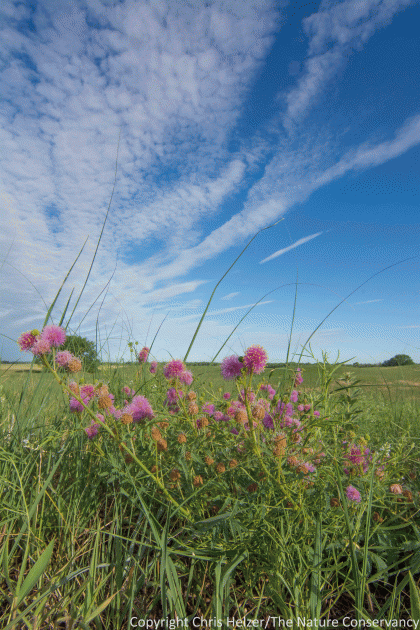
A sensitive briar plant blooming on a sandy hill this year in the Platte River Prairies.

Sensitive briar is named for the sensitivity of its leaves to touch, but it must also be sensitive to moisture conditions or something else.  As I was preparing to write this, I scanned through my field notes because I remembered sensitive briar being extra abundant a few years ago as well.  I was right; I’d noted an extraordinary number of plants back in 2011.  In fact, I wrote a blog post about it!  I don’t have any better explanation this year than I did back in 2011 for why this perennial plant seems to ebb and flow so much in abundance.

This katydid nymph was one of many insects enjoying the abundance (and easily accessible pollen) of sensitive briar this year.

Maybe the ebb and flow is mainly about flowering, and many of our sensitive briar plants just don’t bloom every year.  The only thing giving me pause is an experience we once had with a large plot of sensitive briar plants in our seed production garden.  One year, we thought all the plants had died because they didn’t even come out of the ground that spring.  We wondered if they’d been accidentally sprayed or something the previous year.  Fortunately, we didn’t till the plot up and start over because the next year it was filled with mature sensitive briar plants again!  It’s not that I’m looking for more data collection projects to work on, but it would sure be interesting to mark some plants in our prairies and track them over 10 years or so to see what’s going on…

Just one more fun prairie mystery to solve!
Exotic Beauty

Early in my career, I felt pretty strongly that only native plants should be in the prairies I managed.  Pretty quickly, I realized I didn’t have enough time to eradicate the worst invasive plants from our sites, let alone worry about some of the more innocuous non-native plants.  In fact, I found some of those non-native plants could be pretty valuable (e.g., dandelions and their early season resources for pollinators).

I began to take a much more pragmatic approach to managing plant communities, working to suppress species that tended to form monocultures or become dominant enough to suppress the diversity of plant communities.  Some of those dominant/aggressive species included non-native invasive grasses and woody plants, but also some native species such as big bluestem, eastern redcedar, smooth sumac, and rough-leaved dogwood.  A plant’s status as native or not became less important than how it affected the diversity and function of the plant community it was part of.

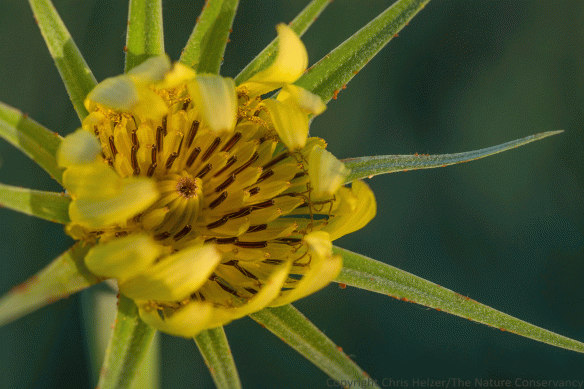
A goatsbeard flower opening at sunrise.  Niobrara Valley Preserve.

One non-native plant I’ve always gotten along with pretty well is goatsbeard, aka western salsify (Tragopogon dubius).  Sure, it wasn’t here before European settlement, but it isn’t aggressive and has simply added itself to the plant diversity of many of our prairies.  Also, it’s really pretty (though so are many nasty invasive plants).  Both when it flowers and when it goes to seed, goatsbeard makes an attractive photography subject.

It’s fun to stick a macro lens into a goatsbeard seedhead, which resembles a fist-sized dandelion head, and try to create interesting abstract images.  Goatsbeard seedheads were one of my favorite subjects when I first started playing with close-up photography about 25 years ago, and they still attract me today.  I never get tired of looking at those big fuzzy parachute-style appendages attached to the seeds.

Becoming less of a snob about the native status of plants has made my life a little less stressful.  There are plenty of plant species that require serious attention in order to maintain healthy, diverse, and resilient prairies.  Worrying about whether a plant was here 200 years ago is the least of my worries.  Now when I walk around a grassland, I’m comfortable greeting species like dandelions, goatsbeard, and lamb’s quarters as friends (while still trying to eliminate problematic non-natives such as crown vetch, Siberian elm, and Canada thistle).