How Small Is Too Small?

What’s the minimum effective size of a prairie?

For example, can a prairie be the size of a kitchen table?  Let’s say someone converted a landscape full of prairie to an immense gravel parking lot, leaving only a round kitchen table-sized parcel of vegetation in the middle.  Is that tiny isolated parcel a prairie?

The question might seem silly, but the question became a useful little thought experiment for me.

That little parcel certainly wouldn’t be big enough to meet the needs of most prairie animals.  Birds, small mammals, snakes, and even smaller creatures like grasshoppers and bees would be unable to find enough food to survive within that small area.  The loss of those animals would affect many of the ecological services and functions that make prairies work.  Those services include pollination, nutrient cycling, herbivory and more.
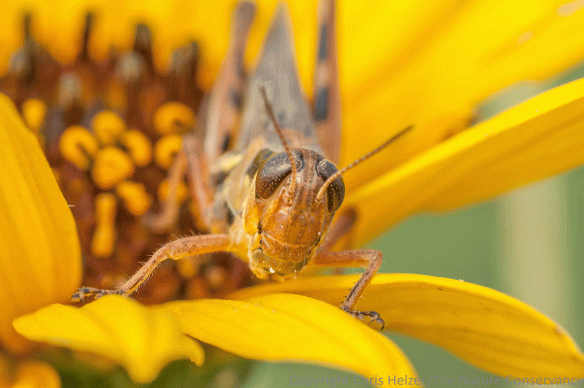
Even small creatures like grasshoppers would have a hard time surviving in a patch of plants the size of a kitchen table.

Some tiny herbivorous invertebrates might be able to survive in that little parcel of vegetation, but probably not enough of them to support most predators that feed on them.  The lack of predation would allow those invertebrate populations to grow much larger than they otherwise would, leading to significant damage, or even mortality, to the plants they feed on.  Once their food is gone, the invertebrates would starve and die as well.

Plants that manage to survive invertebrate attacks and an absence of pollinators in our little parcel would still face major challenges.  In the long-term, they would probably suffer from a huge genetic bottleneck because they don’t have other individuals of their species to cross breed with.  In the meantime, it would take a lot of intensive and thoughtful management to keep them alive.
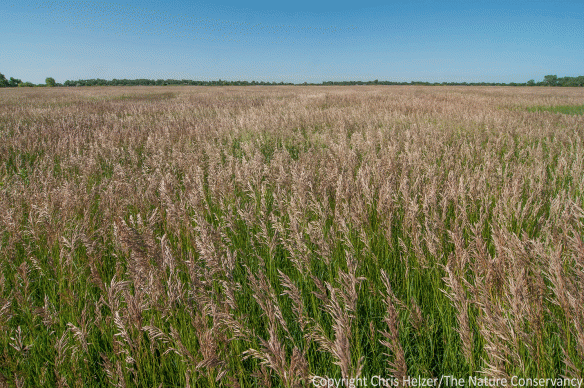
Smooth brome and other invaders can quickly dominate small prairie patches without constant vigilance and suppression.

Invasive species management would be a huge problem because it wouldn’t take long for an aggressive invader to quickly dominate that small area.  Quick action would be needed to remove invasive plants as they arrive.  Fire or mowing would also be needed to prevent a smothering thatch from accumulating as plants grow and die back each year.  Unfortunately, every fire would kill most invertebrates aboveground at the time and destroy their food sources.  We could try to burn only a portion of the parcel and save some of the insects, but with such small populations, we’d still probably lose most species eventually.  Mowing and raking might be an alternative, but we’d still end up removing either the invertebrates or their food sources.

Ok, so we’d just have to live without most prairie animals, but we’d still have plants.  Or at least a few of them.  Some of those plants would be more competitive than others, especially in an animal-less environment, so it would take a lot of effort to keep them from pushing the less competitive plants out.  And, of course, we’re assuming the mysterious belowground processes that allow plants to survive would still function in our tiny parcel – microbial relationships that allow plants to access and process water and nutrients, for example.  If those are sufficiently intact, we’d have some plants.

Would that be a prairie?

I’m pretty sure no one would argue that a kitchen table-sized area containing few plants is a prairie.  Even in the first moments after the parking lot was created, I would argue the remaining patch of vegetation had ceased to be a prairie, even though it still contained a reasonable diversity of plants and animals. It wasn’t really a prairie anymore, just a doomed fragment of its former self.

If we can agree that a kitchen tabled-size patch of land is too small, how big would we have to make that patch before we’d be willing to call it a prairie?  What species and/or ecological processes should we use as criteria?

Can we agree a prairie needs to be big enough to support a healthy pollinator community?  Does it need to be able to sustain viable populations of small mammals, snakes, leafhoppers, spiders, and other little creatures?  Is it a prairie if it doesn’t have a full complement of grassland bird species?  Does that requisite bird community include larger birds such prairie chickens or other grouse species?  What about at least moderately-sized predators such as badgers and coyotes (or even bigger ones) or large ruminants like bison or elk?  Which of those components are we willing to live without, and more importantly, which can a prairie live without and still sustain itself as an ecological system?  A prairie without badgers, coyotes or bison is functionally different than one with those animals, but is it a non-prairie or just a different kind of prairie?
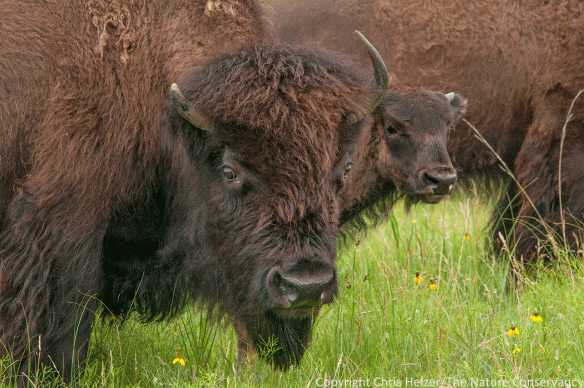
Bison herds need very large prairies, but we don’t know as much about the amount of land needed to sustain populations of bees, leafhoppers, jumping mice, or even genetically viable plant populations.

Even if we reach consensus on the key components of a prairie, we’re still hamstrung by our lack of information about how big a prairie needs to be to support each of them.  We have decent data on the prairie size requirements for many grassland bird species, but beyond birds, we’re mostly just guessing.  If we want the full complement of species, including bison and other large ruminants, we’re going to need thousands of acres, but how many thousands?

More importantly, what does this mean for the many remaining patches of prairie vegetation too small to support whatever we decide are the key components of a prairie?  It certainly doesn’t make them worthless, but it might be important to make sure we’re viewing them realistically.  What are the likely ramifications of the missing components?  The absence of prairie chickens or upland sandpipers might be disappointing, but might not have the ripple effect that the absence of pollinators or coyotes might have.  Can we identify and compensate for the absence of key prairie components by managing differently or more intensively?  If not, how do we adjust our vision of the future for that prairie parcel, and how does that adjusted vision affect how much management effort we invest?  (You can read more about the challenges of managing small prairies here.)

For many of today’s small prairie patches, the only chance of preserving their species and ecological functions is to make those small patches larger and/or more connected to others.  Restoring adjacent land back to high-diversity prairie vegetation allows formerly landlocked populations to expand and interact with others, and creates enough habitat for larger animals to survive.  Identifying potential restoration opportunities might be the highest priority conservation strategy for those of us working with small prairies.

Reasonable plant diversity and the presence of larval host plants like this prairie violet have so far allowed our family prairie to support a population of regal fritillary butterflies, but the small size and isolated nature of our prairie means if the butterflies have a bad year, they could easily disappear and never return.

Our family prairie is a little over 100 acres in size, is managed with large ruminants (cattle), and has regal fritillary butterflies, coyotes, badgers, upland sandpipers, and even an occasional prairie chicken.  However, I’m certainly not comfortable that our 100 acre island within a sea of cropland will to sustain a prairie ecosystem indefinitely.  This thought experiment has forced me to think more seriously about prospects for increasing the size of our prairie and building connectivity to other grasslands.  I hope it’s useful to others as well.
A Milestone for Prairie Restoration

Because conservation work can sometimes seem like blowing into the wind, it’s important to pause periodically to celebrate progress.  For example, I am really excited about what has been accomplished in the field of prairie restoration.  We’ve known for a while that we can convert cropland to prairie vegetation with a high diversity of plant species (150 or more species per planting), and that we can do that on a scale of thousands of acres.  The Nature Conservancy has large projects in states like Indiana, Illinois, and Minnesota where restored prairie landscapes now range from about 5,000 to 20,000 acres in size.  The U.S. Forest Service is transforming an old U.S. Army Arsenal into 20,000 acres of prairie in Illinois.  Prairie Plains Resource Institute, the organization that pioneered restoration techniques in Nebraska, is planting up to 1000 acres a year now and has established well over 10,000 acres total across the state.

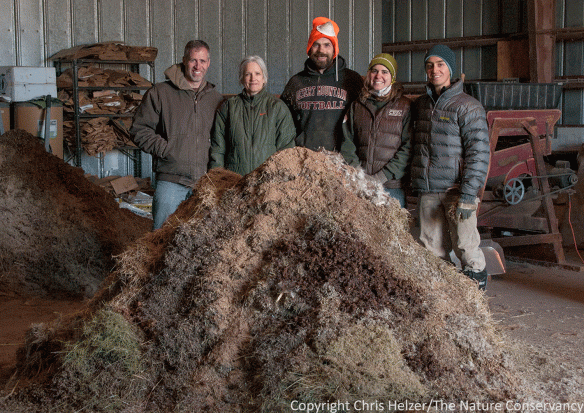
Our staff celebrates a successful year of seed harvest back in 2015.

Our staff celebrates a successful year of seed harvest back in 2015.

Here in our Platte River Prairies, we’ve restored more than 1,500 acres of cropland to prairie.  That’s not insignificant, but more importantly, we’ve been testing the idea that those restored prairies can help defragment the ecological landscape around them.  Habitat fragmentation is one of the largest threats to today’s prairies because it shrinks and isolates populations of species, making them vulnerable to becoming locally extinct without the chance of recolonization from nearby sites.  The real promise of prairie restoration is that it can enlarge and reconnect scattered remnants of native prairie, providing populations of animals and plants a much better opportunity to survive and thrive.  It’s not feasible or desirable to convert the majority of cropland in the central North America back to prairie, but there are particular sites where strategic restoration work could make a huge difference in the potential survival of prairie species and ecological services.

In order for prairie restoration to help defragment landscapes, restored prairies have to provide suitable habitat for the species living in small isolated prairies.  Many bees and other insects specialize on certain plant species, for example, and other animals rely upon an abundance of prey, a diversity of seeds, or other particular food or habitat conditions.  Satisfying the individual needs of all those prairie animals is a critical measure of success if prairie restoration is going to successfully stitch isolated prairies back together.

Over the last several years, we’ve been collecting data to see whether the species of bees, small mammals, grasshoppers, and ants in our unplowed prairie remnants have moved into adjacent restored habitat.  The results have been very positive.  While not every species of animal living in our remnant prairies has been found in nearby restored habitat, we’ve found the vast majority of those we’ve looked for.  We suspect that most of the remaining species are also present but that our limited sampling effort just hasn’t yet picked them up.  We’ll keep trying.

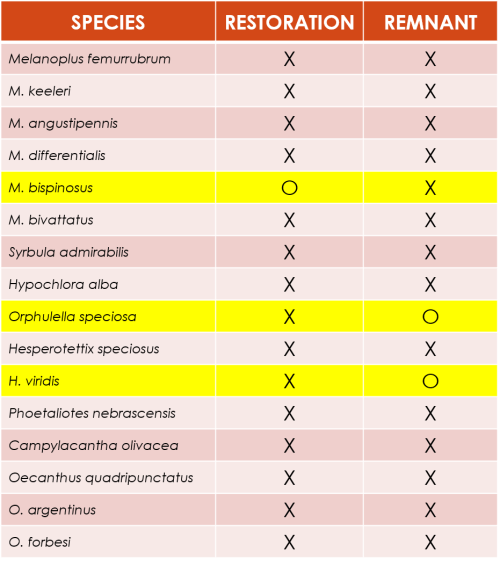
Dillon Blankenship, a Hubbard Fellow, compared grasshopper, katydid, and tree cricket communities on three pairs of remnant/restored prairies back in 2014. Almost all species were present in both restored and remnant habitats. In the three species that weren't, only one or a very few individuals were found, so it's likely just a sample size issue.

Dillon Blankenship, a Hubbard Fellow, sampled grasshopper, katydid, and tree cricket communities on three pairs of remnant/restored prairies back in 2014. Almost all species were present in both restored and remnant habitats. In the three species that weren’t, only one or a very few individuals were found, so it’s likely just a sample size issue.

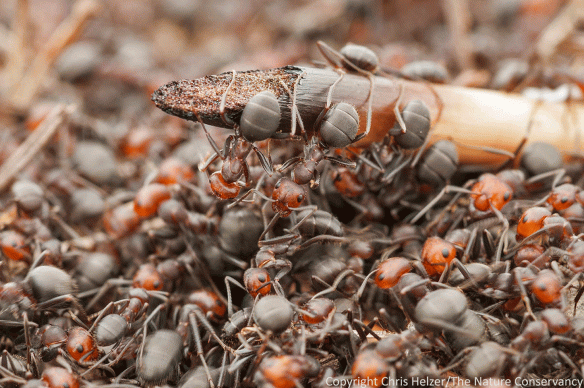
Data from James Trager and Kristine Nemec has helped us compare ant species composition in restored versus restored prairies along the Platte River. So far, we've documented 30 species and only one has been found exclusively in remnant prairie (and, again, it's likely to be a sample size issue).

Data from James Trager and Kristine Nemec has helped us compare ant species composition in restored versus restored prairies along the Platte River. So far, we’ve documented 30 species and only one has been found exclusively in remnant prairie (and, again, it’s likely to be a sample size issue).

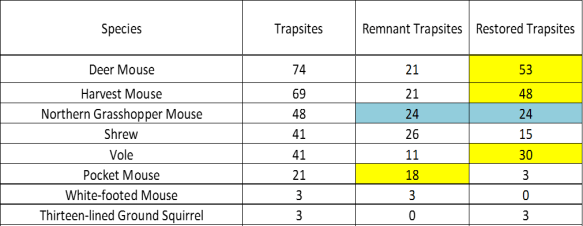
Master Naturalist Mike Schrad and Hubbard Fellow Jasmine Cutter have both helped us compare small mammal populations between restored and remnant prairies. This table shows some of Jasmine's data from one site. In general, we're finding that the same species are in both restored and remnant prairies, but the relative abundance of those species is often different - with some apparently favoring remnant habitat and others favoring restored areas.

Master Naturalist Mike Schrad and Hubbard Fellow Jasmine Cutter have both helped us compare small mammal populations between restored and remnant prairies. This table is from Jasmine’s data from one site, showing the number of trapsites in which each mammal species was caught back in 2014. In general, we’re finding that the same species are in both restored and remnant prairies, but the relative abundance of those species is often different – with some apparently favoring remnant habitat and others favoring restored areas.  We’re now looking at how our management affects presence and abundance of each species through time.

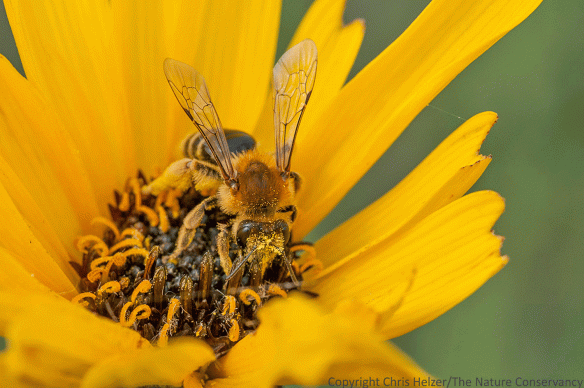
We've had several research projects look at native bees in our prairies. Mike Arduser, Anne Stine (Hubbard Fellow), Bethany Teeter, and Shelly Wiggam Rickets have all helped us compare restored and remnant prairies. So far, we've found over 72 species and the vast majority have been in both remnant and restored prairie.

We’ve had several research projects look at native bees in our prairies. Mike Arduser, Anne Stine (Hubbard Fellow), Bethany Teeters, and Shelly Wiggam Rickets have all helped us compare restored and remnant prairies. So far, we’ve found over 72 species and the vast majority have been in both remnant and restored prairie.

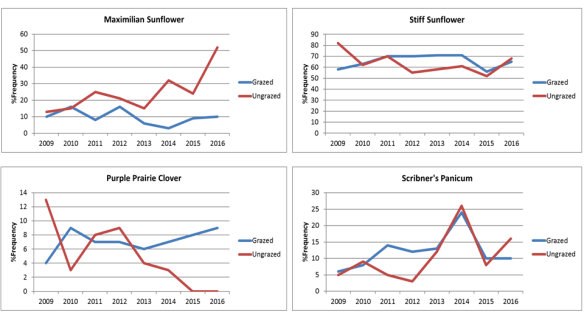
I've collected more than 15 years of data showing that plant diversity and the frequency of occurrence of prairie plant species has remained stable through time. These four graphs show four species in one restored prairie where we're comparing fire/grazing management to fire only management.

I’ve collected more than 15 years of data showing that plant diversity and the frequency of occurrence of prairie plant species has remained stable through time. These four graphs show four species in one restored prairie where we’re comparing fire/grazing management to fire only management.  The long-term persistence of prairie plants and diverse plant communities is critically important for plant communities, but also for the success of efforts to defragment habitat for animals.

These results mean that where prairie landscapes have been largely converted to row crops, we don’t have to just watch while insect or small mammal populations careen toward local extinction in tiny isolated prairies.  We’ve shown that we can make those prairies larger and more connected, and that animal populations can grow and use new restored habitat and diverse plant communities.  We’ve also shown that restored prairies can sustain their biological diversity for decades, even through periods of intensive grazing and drought.  While there are still plenty of questions and potential improvements we can make, we’re now at the point where society needs to decide whether and where to do this kind of restoration.

I don’t know about you, but I think that’s pretty exciting!

Nebraska and other states in central North America have large swaths of productive and important cropland.  As I said earlier, I’m not advocating that we convert most of that back to prairie.  However, there are specific sites where row crop agriculture is marginally productive/profitable and the long-term interests of both society and local landowners might be best served by putting land back into diverse and productive grassland.  Agricultural policies and subsidy programs will obviously play a huge role in this kind of strategic large-scale restoration, and getting the policies in place to facilitate this kind of common sense restoration will be plenty difficult.  That’s nothing new, however.  What’s new is our confidence that if we can implement targeted restoration work, it can make a real difference to prairie conservation.

Restoring the viability of prairies in fragmented landscapes is critically important to prairie conservation success.  The challenges of conserving species in small isolated prairies are immense, and many of those prairies will continue to see declines in biological diversity and ecological function over time unless we can make them bigger and more connected with other prairies.  Helping to document our ability to do that – at least for many prairie species – has been one of the most satisfying things I’ve done during my career.


Important footnote:  Restored prairies are not the same as remnant unplowed prairies.  Soil organic matter levels, for example, can take many decades to recover from tillage, and relationships between plant and microbial communities may take just as long to become reestablished.  Our success in prairie restoration should definitely not be used as justification for plowing up remnant prairie!  However, it’s equally true that prairie restoration efforts aren’t failures just because they can’t create an exact replica of prairie as it existed before it was converted to farmland.  If defragmenting prairie landscapes is the primary goal of restoration, we just need to create restored prairies that complement – not copy – remnant prairies.