Synthesizing the 2022 Conserving Fragmented Prairies Workshop Part 2 – Trees, Shrubs, and Plant Genetics

This is the second installment of what is turning out to be a three-part series of posts synthesizing the discussions we had during our Conserving Fragmented Prairies Workshop back in July. That workshop was co-hosted by Prairie Plains Resource Institute and The Nature Conservancy’s Platte River Prairies. The first post focused on prairie reconstruction (restoration) – the conversion of crop land to high diversity prairie vegetation. This second post focuses mostly on issues related to the control of trees and shrubs but ends with a conversation about local ecotype seeds. The last post will cover grazing and invasive plant management.

Here we go:

Trees

We had some interesting discussion about trees and brush in prairies.  Because there is habitat value in woody cover, it can be an important component in a prairie landscape.  There was some concern expressed about trying to remove all, or even most trees from a site.  On the other hand, there are numerous well-known negative impacts of woody plants in prairies, including loss of grassland habitat, avoidance by wildlife of areas near trees, use of trees and shrubs as perch sites by brown-headed cowbirds, trees acting as starting points for invasive plants, and many more. 

In some ways, allowing a few small patches of woody plants to exist in a prairie patch is more time consuming for managers than eliminating them completely.  Small patches of shrubs tend to grow, and they also tend to spawn trees in their centers.  As birds drop tree seeds from the branches of a plum or sumac plant, the resulting seedlings can start to grow in the middle of a shrub patch where they may be protected from threats like deer browsing and fire (if the shrub patch is too dense to support much grass). 

Small patches of shrubs can become much bigger, as seen in this smooth sumac patch. If those patches grow densely enough, they can shade out grasses and keep fires from being able to burn through them.
Conducting prescribed fires in wooded patches requires a lot more mop up after the fact (compared to burn units made up only of grassland) to make sure all smoldering logs and trees are extinguished.

Like shrub patches, individual trees can also lead to more trees, as well as other invasives that start in and/or are favored by the shade or other attributes provided by the trees.  The shady areas around trees (especially if used by cattle) can produce sparse vegetation that doesn’t carry fire, leading to the same issues mentioned with shrubs.  On the flip side, if fire does carry through patches of trees, any woody material that ignites causes mop up issues after prescribed fires.  Embers from smoldering logs or stumps can blow into nearby unburned sites if they aren’t extinguished. That level of mop up is a much bigger investment than is needed when an entire burn unit consists only of herbaceous vegetation.

All that said, it’s also true that trees and shrubs can add habitat value in a landscape.  So what to do?  Well, for one thing, the neighborhood around a prairie site is important to account for.  If there is abundant woody cover in adjacent sites, it might not be necessary for us to prioritize it in a prairie patch.  In fact, it might be valuable to maximize the size of open space to provide for prairie animals that need broad treeless landscapes. 

Related to that, the size of a management unit also matters.  If we’re managing a 3 acre prairie, clonal shrubs like sumac, dogwood, or plum can be really scary because they can quickly cover up a high percentage of the site if we’re not careful.  On the other extreme, if we’re managing 1,000 acres, a few patches of trees and shrubs can be tolerated, and even important to protect.  The decision about how to handle woody plants is a tricky one but should be made thoughtfully at each individual site, based on the factors listed here and any others that are relevant to that place.

Fire and Browsing

There is a lot of talk about summer burning these days, which I think is great.  We should always keep all options in front of us and not be afraid to test and evaluate those options to see how our prairies respond.  There was some interesting discussion about how summer fire might be affecting shrubs in different places.  In Kansas and Missouri, for example, it sounds like some participants had seen strong suppression of shrubs with summer fire.  

Summer fires are becoming more common and some have had luck suppressing deciduous shrubs and trees with them. This summer fire at our Platte River Prairies burned through a number of dogwood shrubs (shown above) but they all re-sprouted after the fire.

Our recent experience in Nebraska has been less encouraging.  The 2012 wildfire at the Niobrara Valley Preserve (during extreme drought) didn’t seem to check smooth sumac at all, and sped it up where the fire took out junipers and pines and shrubs quickly filled those spaces.  Summer fires we conducted in 2021 in the Platte River Prairies knocked dogwood and plum back to the ground, but I haven’t yet found any that didn’t resprout.  That doesn’t mean the fires weren’t effective, just that a single event isn’t going to solve problems for us.  It’s interesting to ponder whether there are latitudinal differences in how summer fire interacts with shrubs or if different results come from other variations between sites.  There’s a lot still to learn here, and it will probably take combinations of treatments (fire plus other) to effectively suppress woody invasions.

These are smooth sumac re-sprouts about 2 weeks after the late July 2012 wildfire at the Niobrara Valley Preserve.
Rough-leaved dogwood plants inside a grazing exclosure are much taller than those exposed to cattle grazing (see the stem to the left of the cage).

Speaking of treatment combinations, we’ve recently been noticing how much cattle have helped suppress rough-leaved dogwood (Cornus drummundii) in sites with season-long grazing.  In our patch-burn grazed prairies, for example, dogwood patches have remained under 3 feet tall for close to 20 years without any other intervention from us.  Cattle graze the new growth each year and periodic fires set the shrubs back to the ground, allowing cattle to really slow down their growth.  At one site, we’ve changed grazing strategies and are now excluding cattle for a couple years at a time.  The dogwood patches in those rested areas are shooting up and making their presence felt for the first time in 20 years. 

This has been thought-provoking for us as we think about multi-faceted approaches to brush control.  I think cattle are treating wild plum (Prunus americana) similarly, but I need more time to study that.  They don’t seem to nibble on smooth sumac (Rhus aromatica) at all, which is too bad.  Again, I don’t think cattle grazing alone will solve any problems with brush, but they’re not often mentioned around here in the same conversations with browsers like goats, elk, or pronghorn, and it seems like we should reconsider that. 

On the topic of browsing, after my post last week about shrubs and drought, Dr. Jesse Nippert of Kansas State University sent me a recent paper from his lab that provides some intriguing evidence of the promise of using browsing and fire together.  Basically, a season of monthly simulated browsing on dogwoods followed by a fire event a few years later reduced stem density and cover of dogwoods more than I would have guessed, and much more than fire alone.  There’s a lot to build on with all of this.

Restoration and Seed Genetics

One of the more engaging discussions we had during the workshop was on the topic of genetics and seed harvest/planting.  The conversation started with the question of whether it’s a problem to bring outside seeds into a remnant prairie to restore or increase populations of plant species that are missing or at low population levels.  One concern, of course, is that you could weaken the genetic health of an existing population by ‘polluting’ it with genetics from other sites.  You’d also be altering the genetic profile of the site in a way that could create problems for future researchers studying the genetics of populations at a remnant prairie.  Maybe it’s safest to keep remnant prairies pure and not take chances by bringing in seeds or plants from the outside.

That gets messy very quickly, though.  What if you’re restoring (reconstructing) a prairie next to a remnant?  If you’re converting crop land to prairie, that’s going to increase the size of the adjacent remnant and possibly increase its connection to other sites.  That’s likely going to be very beneficial.  But do you need to make sure all the seed for the restoration effort comes from that remnant so you don’t introduce new genetics next door that can pollute that remnant prairie?  That’s pretty restrictive, especially if the remnant is missing species you think should be in both the remnant and restored sites.

Of course, the other aspect of the discussion is the distance we should be traveling to harvest seeds for a restoration project.  People throw out all kinds of numbers when we talk about what constitutes ‘local ecotype seed’ but the truth is we really don’t know enough to define what local seed means or how important it is.  There are good arguments for working only with population genetics within a small area (10-20 miles?) because prairies might have enough genotype diversity within them to be resilient and if we bring in outside genotypes, they could be less adapted to that particular location.  If those new genotypes get mixed in with the old, they could weaken the ability of local plant populations to survive.

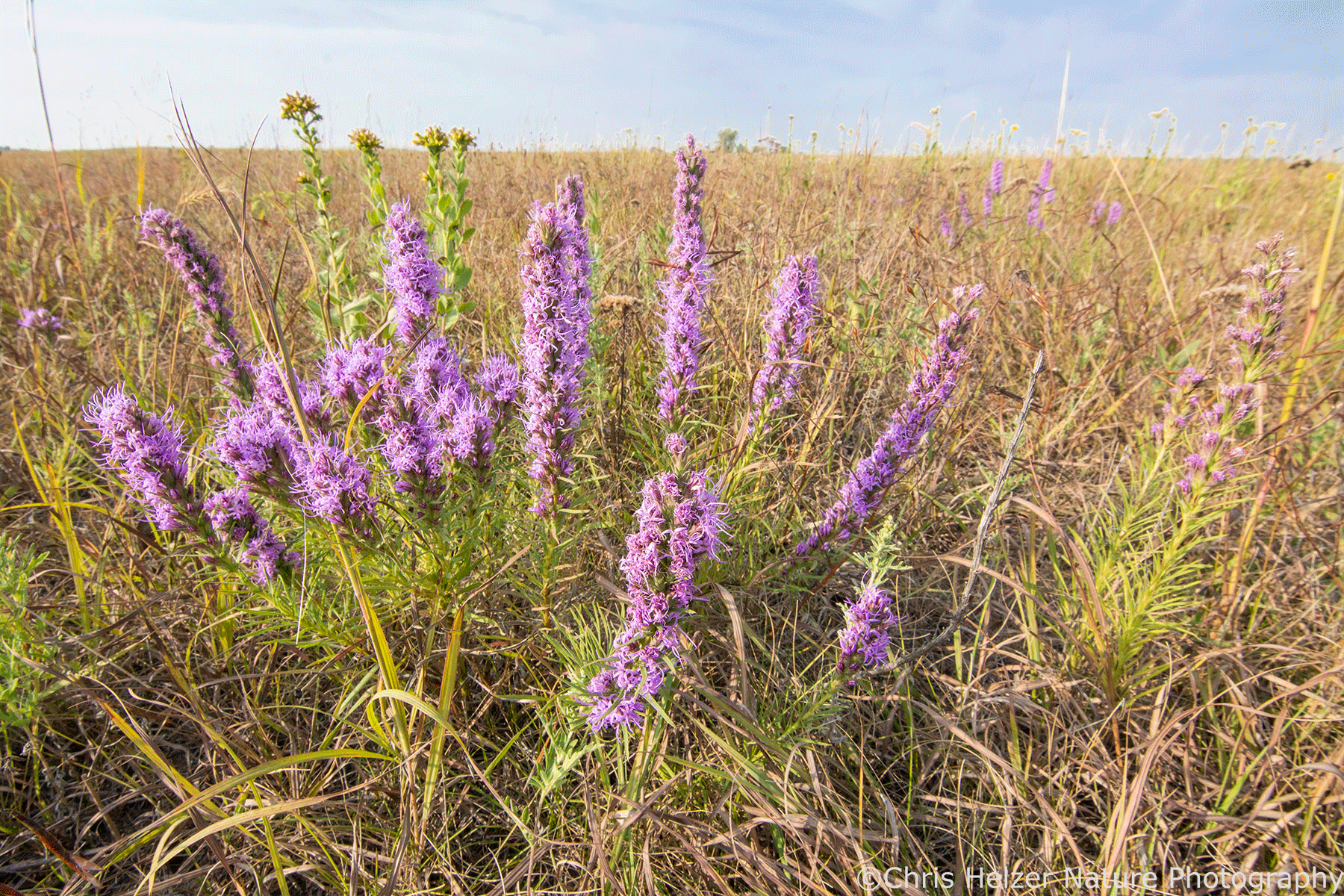
Seeds of lanceleaf gayfeather (Liatris lancifolia). Is it appropriate to harvest seeds from one site and take them to a remnant prairie elsewhere?

On the other hand, there’s also a good argument that increasing the diversity of genotypes at a site helps adapt it to a changing climate by giving it more ammunition for adapting to new conditions.  As an example, I previously wrote about work Marissa Ahlering and others are doing in Minnesota and the Dakotas with ‘regional admixtures’.  In addition, we know that people, bison, and lots of other factors led to plants moving long distances across prairie landscapes in the past, so why worry about it now? 

We didn’t reach any conclusions at the end of our conversations on this topic, but it was helpful to explore the subject and hear different perspectives.  One point that I think is worth repeating is that whatever decision you might make, it’s really important to record what you do.  If you bring seeds from elsewhere, noting that it happened, which species you brought, and from where you brought them will allow future managers and scientists to study and learn from what you did.  We are surely making lots of great decisions about restoration and management, but are probably also making a few that will frustrate those who follow us.  The least we can do is to give them the ability to evaluate what we did and understand the impacts.

Photos of the Week – August 13, 2022

In my last post, I shared photos from the trip I took to the Niobrara Valley Preserve earlier this week. Those photos showcased the drought conditions in the prairie and how they seem to be exacerbating the problem of shrub invasion. While the drought is severe and shrub invasion is a big concern, there was still a lot of beauty and inspiration to be found. I wanted to post some photos today that help illustrate that.

A drone photo of the Niobrara River and a very dry landscape around it.

After spending the day evaluating pasture condition and discussing grazing and weed management strategies, is was nice to spend time in the evening and the next morning just wandering aimlessly with my camera and drone. The above and below photos reinforce how dry it is at the Niobrara Valley Preserve and how much of the vegetation has gone dormant. At the same time, the bison are doing fine, there are still quite a few wildflowers blooming, and insects were abundant and very active.

A drone photo showing part of our east bison herd at The Niobrara Valley Preserve. The bison are feeding in a spring-burned flat in very dry prairie.
Robber fly in a sand blowout. Nikon 105mm macro lens. ISO 400, f/14, 1/100 sec.
A bison calf stares at me as the sun goes down behind it. Tamron 100-400mm lens @400mm. ISO 640, f/6.3, 1/320 sec.
A brown-headed cowbird (I think) flew from the feet of a bison, perhaps chasing the dragonfly above it, as the bison walked toward me. Tamron 100-400mm lens @270mm. ISO 640, f/6, 1/500 sec.
Bison grazing at sunset. Tamron 100-400mm lens @290mm. ISO 640, f/6, 1/500 sec.
A bison cow and calves at sunset. Tamron 100-400mm lens @400mm. ISO640, f/6.3, 1/500 sec.
Antlion in the early morning. Nikon 105mm macro lens. ISO 500, f/13, 1/400 sec.
Face-to-face with an antlion. Nikon 105mm macro lens. ISO 500, f/11, 1/320 sec.

There was no morning dew for insects to be trapped in, which cramped my style a little, but I managed to get some bug photos anyway. Antlions were especially common in the morning, and it was easy to spot them as their wings were highlighted by the light of the rising sun. Some were too wary to be photographed, but others sat still for me as long as I approached them slowly and close to the ground. I found quite a few male bees and wasps on overnight roosts too, but I just shared a bunch of those kinds of photos a few weeks ago, so I won’t add them here.

Metallic green sweat bee on a plains sunflower (Helianthus petiolaris). Nikon 105mm macro lens. ISO 500, f/11, 1/320 sec.

Drought or no drought, prairies are resilient and full of life and beauty. I hope you can find an opportunity to go see some of that beauty at a prairie near you!