
I’ve had lots of people asking me about the 2022 North American Prairie Conference. “Chris,” they ask, “is there going to be a North American Prairie Conference in Nebraska this year?”
Well, the answer to that is yes. Kind of.
Dr. Dave Wedin at the University of Nebraska-Lincoln has been spearheading the difficult effort of deciding how/when/where to host the conference in the context of substantial uncertainty about a fading (?) pandemic. You can probably understand how difficult it would be to commit to hosting several hundred people at an indoor venue, given the ups and downs of the last couple years. After a lot of pondering and planning, it was decided to host an adapted version of the Conference.
Rather than the North American Prairie Conference many of us have attended in the past, full of plenary speakers, concurrent sessions, vendors, and field trips, this year’s event will be a scaled-down, more focused version. It will also be broken into three parts, including a city-wide celebration of prairie, a two-day workshop, and a day of prairie field trips. People are invited to take part in any or all of those.

Part 1: During the weekend of July 23-24, 2022, there will be a number of public events scattered around Lincoln, Nebraska under the unifying theme of ‘Celebrate Prairie’. This will include open houses at prairies, nature centers, and other venues, as well as a film premiere and more. Details will be forthcoming, but there will be a mix of opportunities for both locals and visitors to enjoy.
Part 2: On Monday and Tuesday (July 25-26) there will be a workshop in Lincoln entitled, “Tallgrass Prairie Conservation in a Rapidly Changing World.” It will focus on the many challenges facing tallgrass prairies across the Midwest and eastern Great Plains of North America. Those challenges include daunting grassland stewardship issues that are exacerbated by habitat fragmentation, climate change, and more. However, the workshop will also include discussions about the need to engage the public in prairie conservation and find ways to bring both people and prairies into the future together.
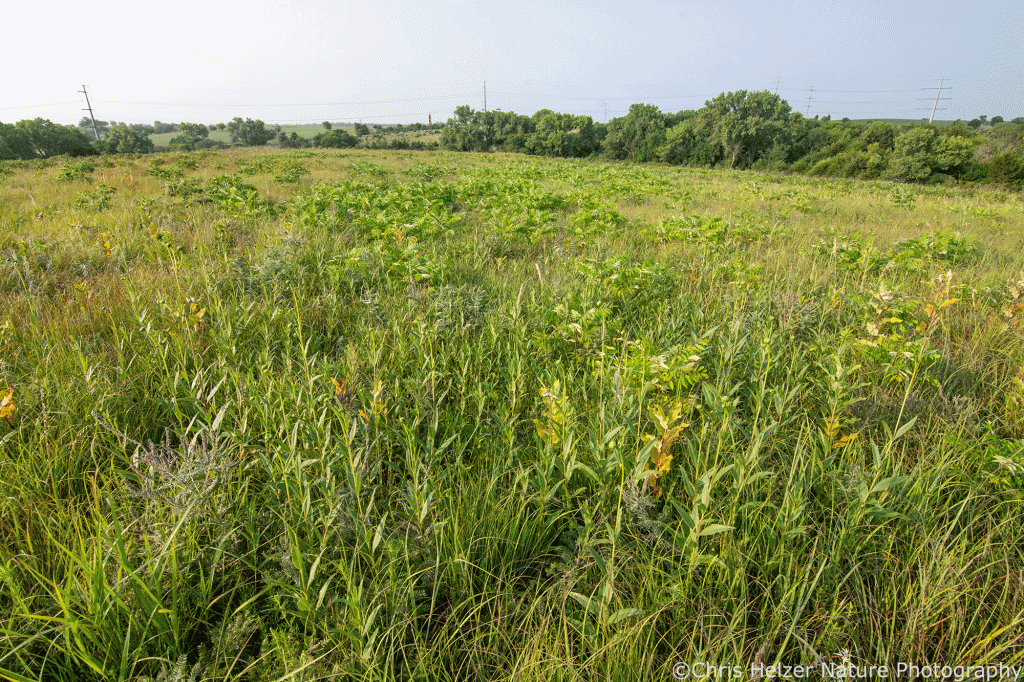
The workshop will include morning field trips to local prairies where approaches to the above challenges are being tested. Many of those sites are part of The Prairie Corridor, a broad collaborative effort that includes the city of Lincoln, Lancaster county, The University of Nebraska’s School of Natural Resources, local foundations, and multiple conservation organizations. The Prairie Corridor project blends conservation, recreation, education, research, and economic opportunity along a long belt of prairie habitat and trails between two nature/education centers.
During the afternoons of both days, we will retreat indoors to share and discuss insights gleaned from the field trips, as well as from the individual experiences of all participants. Those conversations will focus on challenges associated with prairie management and restoration, as well as a public that seems largely indifferent to prairies. More importantly, we want to try to define what a successful future for prairie looks like in fragmented landscapes. What objectives are reasonable and achievable? How do we need to think differently about tallgrass prairie conservation?

Finally, Part 3 will be a series of field trip options on Wednesday, July 27 that will be hosted at sites within a few hours’ drive of Lincoln. I will help lead one of those at our Platte River Prairies, about an hour-and-a-half west of Lincoln. The slate of field trip options will include beautiful examples of remnant prairies, restored/reconstructed prairies, and examples of prairie management that include prescribed fire, grazing, and various invasive species approaches.

More details will be coming soon, including a website and pre-registration information, but Dave gave me permission to spread the word now before everyone’s calendar fills completely for the summer. If you have questions or want to be involved in the planning or hosting of events, contact Dave Wedin through the University of Nebraska-Lincoln. You’re welcome to ask me questions too, but I’ll most likely pass you right along to Dave.
I hope to see many of you at one or more of these events this summer!



 The Prairie Ecologist