Hidin’ Hoppers

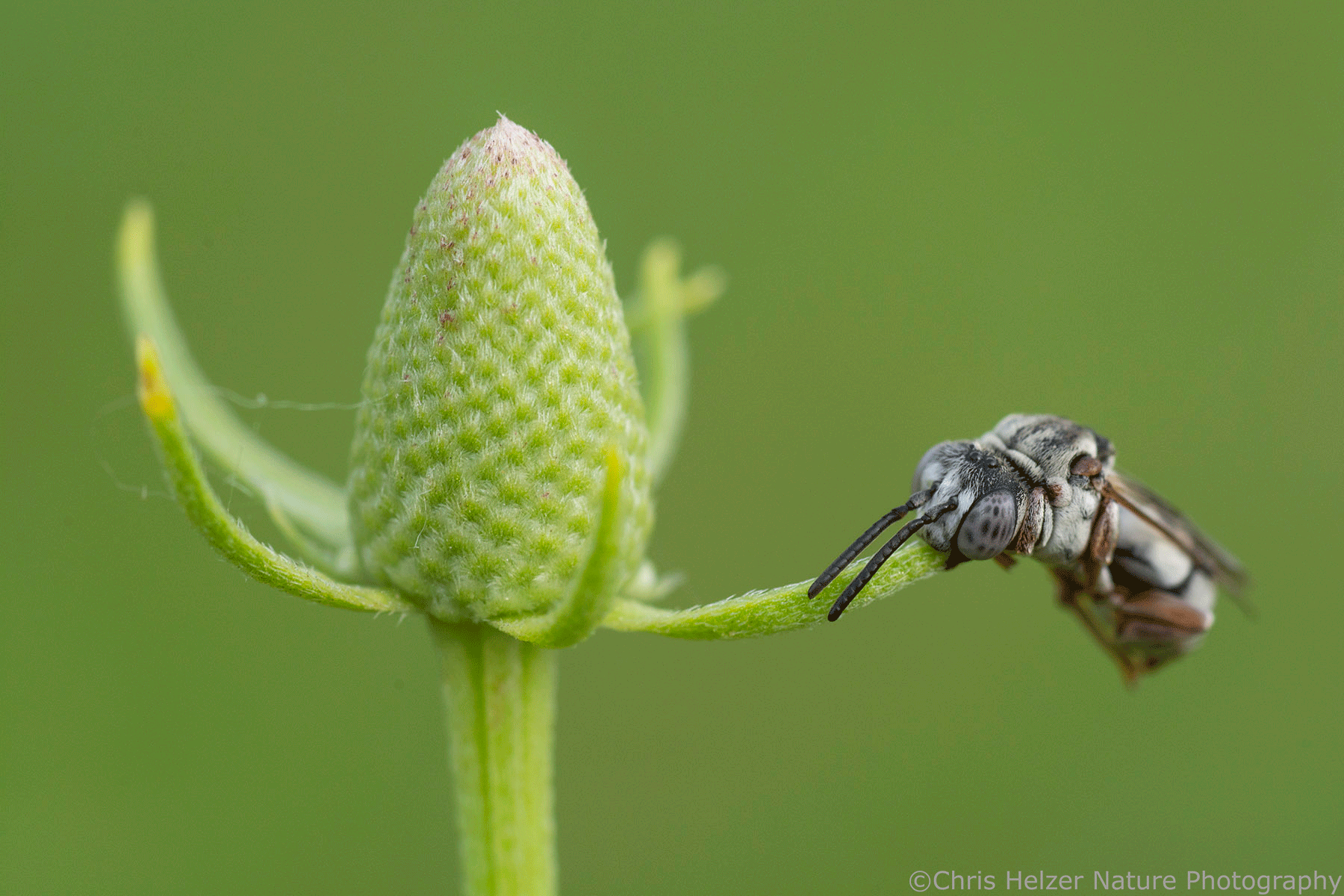
Grasshoppers and katydids provide abundant and nutritious food to many birds and other animals. That works out great for those other animals, but if you’re a grasshopper or katydid, it behooves you to not stand out in a crowd (or a prairie). There are countless examples of great camouflage in the insect world, but I’ve always particularly appreciated the evolved ability of orthopterans to blend into the background. Of course, that sometimes makes photography a challenge, but not in a bad way.

This toothpick grasshopper would have been nearly impossible to spot if I hadn’t seen it hop away from my feet and into this clump of grass.
Sometimes, grasshoppers are so abundant that it’s not possible to ignore them, especially in late summer prairies when many species are mature adults and explode from their perches like popcorn in front of a hiker or vehicle.

Grasshoppers don’t rely solely on hiding for survival, of course. They are also incredible jumpers, with the ability to instantly propel themselves impressive distances through the air when they feel threatened. If they’re caught, they can also expel gross substances out of both ends of their bodies to make predators rethink their choices.

Mature band-winged grasshoppers flash colorful wings and make a loud ‘clacking’ sound as they flee (by jumping into the air and flying), which must be awfully startling and distracting to potential predators. If the strategy works, the predator won’t see exactly where the grasshopper lands and its incredible camouflage makes it difficult to find again. (This strategy also works on photographers, by the way, not just predators.)

I see frequently see several species of band-winged grasshoppers in the Nebraska Sandhills. They’re particularly adept at hiding in the bare sandy patches between plants.
This band-winged grasshopper is basically just a lump of sand with antennae…
When adult band-winged grasshoppers flee, however, they switch from a hide strategy to s startle strategy, deploying colorful wings and a loud distracting clacking sound as they hop/fly away.

Grasshoppers are a much more diverse and interesting group of insects than they’re often given credit for. They have complex communication strategies, for example, including both visual and auditory signals. Many people might also be surprised to know that not all grasshoppers eat grass. In fact, quite a few grasshoppers are quite specialized in their diet choices and a lot of them feed on broad-leaved plants instead of grasses.

The plains lubber grasshopper (Brachystola magna) is a flightless grasshopper the size of a mouse. Against bare sand, it doesn’t appear particularly hard to see, and it’s size works against it. But…
When it’s on its favorite food plant (plains sunflower – Helianthus petiolaris) the plains lubber blends in pretty dang well, despite its size.
The painted grasshopper, aka barber pole grasshopper (Dactylotum bicolor) seems like it would be easy to find, but like leopards, they can blend very easily into the shadows and patterns of prairie vegetation.
Katydids are no slouches in the camouflage department either. This bush katydid (Scudderia sp.) looks an awful lot like a leaf to someone scanning the prairie for prey.
I know I’ve mentioned the cudweed grasshopper (Hypochlora alba) many times on this blog, but it still deserves to be included in any discussion of grasshopper camouflage. Its ability to blend with its favorite food plant (cudweed sagewort – Artemisia ludiviciana) is simply magical.

We’re creeping closer to the beginning of grasshopper season here in Nebraska. Some species overwinter as adults and can be often be found soaking up the sun on warm days in late March or early April. Soon after, they’re joined by many others – of all different sizes and colors. If you’ve never paid special attention to the diversity and beauty of grasshoppers and katydids, maybe this would be a good year to start.

If you can find them.

Photos of the Week – February 26, 2022

One of the reasons photography is so important to me is that it encourages me to concentrate on finding beauty. When I’m feeling uncertain, anxious, or unhappy, redirecting my brain to search for beauty helps. It provides a distraction while the camera is in my hands, but the effects linger well past the actual experience – like a temporary reprogramming of my brain. Photography doesn’t allow me to escape the world or my obligations, it just allows me to put them in context.

A skinny patch of open water is fringed with frost on the Platte River at The Nature Conservancy’s Platte River Prairies yesterday. Nikon 10.5mm fisheye lens. ISO 400, f/22, 1/800 sec.

Yesterday morning, I spent a couple hours scooting around on the frozen surface of the Platte River, photographing ice, frost, water, and sunlight. The temperature was hovering around zero Fahrenheit, but there were a few tiny slivers of open water to be found on the otherwise solid mass of ice and I was drawn particularly to them. I spent most of my time lying prone and scooting around the edges of the shallow water. I got my elbows wet a couple times when I leaned a little too heavily on the thin margins of those openings, but my coat absorbed the water before it got to my skin.

Most of the river was completely covered in ice, which was seasoned with sand from exposed sand bars, blown about by recent strong winds. Tokina 11-20mm lens @11mm. ISO 400, f/22, 1/320 sec.
Here’s a close-up view of some of the frost on the top of the ice. Nikon 105mm macro lens. ISO 400, f/13, 1/1000 sec.

In addition to the distractions of the ice and frost, I also pondered some mysterious trails in the sand at the bottom of the river. The long tracks were less than 1/2 inch in width and seemed to go in all directions, so they definitely weren’t just caused by objects being pushed by the flow of the river. They reminded me of trails made by freshwater mussels, but they were awfully small and my understanding is that the strongly shifting sediment in the Platte makes it a difficult place for mussels to live. Big snails? Tiny aquatic voles?? I have no idea. Help, anyone?

Mysterious trails in the river sediment. Tokina 11-20mm lens @20mm. ISO 400, f/16 and 1/160 sec.
Frosty reflections. Nikon 105mm macro lens. ISO 400, f/22, 1/320 sec.
More frosty reflections. Nikon 105mm macro lens. ISO 400, f/16, 1/1000 sec.
Hey, look, frosty reflections! Nikon 18-300mm lens @175mm. ISO 400, f/16, 1/1000 sec.
This appears to be some reflections of frost. Nikon 18-300mm lens @125mm. ISO 400, f/16, 1/1000 sec.
Even more reflections. Nikon 18-300mm lens @320mm. ISO 400, f/16, 1/1000 sec.
A tiny ice shelf. Tokina 11-20mm lens @13mm. ISO 400, f/16, 1/1000 sec.
Cottonwood leaf. Nikon 10.5mm fisheye lens. ISO 400, f/22, 1/500 sec.

This weekend’s warm temperatures will melt most of the ice I was sliding on yesterday, but it will also help clear the river for the sandhill cranes that are already starting to arrive. Those cranes, along with ducks, geese, and other water birds, will provide another source of beauty and distraction for the next month or so. As those birds move on northward, green plants will start to poke out and re-start the growing season. There’s a constant, if ever-changing supply of beauty around to help me deal with all the aspects of the world that are less attractive. And I’m very grateful. Be well, everyone.

Frost, ice, water, and sun. Nikon 10.5mm fisheye lens. ISO 400, f/22, 1/800 sec.