I’ve got so many photos to look through from the last couple weeks. In fact, I’m in the middle of going through a huge batch from yesterday and am taking a quick break to write this post. I’ve been to a number of great prairies recently, but Lincoln Creek Prairie is the steady and true prairie I can always slip over to when the light is nice and I’ve got a few minutes to spare.
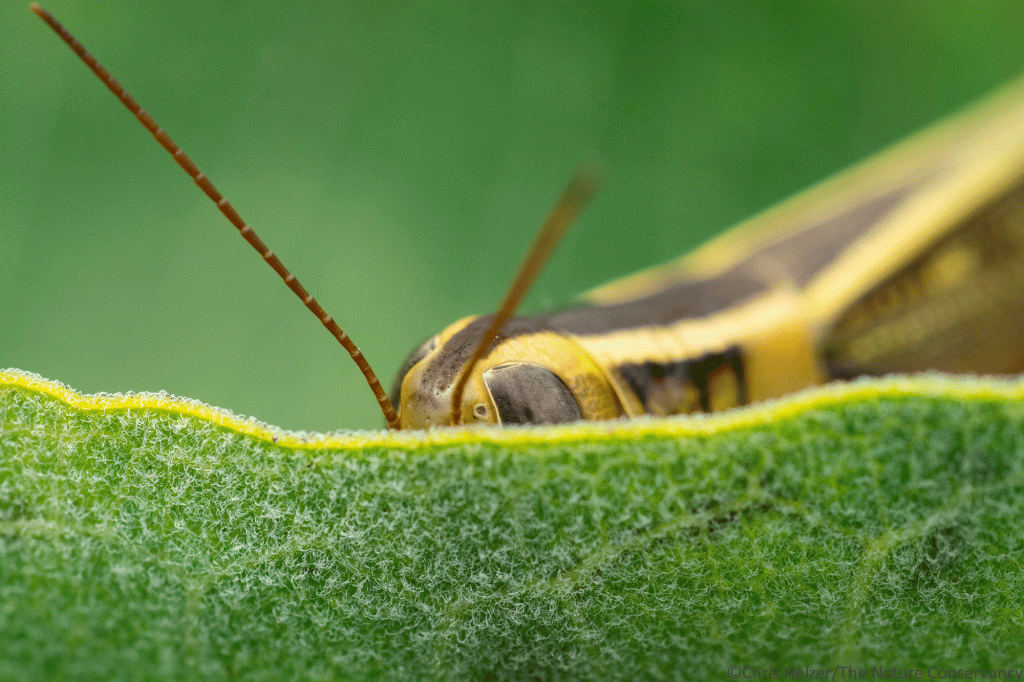
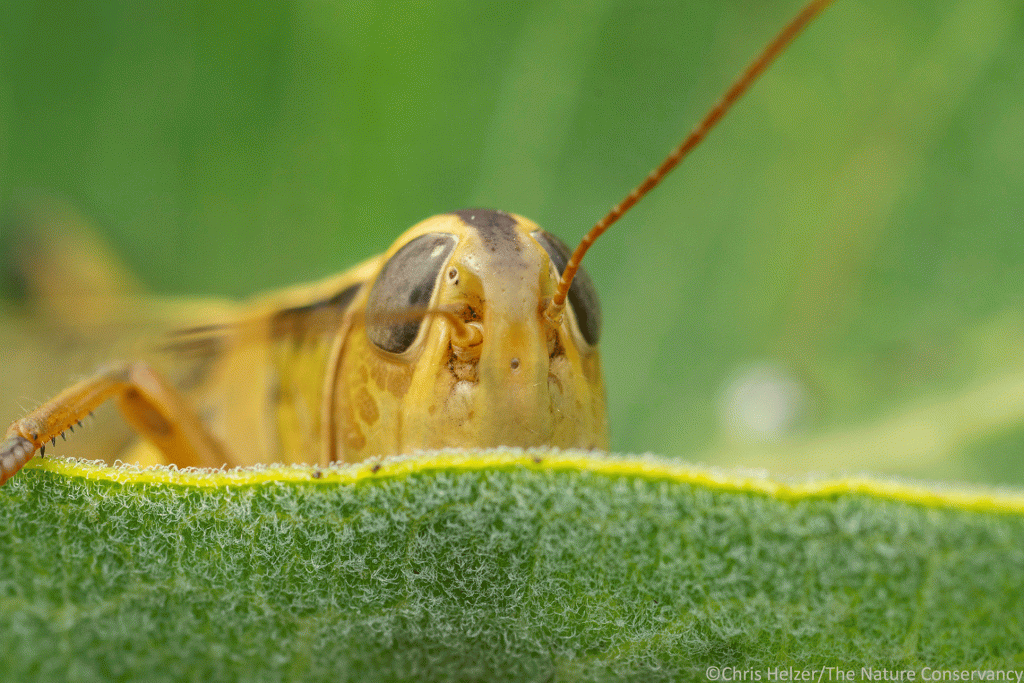
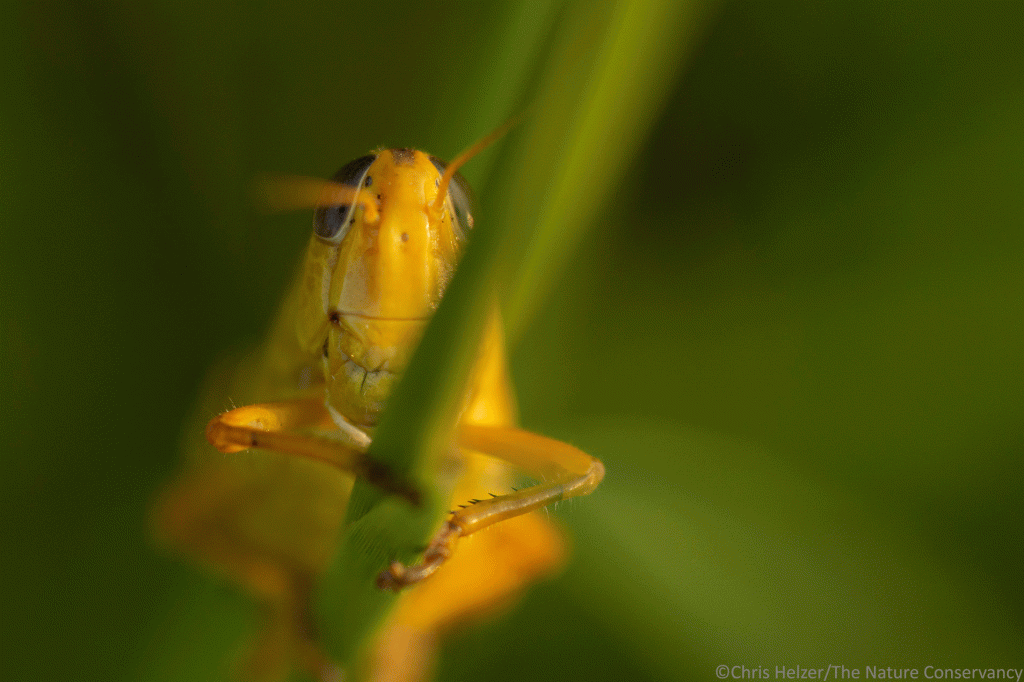
During my last couple evening visits to LCP, big two-striped grasshoppers (Melanoplus bivittatus) have been very accommodating – sitting very still while I stick my lens right up to their faces. One of them was paying peek-a-boo with me for a while behind the curled edge of a milkweed leaf. Another was almost glowing in resplendent orange in front of a deep green background, reflecting the warm light of a setting sun. The last allowed me to silhouette it against that same sun as it sank toward the horizon.
Here is a quick batch of recent grasshopper photos from Lincoln Creek Prairie in Aurora.
Nikon 105mm macro lens. ISO 400, f/13, 1/320 sec. Nikon 105mm macro lens. ISO 400, f/13, 1/320 sec. Nikon 105mm macro lens with Raynox DCR-250 magnifier. ISO 400, f/20, 1/100 sec. Nikon 105mm macro lens. ISO 400, f/7, 1/500 sec. Nikon 105mm macro lens. ISO 400, f/10, 1/125 sec. Nikon 105mm macro lens. ISO 400, f/5, 1/3200 sec.
It’s been a pretty great summer for prairie exploration so far. Just in the last couple weeks, I’ve discovered or rediscovered lots of really interesting creatures or behaviors. I’ve already shared a few of those in previous posts, but I thought I’d dump a bunch more into today’s post. It’s inspirational to me how much I continue to discover about prairies, even in sites I’ve been visiting and studying for more than 25 years!
Spittle bug spittle on rosinweed (Silphium integrifolium). Lincoln Creek Prairie, Aurora, Nebraska.
We’ll start with spittle bugs. I’ve photographed the spittle of spittle bugs many times. They’re easy to find and easy to photograph. Inside each jumble of wet frothy bubbles is a spittlebug larva, which feeds on the juices of the plant and ‘blows’ bubbles out its rear end, which accumulate around it. The bubbles provide protection from predators and desiccation.
That’s all great, but old news. Until last month, I’d never been able to find the adult spittlebugs, even though I know they’re pretty common. All of a sudden, I started seeing them everywhere (see below) around Lincoln Creek Prairie here in Aurora, and managed to photograph them a couple different times. They were bigger than I’d expected – larger than most leafhoppers, if you’re familiar with those – but really attractive!
Two-lined spittle bugs, aka froghoppers (Prosapia bicincta). Lincoln Creek Prairie, Aurora, Nebraska.
Over the last several years, I’ve been trying to accumulate photos of the various insects that are specialist feeders on millkweed. These creatures fascinate me because they’ve evolved strategies for dealing with the toxic latex inside the plants they eat. Some of them eat around the latex, but others have developed the ability to ingest the toxin without serious consequences. The first success I had this summer was with the milkweed stem weevil, pictured below. I was at Nine Mile Prairie in Lincoln and noticed them on a couple different plants. I hadn’t heard of the milkweed stem weevil, but the little gray critters seemed to be only on milkweed, so I suspected they might be specialists and made sure I got some photos.
Milkweed stem weevils are cool little beetles that can do some serious damage to milkweed plants. I can imagine that if I was trying to raise milkweed, I’d see them less positively, but since I’m just observing them doing their thing in prairies, I just see them as fascinating. Their larvae burrow through milkweed stems and also feed on seeds. The adults feed on new leaves, though the one I photographed below seemed mostly interested in a developing pod. I didn’t see very many of them across Nine Mile Prairie the day I was there, so it didn’t appear they were having much impact on the numerous milkweed plants in that particular prairie.
I’m pretty sure this is the milkweed stem weevil (Rhyssomatus lineaticollis). It sure acted like it! Nine Mile Prairie, Lincoln, Nebraska.
The second milkweed specialist I added to my photo library this summer is the unexpected tiger moth caterpillar. Besides having a great name, this is also a beautiful vibrant orange and fuzzy caterpillar. It feeds on the leaves and pods of milkweed and was present on just about every green milkweed plant I saw last weekend at the Tallgrass Prairie National Preserve in Kansas.
The species is apparently not very mobile, even as an adult – sticking close to the milkweed populations it grew up eating. As a result, it is a species with very patchy distribution, often existing in isolated populations. In a landscape like the Kansas Flint Hills, where I photographed these, there’s a decent chance multiple populations can interact and interbreed because the landscape is pretty contiguous. In more fragmented landscapes, however, it seems like the species could have, or develop, some serious genetic isolation issues.
Caterpillars of the unexpected tiger moth (Cycnia inopinatus) on green milkweed (Asclepias viridiflora). Tallgrass Prairie National Preserve, Kansas.More unexpected tiger moth caterpillars.Yet another unexpected tiger moth caterpillar.
While photographing some wildflowers in our Platte River Prairies last month, I started noticing some big winged ants crawling up and down stems nearby. I managed to get a couple decent photos and sent them to James Trager for identification. As always, he was not only helpful in identifying them, but also in providing their story.
According to James, the ants appear to be winged females of Formica pergandei, or another of the same group, which is known to kidnap individuals of other ant species. The kidnappers bring the captured ants (usually as pupae) back to their colony and put them to work. As a result, the colonies of F. pergandei often consist of two or three species of ants, and the ones that don’t belong to the host species end up working to feed and support the host. Even more impressive, the ratio of kidnapped ants to host ants can be as high as 5:1!
A winged female kidnapper ant (probably Formica pergandei). Platte River Prairies.
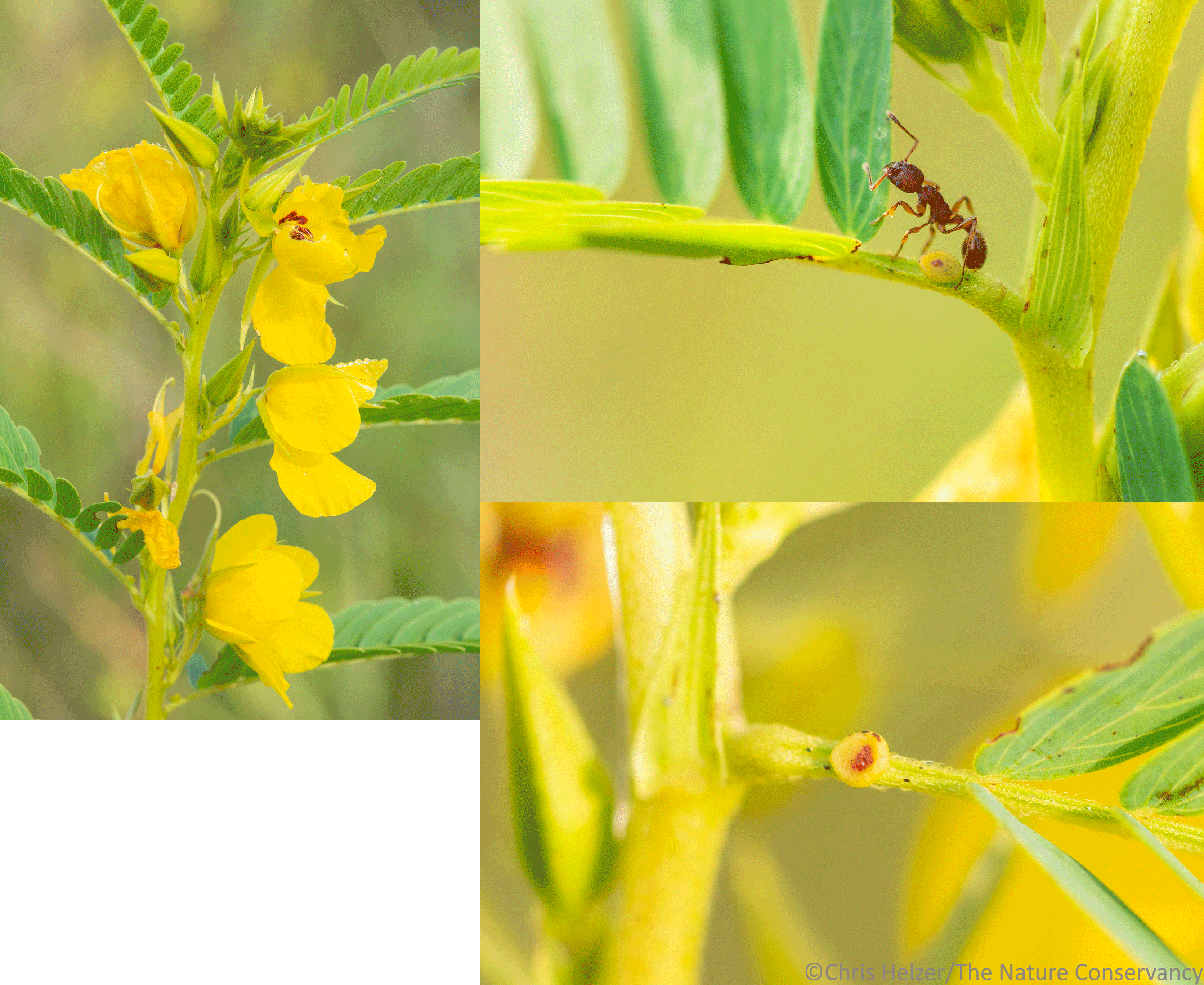
Speaking of James Trager, he was the person who initially alerted me to the extrafloral nectar produced by some prairie wildflowers. I commonly see ants scrambling around on sunflowers, for example, trying to satisfy their sweet tooth with the sugary droplets produced outside the flower on those plants. I knew partridge pea also produced extrafloral nectar, but the species isn’t common in the prairies I visit most, so I don’t see it often.
There was a patch of partridge pea at Nine Mile Prairie when I visited it recently, and I noticed some ants crawling around. Getting close enough to photograph the ants revealed the little ‘bowls’ on the leaf petioles, where clear liquid was being produced and eaten by the ants. I hope to spend more time photographing this in the future, but I managed to get some shots that at least show what’s going on. I also found a couple research articles that had found that attracting those ants can produce measurable benefits to the plant’s growth – probably because the ants (predators) help keep herbivores away.
Partridge pea and an ant feeding from its extra floral nectaries. The bottom right photo shows the little ‘bowl’ of the nectary with a drop of nectar in it. Nine mile prairie, Lincoln, Nebraska.
The final observation I’m sharing today is another one from the Tallgrass Prairie National Preserve. Kim and I went to Kansas for the weekend so she could do some long training runs. I just wandered around the prairie while she was racking up lots of miles on the trails. On our second morning, it was overcast and dark, which made photography pretty challenging. There were a couple discoveries, though, that I couldn’t pass by, so I got out my little flash diffuser and made the most I could of the situation (I usually like flash photography much less than just using natural light).
In this case, using flash was particularly useful in photographing the tiny jumping spider that had constructed a hideout at the top of a prairie clover plant. It had used silk to sew the seed heads together and seemed warm and dry when I found it, despite a rainstorm having moved through less than an hour before. I could see the spider inside, but just barely, because it was in the shade and the light from the overcast skies was already pretty dark. Using a diffused flash helped me illuminate the spider inside its shelter and highlight its big gorgeous eyes.
I see these kinds of spider shelters often, usually containing jumping spiders or crab spiders. What I don’t know is whether they use those shelters over and over through the season or just as temporary overnight or other short-term housing. Anyone know?
Jumping spider in its silken shelter. Tallgrass Prairie National Preserve, KansasA closer view of the jumping spider and its amazing eyes.
These are just a small subset of the stories I’ve been able to watch unfold in prairies this summer. I’m discovering most of them by simply pausing, kneeling down, and carefully scanning the prairie around me. Sometimes I see interesting things as I’m walking, but as was highlighted during my 2018 square meter photography project, I see even more when I stop and really focus on what’s nearby. (If you want to see or read more about that, you might be interested in the book that came from that square meter project – you can see more about that here.)
I hope you’re all getting a chance to explore prairies near you and are finding similar stories playing out in front of you. If not – get out there!






 The Prairie Ecologist