
In land management, as in most of life, it’s important to know your objectives and periodically check in to see if you’re meeting them. Otherwise, it’s easy to get buried in work and forget what it is you’re actually trying to accomplish. The primary objective of most prairie managers, for example, isn’t to kill all the trees on their prairie or to burn a particular management unit every two or three years. If you stop and think about it, your objective is probably linked to the something like the wellbeing of a particular rare species, the breeding success of certain birds, and/or the continued diversity of plant and animal communities. Regardless of what you’re aiming for, it’s critically important to have a clear idea of what that is.
Now, once you know what it is you’re trying to accomplish, you just have to go out and measure your success, right? Should be as easy as anything. Sure. That’s why we’re all so good at ecological monitoring.
In some cases, simple objectives lead to simple monitoring needs. If your primary goal is the wellbeing of a particular rare plant, monitoring is pretty straightforward. You can just go out and count stems, flowers, seed heads, new seedlings, or whatever metric you think is most important. You can then look at how those metrics are responding to your management, weather patterns, and other factors. If the plant species is doing well, keep doing what you’re doing. If it’s not, try something different.
Few of us, though, have such a simple objective. In fact, I’d argue that most of us should have much broader and more ambitious objectives that include the overall diversity and resilience of the various plant and animal communities in our prairies. We might have a few groups of those plants or animals we’re paying special attention to, either because our organization mandates it or because we particularly like them. There’s nothing wrong with that, but since prairies rely on complex networks and processes to remain healthy, focusing only on a few species can mean ignoring the larger communities our favorite species rely on.
Great. So we’re going to keep our prairies nice and diverse. So to monitor our progress, we just have to…. count… every…. species??
This is the point at which a lot of prairie managers throw up their hands and turn back toward the invasive plants they’re fighting. Monitoring is too much work. I know I have to kill these trees. I know I have to burn this prairie. I’ll just focus on that and hope for the best.
Before you join those frustrated land stewards, give me a quick chance to throw out an idea. If you’re managing for diverse plant and animal communities, you’ve probably thought about what kind of habitats and growing conditions will be required right? Many of us strive to create a shifting mosaic of habitat types across our prairies to accommodate as much diversity as possible. If so, setting objectives for the habitat conditions you want to provide each year gives you something clear and measurable to track.
Using the shifting habitat mosaic approach as an example, the first objective is to provide patches of habitat across the prairie that represent the widest range of possibilities – short/sparse habitat, tall/dense habitat, thin/weedy habitat, etc. The second objective is to vary the location of those habitat patches year to year. We can measure that! If you have the time, you could do formal monitoring by sampling the height, density, and other features of the prairie vegetation in each habitat patch, but you wouldn’t necessarily have to. For most of us, simply making an annual map showing the location and general description of each habitat patch might be sufficient. Do those maps show that you’re creating the kind of habitat mosaic you want?
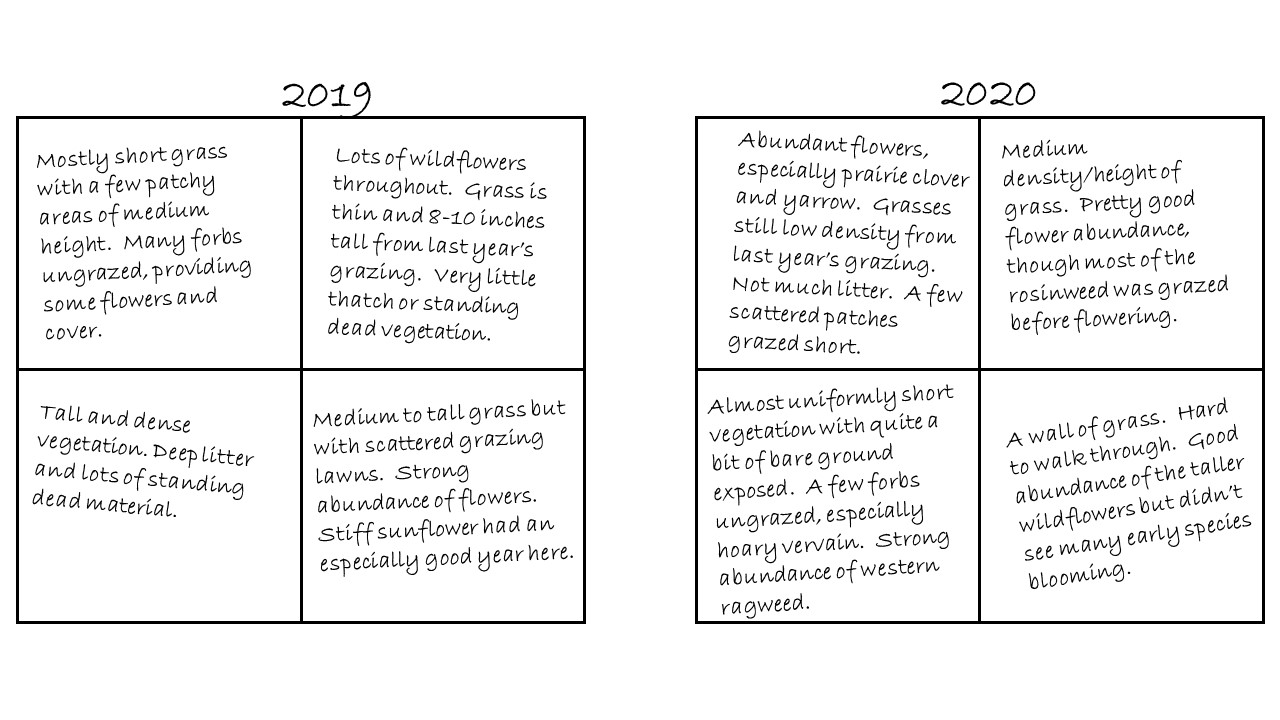
To be clear, that map is different from a map that simply documents your management. That can be useful too, but I’m talking about a map of the actual habitat conditions on the site. The two are hopefully linked, but one of the benefits of monitoring is to see if your management is actually doing what you need it to do, right? Your map should have lines roughly drawn around patches of habitat that are different from each other and written descriptions of each patch. You can then compare maps over several years to see if you’re providing the range of habitat types you want and if they’re shifting around the prairie as desired. This kind of map is also really helpful as you are planning your next management because you can see where you’ve been and think about where you want to go next.
Mapping habitat is pretty easy, but if that’s the only monitoring we’re doing, we’re making some pretty big assumptions. Primarily, we’re assuming the habitats we’re creating are supporting the kind of broad diversity of organisms we want. We need to test those assumptions when we can.
Fortunately, testing assumptions can be a lot easier than monitoring. For one thing, you don’t have to test every assumption over and over. Instead, assumption testing is about answering a distinct question. It’s really research, rather than monitoring. Example questions might include:
- Do we have all the grassland bird species we’d expect in this region nesting in our prairie each year?
- Are there several species of blooming flowers available for pollinators at all times during the season?
- Are there any plant species that never get a chance to bloom and reproduce over the cycle of management being applied?
Some of these questions can be addressed by simply recording what you see (what species of birds do I see in each management unit each year?). Others might take a concerted effort for a few years (walking a bi-weekly or monthly transect through each habitat patch and listing the flowers you see blooming). As you investigate each assumption, you’ll probably learn things that will help you adjust your management approach. That will lead to new questions.
You might not have the time or resources to answer all your questions by yourself. In that case, you might be able to talk to other prairie managers in your area to see what they’ve learned, or turn to scientists who have studied the topic. If you work for an organization with resources and/or relationships with academic institutions, you might be able to collaborate with them on a graduate research project.

There is, of course, value in long-term monitoring too. If you have the time or capacity to track the diversity/composition of your plant community – even in a few portions of your site – that can be really helpful. I’ve learned a lot by doing that in selected management units over time (collecting data annually in some and less frequently in others), but I don’t just collect the data and store it away. I dive into it to help me test assumptions. I’ve been able to see how individual species and overall species diversity respond to various management and weather patterns and feel confident that we’ve not lost any plant species from our prairies.
It’s tempting to look for an indicator species or two that you can track as a way to measure the overall health of the ecosystem. Prairie chickens, for example are often held up as a potential indicator species because they require a wide range of habitat types. I think that’s a trap. If you care about prairie chickens or other birds, by all means, pay attention to how they’re doing. But an abundance of prairie chickens or grasshopper sparrows doesn’t tell you anything about how sunflowers or leafhoppers are doing. If you want to measure habitat, measure habitat – and do some periodic checks to see if the species you’re expecting are responding appropriately. I’m not aware of any single species or group of species that is so tied to the rest of an ecological community that their abundance or breeding success will tell you how the rest of the community is doing.

Don’t beat yourself up for not counting every flower, bird, or bee in your prairie each year, but don’t throw up your hands and give up either. Your top priority should be to have clear management objectives. Once you have those, make a list of ways you could measure success and see what seems feasible. It’s important to track your results in some way, but it doesn’t have to be overly time consuming to be helpful. Do what you can, learn from what others are doing, and keep looking for ways to improve your management.



 The Prairie Ecologist