Hubbard Fellowship Blog – Kate Contemplates Cranes, Calendars and Home

This blog post is written by Kate Nootenboom, one of our 2021 Hubbard Fellows. Kate came to us from Portland, Oregon, by way of Carleton College in Minnesota. Kate, along with her fellow Fellow, Sarah, has been very busy learning about The Nature Conservancy and our work, picking up new land management skills, and preparing for a very busy field season coming up. This is her first stand-alone blog post for The Prairie Ecologist, but you’ll hear more from her in the coming months.

When I arrived in Wood River, Nebraska almost two months ago, I was greeted by a pandemic-appropriate welcome committee: not a single person, just a note from staff, a goodie bag, and a Nature Conservancy photo calendar. I flipped this last gift to February and hung it on the wall, and so for my first month of settling in I was greeted every day by a photo of sandhill cranes touching down on a Great Plains horizon.

(Editor’s note: Kate arrived the weekend before her job started. I want to be clear that there were actual people present when she officially started Monday morning…)

Sandhills cranes on Kate’s calendar.

For weeks, this photo served as a reminder of the new place where I, too, had just touched down: the Central Platte River Valley. The famed pinch-in-the-hourglass of the central migratory flyway, and springtime mothership of cranes and crane-watchers alike. As March drew closer and the skies grew ever louder with wings, the photo and I shared our final days of anticipation together.

When March came, I flipped to the next calendar page, and in doing so finally read the caption below the photo. Sandhill cranes, Oregon, USA. The birds that had welcomed me to Nebraska weren’t flying over the Great Plains at all, as I’d assumed, but over my own home state. I’m an Oregonian born and raised, but I had never seen nor heard of cranes in the place I thought I knew best. I texted my dad with the news.

“Of course there are sandhill cranes in Oregon,” he replied. “I hear them every spring over Sauvie Island.”

This double revelation, that cranes had flown through my childhood home and I’d never noticed, shook me (though in my defense, the Pacific flyway is nowhere near as well-trodden as Nebraska’s central flyway). It also offered a poignant reflection on this idea of home, and what it means to know or love a place well enough to call it that.
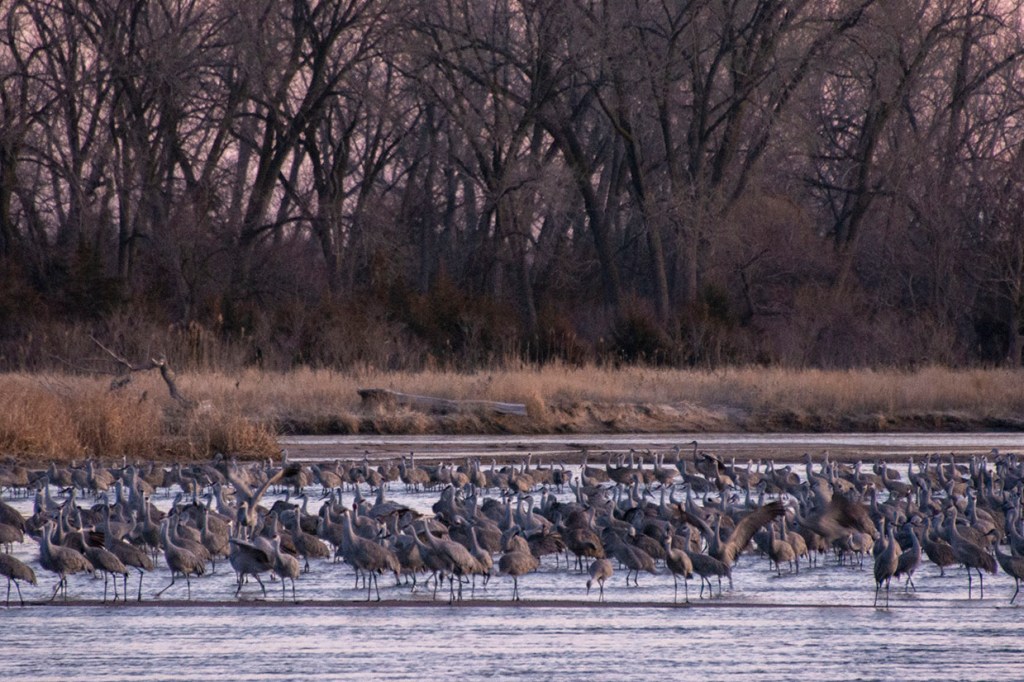
Migratory sandhill cranes on Nebraska’s Platte River. Photo by Kate Nootenboom.

Thanks to walks with Chris through the richly diverse prairies along the Platte River, I anticipate soon passing the milestone of being able to identify more native species in Nebraska than I can in Oregon. I remember passing this milestone in Minnesota as a student, and the complexity it added then to my conception of home. Just the other day, my UPS deliverer asked if I was from Minnesota (inferring from my license plates). I said yes, and we talked about his connection to the Twin Cities and some of my favorite places there. As he drove away, I realized my answer hadn’t been entirely truthful – I’m not from Minnesota. But it also hadn’t felt like a lie.

A license plate doesn’t make a place home, and neither does a mental index of plant names.  But at least knowing the plants means you’re paying attention, and paying attention means you’re beginning to care.

Maybe that’s all home needs to be: a place that you give your attention to, that you care for and feel cared for by. Under those standards it can easily be shifting and multiple. Why assume “home” must be static? Migration is a beautiful and powerful force for many species, including our own, and plenty of people know the truth in feeling at home in myriad places. After all, what is home to a sandhill crane? One may travel thousands of miles in a single season but returns dependably to the same ponds, sandbars, and corn fields along the way (I read recently that some cranes are seen in the same corners of corn fields year after year. Do they feel at home there?).

Sandhill cranes and a full moon. Photo by Kate Nootenboom.

I have more questions than answers on this, and I’m always interested in hearing what “home” means to other people. Is home a place to you? Or several places, or a type of place? Is it a building, or a landscape, or a migratory path? What threshold must you cross (license plates, plant names, or otherwise) before a place counts as home?

These are fun questions to think about, especially in this season of sharing our stretch of the Platte River with the sandhill cranes as they travel along the flyway. I look forward to finding more reasons to think of Nebraska as home, but for now I’ll look up into the springtime sky and listen to its most iconic sandhill soundtrack, and be reminded (just a little bit) of Oregon. These days, home is a bit of a unison call.

Cranes and sunset. Photo by Kate Nootenboom.

Can We Please Stop Calling It Land Protection?

One of the most intriguing, important, and complex discussions going on in conservation right now involves the concept of land protection.  In many ways, the term land protection is flawed, outdated, and even offensive, but we’ve not been able to reach consensus on an alternative.  The term effective conservation is a frontrunner that I think has some promise, but I’m not sure it’s perfect either.

Many conservation organizations were started by people who were rightly concerned that beautiful and important natural areas were being transformed – often irreversibly – in ways that destroyed or greatly diminished their intrinsic value.  Land protection was seen as the way to save places from that fate.  In most cases, successful protection meant putting the land into the ownership of a government or conservation organization so it would remain intact and safe from becoming a housing development, cropfield, or strip mine.  Often, protection also meant safety from logging, grazing, or other practices that were seen as potential threats to the integrity of the ecosystem.

I love having public lands to explore on my vacations, including designated wilderness areas. On the other hand, I feel an urgency to visit them soon because the lack of management many areas receive puts them at great risk of catastrophic wildfires and other threats. These areas are legally protected, but only from selected pressures.

Science and conservation have grown tremendously since the early days of land protection.  We still face huge threats to the health and integrity of ecosystems, but we also recognize that protecting the integrity of land includes much more than just preventing dramatic conversions to suburban housing or tilled land.  It means ensuring land is managed in ways that maintain species diversity, productivity and ecological resilience. 

Drawing lines on a map and designating places as parks or preserves can provide them with the legal status to stave off dramatic conversions.  That’s been a very important strategy across the world. While many parks and preserve are well managed, however, it’s also easy to find examples that are becoming degraded because of insufficient or poor land stewardship.  On the flip side, there are plenty of examples of privately owned lands in terrific shape that are being actively and thoughtfully managed.

What does land protection even mean, then?  The model of land protection through legal designation has worked well in many cases, but also has many flaws, especially because that designation doesn’t always ensure (and often hinders) effective management.  At the same time, while many private lands have a long history of being well-managed and have done a great job of ‘protecting’ ecosystems, there is no guarantee the next owner will take the same approach.  Neither of those examples provides long-term assurance that ecosystems will remain healthy.

On private lands, there are tools such as conservation easements that a private landowner can choose to employ to make sure subsequent owners don’t till up, mine, or build houses on their land in the future.  Easements can be helpful when that kind of conversion is a serious threat, but they don’t typically provide much protection against threats like invasive species, overgrazing or fire suppression.  The greatest worry of landowners who spend a lifetime carefully restoring and/or managing their property is that all their work will be undone after they’re gone. 

One of the best regulators of sustained and thoughtful private land management is the local culture in an area.  When there is a shared land ethic among the majority of people in a geographic area, multiple good things happen.  First, there is a strong social pressure to manage land in ways that conform to that land ethic, even when other approaches might be more financially lucrative.  Because humans are social creatures, that pressure is real and effective. 

Second, a local land ethic is often supported and codified in local laws and customs, building an additional layer of ‘protection’.  Tax laws, zoning regulations, and even the way bank loans are evaluated can all be greatly influenced by a local land ethic.  The result is an entire community of people who have agreed to a social contract regarding the way they interact with the land.

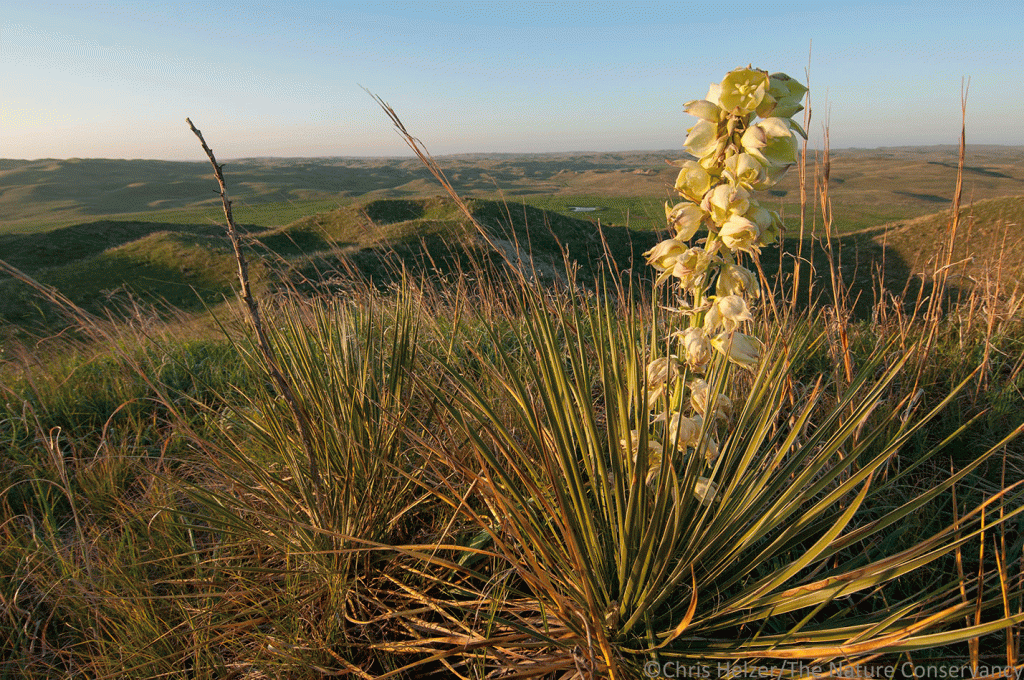
The Nebraska Sandhills is an example of a landscape I think should be considered ‘effectively conserved’. The ranchers there have done an excellent job of keeping the 12 million acre prairie intact and in good condition. There are still conservation concerns, of course, including several serious invasive species, but the best conservation strategy for the Sandhills is to make sure ranchers have the tools and resources they need to continue their thoughtful stewardship of this incredible landscape.

Many indigenous cultures, of course, have sustained a conservation land ethic for eons.  Less mature, but still powerful land ethics exist in agricultural and other rural communities around the world.  Those land ethics vary tremendously, of course, and not all of them emphasize conservation as a top priority.  When they do, though, the result can be a landscape that sustains ecological function to the benefit of both nature and people.

One of the big problems with land protection initiatives is that they usually start by assuming land is currently unprotected if it isn’t a park or preserve or have some other legal status.  That’s a harsh thing to hear if you’re someone whose family or community has spent generations caring for the land in a conscientious way.  It’s especially frustrating when there are so many examples of ‘protected’ lands that are in pretty rough shape.

I think the term effective conservation has a lot of merit because it has less loaded language than land protection and feels more able to account for the various ways of assuring that land will remain healthy for the long term.  Wouldn’t it be great if we could measure conservation success by quantifying the acres and landscapes where land is currently healthy and the factors that promote that health appear stable?  We could then keep track which areas are effectively conserved and work to support the enabling conditions in those places, regardless of what those conditions are.

In some cases, ownership by governments or conservation entities might be an essential part of effectively conserving a site.  That might be especially important where there isn’t an enduring local conservation ethic or where there are significant threats beyond what a local culture can control.  Parks and preserves can also play important roles in specific situations in which a rare ecosystem or species needs a particular kind of management that may not be feasible for most private landowners.

Land owned or controlled by conservation entities can also be critical places to develop and test innovative land stewardship practices.  In many cases those organizations can afford to experiment with approaches that, if they fail, could cause significant financial hardships for most private landowners.  Those organizations often have an easier time building relationships with academic institutions and setting up research projects in ways that might interfere with most private land operations.

Public access is another important purpose for parks and preserves.  It’s critically important that we provide places where members of the general public can interface with the outdoors, explore and learn about nature, and develop their own conservation ethic.  Some private landowners can provide those experiences too, of course, but the majority tend to value privacy and control over who is on their property. 

Toadstool Geologic Park is one of my favorite public areas in Nebraska. It has incredible geologic and paleontologic features and I’m grateful that it has been designated as public land to everyone – from researchers to tourists – has access to it.

However, land counted as effectively conserved should absolutely include land in private ownership too.  There are plenty of landscapes and communities with a strong conservation ethic and a track record of sustaining healthy ecosystems.  Working with those communities to help facilitate their efforts and provide them with the best available information is an extremely effective means of conserving land.  It’s also, by the way, pretty inexpensive.

It’s time to move beyond the outdated conservation strategy of ‘land protection’.  We need a metric for tracking conservation success and progress that is more inclusive and that recognizes the contributions of a broad array of people and communities.  This is about more than just tracking progress.  It’s also about defining what effective conservation means, which allows us to come up with the best strategies to promote and sustain it.

This is a complicated topic that needs a lot of input from many people. To be clear, this blog post reflects my own personal views, not those of The Nature Conservancy or anyone else. If you disagree with my ideas or have additional (constructive) thoughts, please put them in the comments section below.