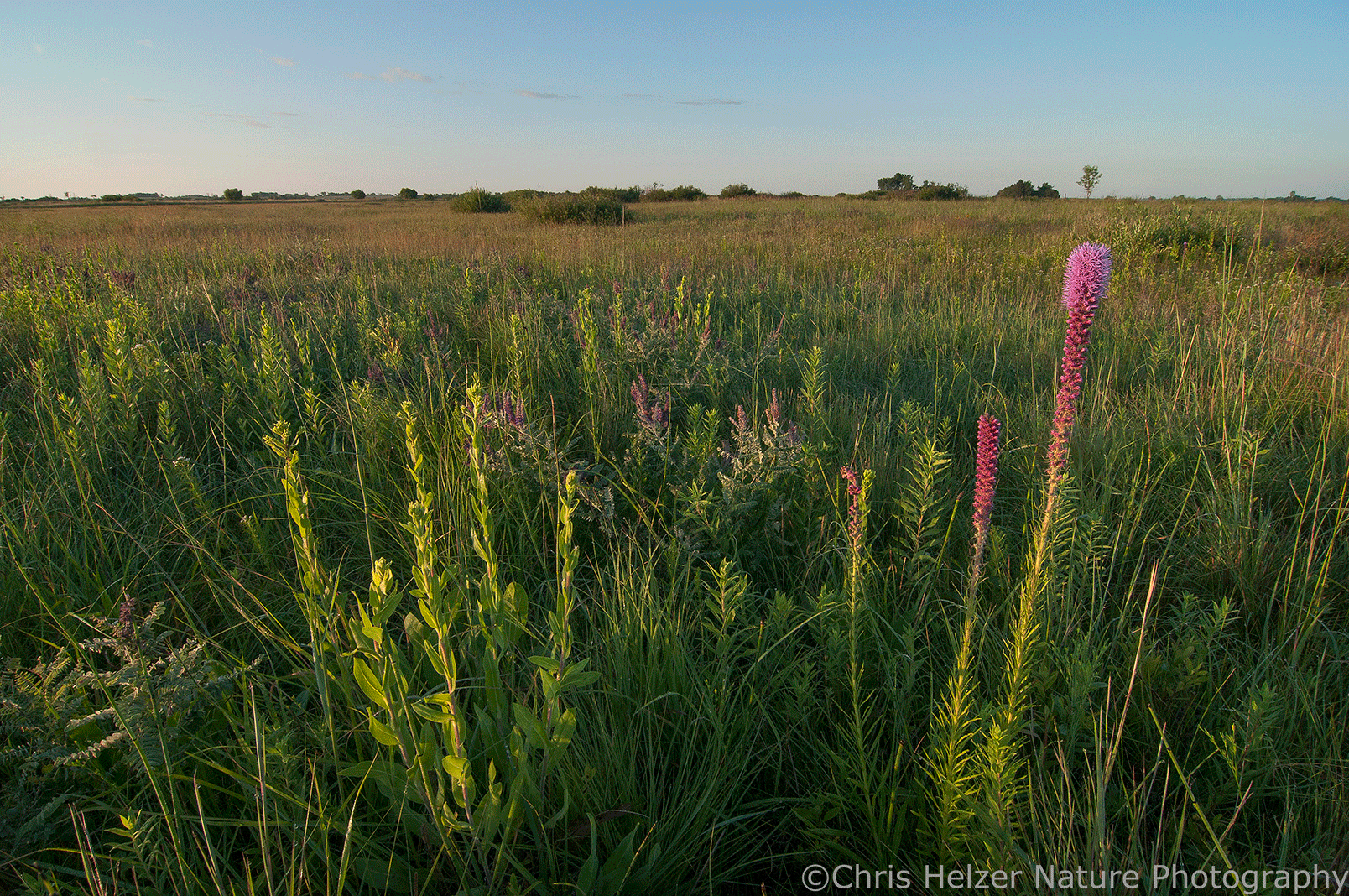
It’s always a pleasure to visit The Nature Conservancy’s Nachusa Grasslands in northern Illinois. If nothing else, it’s gratifying to see thousands of acres of restored prairie in a region where very little prairie exists otherwise. Planted prairie surrounds and connects small remnant prairies, wetlands, and savannas. The Conservancy started with little, precious ecosystem fragments and have built a prairie landscape that supports communities of plants and animals and gives them a decent chance of surviving into the future.
Plus, the place is gorgeous.
Most of the remnant prairie at Nachusa is on dry hilltops. They were surrounded by cropland, pasture, or trees, but are now embedded within a matrix of diverse prairie.
Nachusa Grasslands hosted this year’s Grassland Restoration Network. It’s a perfect place for a workshop made up of field tours and frank discussions about the challenges and successes of prairie restoration. Nachusa has a strong team of staff and incredible volunteers, and together they’ve built a program and site that is the envy of most of us in the grassland restoration world. Bill and Susan Kleiman, who live right on site, have been guiding that program since the early 1990’s.
During this year’s workshop, we spent a day and a half exploring (and marveling at) different parts of Nachusa Grasslands. We talked about their strategies for seed harvest, cleaning, and planting, invasive plant control, brush management, and the research and monitoring efforts that help them gauge success. We also went on a long evening tour in search of their bison herd.
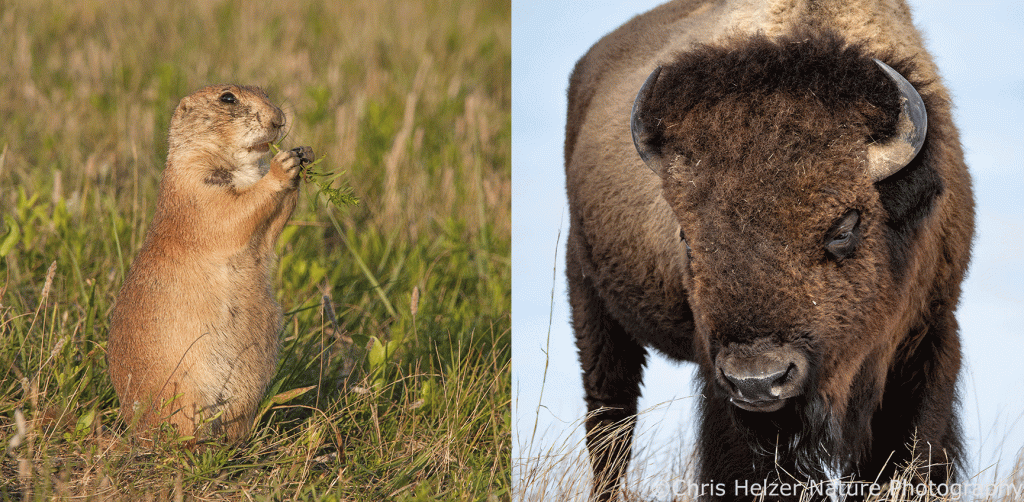
Oh yeah, did I mention they also have bison? Apparently, people get a kick out of seeing those. We did too, though it was getting pretty dark by the time we finally came across them.
Each of the workshop tours was led by staff or volunteers who shared their experience with the 100 or so people in attendance (we had five sets of tours during each session, so group size was nice and small). What makes the network so fun, though, was that the field tours often turned into discussions among both experienced and relatively new ecologists and land stewards. Conversations were lively and fruitful, with people asking questions and sharing their own experiences.
Long-time volunteer Bernie Buchholz (center, facing away) talks to a group at an 80 acre unit he has been restoring and managing for many years.
Some of the keys to success at Nachusa Grasslands are as follows:
Use lots of seed (50 lbs or so of bulk, uncleaned seed per acre), including forbs, sedges, and bunchgrasses (prairie dropseed, little bluestem, needle grasses, June grass, etc.). Use very little or no seed for Indiangrass, big bluestem, or switchgrass.
Burn woodlands/savannas frequently, combined with mechanical shredding/clearing of larger trees.
Be persistent and strategic with invasive plant control. Map plants/populations and hit them repeatedly with spot spraying, mechanical removal, or whatever the best method is.
Make sure invasive plants and their seed bank are cleaned up before spending the time and money on a diverse planting.
Empower volunteers to take ownership of the site, including giving them parcels to manage/restore, and provide them support from staff and a community of other volunteers.
The buildings, equipment, trainings, and strategies are all incredibly organized. It was almost intimidating to see, but very impressive.
If you’re interested in the in-depth content of our discussions last week, head over to grasslandrestorationnetwork.org. Bill Kleiman, Juli Mason, and Mike Saxton moderate the site, which includes helpful blogs by them, as well as lots of guest posts by others in the field. I’m guessing there will be a summary of this year’s workshop coming soon, but you also can search for and read about lots of topics they’ve already covered. It’s a terrific, practical, easy-to-read resource.
For the rest of this post, I’m mostly going to show you photos from Nachusa Grasslands, with a little commentary. If you live or are traveling nearby, please don’t miss the opportunity to stop by and explore the site for yourselves.
Here’s Bill Kleiman (standing with the white shirt) talking about invasive plant control.This savanna is on a good trajectory. Frequent fire has greatly reduced the abundance and density of honeysuckle and native plants are thriving in the dappled sunlight beneath the oaks, hickories, and other trees.Prairie bushclover (Lespedeza leptostachya) is a federally listed rare plant that grows in dry upland prairie habitat. Scientists think it might thrive best with grazing, so Nachusa staff and researchers are closely watching the effects of the bison.Much of what is now prairie at Nachusa started out as dense, brushy woodland. Converting the woodland to prairie/savanna takes time, fire, seeds, and lots of invasive species management.A robber fly on its overnight roost at sunrise.Perennial sunflowers (probably Helianthus laetiflorus) at sunrise.Rough blazing star (Liatris aspera) in restored prairie.Sarah Bailey from Prairie Plains Resource Institute looking across a big patch of showy goldenrod.Perennial sunflowers (H. laetiflorus?)A pearl crescent butterfly in the early morning.Assassing bug on roundheaded bushclover.A dead fly infected with Entomopthora fungus that made it crawl high up a plant before it died.Banded garden spider with captured katydid.Gerardia (false foxglove) flower. Not sure what species, but maybe Agalinus purpurea?It’s fun to see bison in tallgrass prairie. Or what we could see of them in that tall vegetation.It’s also fun to see bison and bur oaks together.Sometimes, like in this case, you can see the bison from the unstaffed visitor center. Nachusa’s headquarters is in the background.Prairie at sunrise.More prairie at sunrise.Wild white indigo pods and sunrise.Cream gentian at sunrise.Assassin bug on a sunflower head.Morning prairie with indigo, blazing star and much more.
Hoo boy, things have really picked up in the ol’ square meter plot over the last several weeks. Maximilian sunflower and pitcher sage are both in bloom and there’s a lot of action going on around those flowers. Actually, there’s a lot of action away from the flowers, too. Here are a few photos from mid-August through the first week of September.
The hilariously-named ‘twice-stabbed stink bug’ has been hanging around consistently. There are almost always several of them on the few flower heads of pitcher sage (Salvia azurea).
I missed much of one week in late August because I served as a juror on a criminal trial. It was really hard to be away that long at the peak of wildflower season. I did sneak away one evening, but I still missed a lot of the week. I don’t like to think about everything that happened when I wasn’t there. I’ve been trying to make up for that lost time ever since.
(To be clear, when I say I snuck away, I don’t mean that I snuck out of the courtroom. I’m not quite up to that level of obsession. I went home after we were dismissed for the day and then drove over to Lincoln Creek Prairie. I even told Kim I was going. Maybe ‘sneak’ wasn’t the right word to use at all, now that I’m thinking about it.)
This derbid planthopper was one of my favorite finds during the first iteration of this project back in 2018. It was fun to see the species reappear this year.
I’m still seeing a lot of new species showing up in the plot. I’m up to about 270 species of plants and animals (and fungi) so far this year. That’s way above the 113 species I photographed in 2018. As I’ve said before, I think there are lots of reasons for the higher number this year. The prescribed fire this spring almost certainly played a big role, but I really think I’m just a better observer this time around.
Cucumber beetles (ladybug-sized beetles but yellow/green with black spots) are another consistent species in the plot.
I’m also seeing a lot of familiar species. There are a few plant species from 2018 that aren’t around this time, but the net count is higher this year than 6 years ago. I miss stiff sunflower (Helianthis pauciflorus) and sideoats grama, but the addition of pitcher sage (and several others) takes the sting away.
Speaking of stings, the other day, I met a high school class at Lincoln Creek Prairie (where my plot is) to teach them some plant identification. While I was doing that, I talked about why you shouldn’t be afraid of bees and wasps that are nectaring on flowers. To demonstrate, I picked up one of each (just let them crawl onto my finger). The kids were pretty impressed with that. Then we walked past my square meter plot, and as I tried to explain what I was doing, and why, I lost them completely. I should have just stopped after the bee/wasp demonstration.
Large milkweed bug on a butterfly milkweed pod.
Late last week, I came across a white patch near the top of a sunflower plant. My first thought was that it might be a fungus. Looking closer, it was obviously some spittle bugs feeding and creating a protective refuge of bubbles. In fact, I was able to watch the bubbles coming right out of the wiggling rear ends of the larvae. How about that for fun? Prairies have everything…
This is the first time I’ve found spittle bugs in the early stages of building up their bubbly shelter. You can see the rear ends of two larvae sticking out of the bubbles.
I’ve been a little surprised not to have seen more predatory invertebrates in the plot, given the high numbers of potential prey. Lynx spiders are still hanging about and catching a wide variety of food items. An ambush bug has also shown up and is hunting on the sunflower blossoms.
I keep expecting to see some spider webs, but I haven’t seen any since early summer. I also haven’t seen any praying mantises. Or robber flies. There’s still time, I guess.
Lynx spider with a long-legged fly.Ambush bug on Maximilian sunflower.
In 2018, I was surprised not to see many grasshoppers. I wondered at the time if the amount of thatch in the prairie (it wasn’t burned that year) was the reason. This year, whether because of the fire or not, I’m seeing a lot more grasshoppers. I’ve found at least three species, but I’m wondering if a few more will end up on my list after an expert looks through my images.
Red-legged grasshopper (probably) on Maximilian sunflower.The same grasshopper and sunflower species.
Unsurprisingly, the abundance of blossoms has attracted an abundance of bees (and flies and wasps, and beetles, and bugs…). There have been lots of bee species, including three bumble bee species and a bunch of little solitary bees. What I haven’t seen since butterfly milkweed stopped blooming, though, is a honey bee. There were lots of those around back in June, but I wonder where they went? Maybe there’s something nearby more attractive than sunflowers, but, if so, I’d like to know what it is!
Not that I mind the absence of honey bees, of course. I’m perfectly happy to see a bunch of native species that don’t have to worry about competing for resources with those hyper-organized little buggers. There’s enough air traffic without them.
Native bees are really enjoying the sunflower blooms.American bumble bee (Bombus pensylvanicus) on pitcher sage.Eastern bumble be (Bombus impatiens) on Maximilian sunflower.
Goldenrod soldier beetles are definitely the most abundant and consistent of the square meter plot insects right now. I see them in the morning, I see them in the evening, and they’re around all day long. They make great photo subjects because they tend to tolerate my presence and hang out in plain sight (as opposed to a lot of insects that either fly off or scurry to the other side of a flower or stem when my lens approaches). As a result, I’ve got a huge number of soldier beetle photos and I’m sure more will be coming.
Soldier beetle and sunflower silhouettes before sunrise.Soldier beetle and sunflower.Another soldier beetle and more sunflowers.
I feel like I have to constantly remind people that the square meter photography project is not all about the species count. Sure, it’s fun to highlight the diversity of prairie species that can be found if you look closely, but that’s really only one component of the effort. I also want to show off the beauty, dynamism, and complexity of grasslands.
That’s why the project is so much fun. I’m discovering new photographic opportunities every time I visit. I look for the way the sun peeks between petals of a flower. I appreciate the upside down world as seen through a dew drop.
Also, this summer is the first time I’ve ever paid much attention to the flowers of little bluestem. I’ve photographed other grass flowers, but for some reason, hadn’t really looked closely at little bluestem. It’s in my plot, so I looked.
Sun and flowers.Big bluestem and dew drop.Dew drop on sunflower leaf tip.Big bluestem flower inside a dew drop.Little bluestem flowers on a dew morning.
Even species and aspects of prairies I’ve seen and photographed many times can be new and interesting when I force myself to look at them. Instead of thinking, “Oh, I’ve already got plenty of photos of Indian grass flowers,” I have to think, “Hm. How do I capture this particular set of anthers in an interesting way.” It’s a terrific catalyst for creativity.
Indian grass flowers.Big bluestem flowers and early morning sun.
Despite what I just said about the project not being just about a species count, it is really fun to find something new almost every time I visit. It’s also astounding to me how many different species I’ve found within some groups of organisms. In 2018, for example, I was excited to have photographed 21 different fly species. This year, I’m well over 50, and probably closer to 60 (I need more help distinguishing between them). I’ve found more than 40 beetle species and at least 25 bees, as well, but it’s the diversity of flies that most fascinates me.
In particular, hover flies have really caught my attention. It’s not like I’d ignored them before, but I’m seeing a lot of new species I’d never seen (or had never recognized) before and I’m loving it. I’m including just a small subsample of those below to give you a taste.
A hover fly (Toxomerus politus) and big bluestem. Note the streaks of pollen blowing out of the anther below the fly.Another hover fly in the Syrphidae family.
I’d known that Syrphid fly larvae were predators, so I didn’t even think about them when I wondered what the tiny pale larvae were that crawl around on big bluestem flowers. I’ve seen those little larvae for years, and even have a few photographs of them. But it wasn’t until I photographed them in the plot and submitted the photos to bugguide.net that I learned what they were.
Syrphid (hover) fly larva on big bluestem.A hover fly larva apparently feeding on the same anthers the adults have been feeding on.
Another group of hover flies is also known as drone flies. I’ve noticed them before because they look a lot like less-fuzzy bees, but hadn’t really paid close attention to the different species. I still struggle to tell some of them apart, so I rely on bugguide experts to help. I’m getting better, but I still guess wrong – sometimes confidently so.
Hover flies (aka drone flies) (Eristalis stipator, I think)Another Eristalis hover fly.Face-to-face with a hover fly.A different hover fly with speckled eyes (Eristalinus aeneus).
One of my all-time favorite statistics is that there are around 61,000 fly species in North America. That seems extraordinary, but feels a little more reasonable when I think about the diversity I’ve seen in my tiny focal area. A lot of North American fly species have yet to be named and recorded. That also feels understandable, given how incredibly small lots of them are.
I’ve seen two little flies within the last couple weeks that even my 2x macro lens struggles to capture details of. Even when I crop the image enough to see details, the graininess of the image makes it nearly impossible. The one in the photo below is only the second smallest I’ve seen.
A teeny weeny little fly.
I can already feel the end of the sunflower bloom coming, which has increased my sense of urgency to be at the plot as much as I can. I think all the buds have opened now, and a number of the flowers have started to senesce. There’s a lot of beauty in that senescence, too, so it’s not all bad news, but I’ll sure miss the hordes of pollinators buzzing around when their favorite food source dries up.
A fading flower.
Of course, some of the flowers wilt reasons other than old age. Just as I did in 2018, I’m seeing multiple flowers that have been hit by head-clipping weevils. These insects girdle the stem below a flower head, which causes it to tip downward and start to dry up. They then lay eggs on the disc of the flower head. Later, those eggs hatch and the larvae feed on the decomposing tissue (often after the flower has fallen to the ground). Scientists think the weevils girdle the stem to make the flower less attractive to other egg-laying insect species, reducing competition for their own larvae. Pretty smart!
A sunflower girdled by a head-clipping weevil.
I’ve photographed what I think are head-clipping weevils several times this year, but last week, I was finally able to photograph one in the tipped-down flower head itself. The logistics of that weren’t easy because the flower was about two-and-a-half feet off the ground, so I had to lie on the ground with my upward-pointing camera on a tripod. Then, I had to somehow lift myself up with one hand while trying to both focus and activate the shutter with the other. All this happened while I was staring into a bright sky and trying to see what was inside the deep shadows of the upside-down flower.
Looking upward into the flower where the weevil is hanging out.The same weevil exiting the flower.
Fortunately, this happened in the presence of Ethan and Dakota from Platte Basin Timelapse, who have been helping me document both the plot and my photographic efforts this summer. They happened to be on site when I was contorting my body below the sunflower, so there will probably be footage emerging at some point. Stay tuned.
By the way, if you haven’t visited Platte Basin’s website, you’re really missing out. In addition to a huge series of extraordinary timelapse videos, they also do a tremendous job of creating videos on a wide range of nature and conservation topics. Check them out!
Ethan Freese (left) and Dakota Altman (right) of Platte Basin Timelapse hanging out with me at the plot last week.
Ok, I’d love to write more, but I just got back from another visit to the plot and I’ve got a couple thousand images to sort through! I’ll show you some of them in a few weeks. I’m also trying to figure out logistically feasible ways of letting you explore the full library of images, or at least a big portion of them at some point. I think you’d find it really inspiring, but I don’t know yet how to do it in a way that’s not completely overwhelming.
In the meantime, I’ll keep working. I get to go to the Grassland Restoration Network workshop in Illinois this week, which is going to be fantastic. On the other hand, I’m going to miss a big chunk of time with the Maximilian sunflowers and pitcher sage flowers. I sure hope some of them are still blooming when I get back. (Since I’m putting in wishes for consideration, I’d also like to have a monarch or two roost overnight in the plot, too. But only, of course, when I’ll be around to see it.)