Worrying About What We Can Control

Reminder – our 2023 Platte River Prairies Field Day is THIS SATURDAY, July 8. We will have sessions running between 7am and about 2:30pm and you can stop by anytime. This is a free, family-friendly event. Here is the final (?) schedule for the day. Please RSVP (email address in the link) if you plan to come so we can be prepared. The weather forecast looks fantastic!

But anyway, here’s today’s post. It’s a little long (but with lots of photos). If you restore or manage prairies, though, I hope it’ll be thought-provoking and helpful.

How much influence does land management have on prairie plant communities? Two research projects from the University of Nebraska-Lincoln have shed some light on the relative importance of management versus ‘abiotic’ factors such as soil texture, and nutrient levels (especially nitrogen). This week, I was noticing the visual evidence of what Rae Powers and Katharine Hogan found during their graduate research. You can read more about their projects at the end of this post.

Take a look at the photo below. (If you click on these photos, you’ll get much bigger and more clear versions. If you’re reading this within an email, click on the title of the post to open it online and then you can click on images.)

Photo #1. 2002 Planting, west end. July 4, 2023 photo.

The plant community in the above photo is visually dominated by invasive grasses – smooth brome and annual bromes – with some non-native mullein plants in the background. Yuck.

The next photo shows the same site, not far from where the first photo was taken. The second photo is dominated by mullein plants with an understory of annual bromes. If you look closely you can see some native grasses and some ‘weedy’ native wildflowers like hoary vervain and yarrow.

Photo #2. 2002 Planting, west end. July 4, 2023 photo.

If you have much experience with prairie management and restoration, you’ve probably formed an opinion of the prairie planting they’re in, which is over 20 years old. That opinion is probably not very positive. This prairie is a mess, right?

Ok, here’s photo #3:

Photo #3. 2002 Planting, southeast quarter. July 4, 2023 photo.

Now we’re talking! This looks way better. It’s visually-dominated by native species, including sand lovegrass, stiff sunflower, big bluestem, roundheaded bushclover, and sundrops (Calylophus serrulatus). Since I took the picture, I can tell you the scene also features purple prairie clover, shell-leaf penstemon, and Junegrass, among other other plant species. It appears to have nice plant diversity and very few invasive plants.

One more photo:

Photo #4. 2002 Planting, southeast quarter. July 4, 2023 photo.

The fourth photo is pretty grassy, but the grasses appear to be mostly native species. Lots of big bluestem, Indiangrass, switchgrass, little bluestem, and others. Not a great place for bees and butterflies to find nectar, but decent habitat cover for some wildlife species.

If you’ve glanced at the captions of those photos, this next statement won’t be a surprise. All four of those photos were taken on the same day from the same prairie planting. What in the world could explain the huge differences between the conditions across that single site? The site, by the way, is about 64 acres in size and was planted with 218 species in late 2001 and early 2002. Here’s a map, showing both the 2002 planting and another one planted in 2000 that I’ll talk about shortly. You can also see a remnant prairie to the west (left) of both those plantings.

See all those patterns in the 2002 planting? They show the alluvial soils that underlay both the remnant (unplowed) and restored (replanted from crop field) portions of this area. In dry years (as in when this aerial image was created) you can really see the old river channels and sandbars upon which today’s prairie grows.

Long ago, the 2002 planting site was leveled for farming. They made it flat so they could irrigate it by running water down the rows. During the leveling process, they knocked the tops off the old sandbars (including the topsoil that centuries of prairie growth had generated) and pushed the soil into the old river channels. As a result, the dark green streaks in the above map have multiple layers of topsoil and the brown areas between have very little.

The differences in soil texture, nutrients (especially nitrogen), and organic matter across that old alluvial network have tremendous influence on plant communities – especially in dry years. Here’s one more photo of the same 2002 planting that really illustrates that. The green stripe down the middle is dominated by native grasses like big bluestem and native forbs like stiff and Maximilian sunflowers (and lots of others). The areas on each side are full of annual bromes and ‘weedier’ native plants like tall dropseed, daisy fleabane, hoary vervain, and others, as well as a few mullein plants.

Photo #5. 2002 Planting, west half. July 4, 2023 photo.

There’s no difference in management between the green and brown areas in the above photo. What’s driving the starkly different plant communities is mainly the soil pattern beneath them (interacting with weather patterns). Among other things, the higher organic matter beneath the green areas have buffered plants much better from the effects of the drought over the last couple years. Often, sandier soils with lower nitrogen foster the highest plant diversity, but drought interactions complicate that and our plant communities can look very different from year to year.

It’s definitely messy, but not necessarily in a bad way. In fact, once you get used to it, it’s fascinating to watch over time. In years of abundant rainfall, the ‘droughty’ areas are pretty green and have decent plant diversity, including both native and non-native plants. In dry years, the soil contrasts are exacerbated and noticeable – like they are this year.

.

It’s taken me a long time to accept that prairies I’ve planted have areas that are pretty and diverse (as I’d envisioned while harvesting seed) and others that are, well, less so – especially in some years. That happens regardless of matter how well we harvested seed, how diverse our seed mixes were, and how diligent we were about site preparation and post-planting management. Some soil patches favor dense grass, others favor opportunistic and/or invasive plants, and others foster diverse plant communities.

At the Platte River Prairies, we’re lucky that those soil variations are intermixed, which automatically creates a lot of heterogeneity across every prairie. In both remnants and restorations, there are dry and ‘weedy’ patches, patches of dense grass, and patches of high plant diversity with lots of the wildflowers we worked hardest to establish. As a whole, all that variety creates lots of habitat for lots of different species.

Now, that doesn’t mean management doesn’t matter. Plant composition and diversity are not pre-ordained by soils, they’re just somewhat constrained by them. Both Rae and Katharine found that while abiotic factors controlled a lot of the variation in plant composition, management had strong impact on plant species richness and evenness (the abundance of species relative to each other).

Here are some visual examples of how that plays out on the ground. The following images show scenes from the 2000 Prairie Planting just to the south of the 2002 Planting we were just looking at.

The first two images below show a portion of that prairie that was unburned and lightly grazed for a couple years before being completely ungrazed this year. They are in a portion of the site that favors plant diversity (sandy soils with low nitrogen) but management has favored grass dominance over the last few years. That management, though, has also encouraged plant species that cattle especially like to eat, including entire-leaf rosinweed (Silphium integrifolium) and Canada milkvetch (Astragalus canadensis).

Photo #6. 2000 Planting, east half. July 4, 2023 photo. Note the abundance of rosinweed (tall) and Canada milkvetch (bushy), both of which will bloom soon.
Photo #7. 2000 Planting, east half. July 4, 2023 photo. There is lots of grass, but also purple prairie clover in the foreground, sensitive briar in the background, and other wildflowers intermixed.

Now, here are three photos taken a short distance away, in the same general soil type on the west side of the dotted line in the map above. The prairie here was burned in 2021 and grazed hard all that year. Last year, it was grazed fairly lightly and is ungrazed this year. The impacts of that fire and (especially) grazing from 2 years ago is still very evident. Grasses are much less dominant here than the lightly grazed area just to the east, and the diversity and abundance of flowers is much higher.

Photo #8. 2000 Planting, west half. July 4, 2023 photo. The fire and grazing in 2021 has encouraged an abundance of blooming flowers and shorter, less dense grass.

In the above photo, there is an abundance of purple prairie clover in the foreground, along with yarrow, stiff sunflower, compass plant, rosinweed, cudweed sagewort, upright prairie coneflower, and other wildflowers. In the photo below, Junegrass is having a great year, probably because of the reduced vigor of big bluestem and other taller grass species.

Photo #9. 2000 Planting, west half. July 4, 2023 photo. Junegrass (the brown seed heads) is particularly abundant here.

The soils aren’t driving the differences seen in these last 5 photos – management is. Those management impacts are mostly temporary, though. If we don’t burn or graze that west area where flowers are abundant this year, we’ll likely see fewer flowers and more grass dominance next year. Cody is planning a summer burn on part of the east area where grasses are currently dominant, and then hopes to let cattle in to graze the aftermath of that burn. That will push that area toward a higher abundance of wildflowers for a while.

.

Basically, what we’re seeing here is that soils set the stage for a plant community and determine what plant species are best adapted to grow in a particular place. Management, then, helps determine the relative abundance and dominance of those species (interacting with weather patterns). Grazing on our sites tends to foster higher plant diversity (especially during recovery periods after season-long grazing bouts) and changes the competitive environment.

Some plant species thrive best when an area hasn’t been grazed for a while. Others respond most positively during or shortly after grazing. By cycling through periods of grazing and rest, we hope we’re giving all those species a chance to hang around (and our long-term data supports that).

The data and patterns I’m talking about here are only part of what Rae did for her Master’s degree and Katharine did for her PhD dissertation (not yet available). Their work described what they saw here at the Platte River Prairies and nearby prairies at the Crane Trust. The broad idea that soils constrain plant composition and management influences plant diversity and relative abundance probably extrapolates to most grasslands. The patterns might be a little more obvious in our alluvial soils, though, especially on previously-leveled crop fields planted to prairie.

If you’re restoring/reconstructing prairies or managing them, I’m hoping this information helps you better understand your sites and what’s happening there. For me, it’s been helpful to accept that the impacts of our land management (and restoration) practices are limited. Prairies are really dynamic but the potential variation within a particular plant community is restricted by soils and heavily influenced by weather patterns.

As a result, the old adage, “only worry about what you can control” applies here. Don’t beat yourself up because parts of your site are less ‘pretty’ than others and/or more prone to invasion than others. Instead, explore and document the possible range of variation within plant communities in different locations. Some areas might be able to facilitate tremendous plant diversity, while others might favor a few species over all others or fluctuate wildly based on annual rainfall patterns. Once you know the limitations of particular areas, you can make (and evaluate) stewardship decisions appropriately.

I’m going to end by sharing two more photos from the 2000 planting. Prairies can look very different from year to year. They’re incredibly dynamic and adaptable (and not just the plant communities). These two photos are representative of how the 2000 planting looked in September 2022 and in August 2017. In both cases, the photos were taken a year after the site was burned and grazed all season. One was a drought year (2022) and the other was a year of at least reasonable moisture (2017). Both are within the range of variation possible for that site.

2000 Planting in September 2022 (drought year).
2000 Planting in August 2017 (non-drought year).

Have fun. Experiment. Find out what range of variation your soils can provide and then play in that space.

Reporting Live (on tape) from the 2023 North American Prairie Conference

The Hubbard Fellows and I just returned from the 2023 North American Prairie Conference. I got to meet and/or catch up with a lot of you there, which was wonderful. It was a terrific event; exquisitely organized, very informative, and – as always – inspiring. Here is a quick recap, along with a few highlights and topics that I found helpful and thought-provoking.

A tour participant photographs abundant wildflowers at a restored (reconstructed) prairie planted by Jon Judson (Diversity Farms) about an hour west of Des Moines.

More than 600 people attended at least part of the four day conference. If you’ve not attended a North American Prairie Conference (NAPC), you might expect it to be full of academic scientists and professional biologists presenting research papers. Those folks were there, for sure, and there were a lot of scientific presentations. But the attraction of the NAPC is the breadth of discussion topics and attendees. In addition to ecology and land stewardship, there were presentations on art, storytelling, agriculture, diversity/inclusion and more. There was also a lot of discussion about prairie invertebrates this year, which I (of course) found gratifying.

A large percentage of attendees are directly involved in restoring or managing prairies. Quite a few of them are professional biologists – or interns working in that direction. Many others, though, are not. They’re people with non-conservation jobs who have fallen in love with prairies and want to learn everything they can about them. They also want to DO something to help. Incredible.

There were also quite a few landowners who were looking to trade ideas and gather information to help them restore habitat on their farm or acreage. Some of those people have been doing tremendous work for a very long time and have a wealth of knowledge. Others are just starting out. Both were fun to talk with and listen to.

Beth Henning (left) led part of the field tour I was on. Her 90 acre property was a prime example of what can be accomplished by one or two dedicated people who learn, adapt, and pour their energy into a site.

As always, the field trips were a big highlight of the conference, and there were lots of options available. Everyone I talked to found their tour to be inspiring and educational, which says a lot about the amount of great work going on in Iowa prairies. My tour was invigorating too – we visited properties owned and managed by Beth Henning, White Rock Conservancy, and Jon Judson.

Beth’s property was gorgeous, and we saw examples of the intensive work she and her late husband have done to restore prairie and savannah habitats across the site. I loved listening to her talk about learning and adapting through time, and the results were spectacular. She also spoke positively about the conservation easement she’d placed on the property through the Iowa Natural Heritage Foundation.

We then visited adjacent land owned by the White Rock Conservancy. Formed by the Garst family, the non-profit land trust is involved in land restoration, agriculture, recreation, and much more. They have some great habitat work going on and it fun to see a portion of that.

Prairie coreopsis in restored prairie at White Rock Conservancy.

Finally, we ended up at land owned by Jon Judson of Diversity Farms. Jon provides restoration services and harvests prairie seed and had worked with both Beth and the White Rock Conservancy. At his site, we looked at a beautiful remnant prairie and a prairie planting adjacent to it. It was a site rich with colors and texture.

During the conference, the topic of mental health came up multiple times. In particular, people were talking about how to keep from slipping into despair in the face of the seemingly overwhelming challenges we face in land management. Threats from invasive species, climate change, public apathy, and others seem to always be growing. How are we supposed to stay positive and find joy in our work?

There were lots of good suggestions made, including taking plenty of time to stay connected to nature and to celebrate successes. I’ve written here before that it helps me to remember that we don’t have to fix nature, we just have to keep it operational and then hand it off to the next generation, who will have new technology and ideas to apply to the job.

A big patch of New Jersey tea (Ceanothus sp) in remnant (unplowed) prairie.

For what it’s worth, I also think its important that we don’t spend too much time looking backwards and thinking about what a site used to look like. It’s easy to fall into the trap of using that past state as a target for future condition, even though the world has changed in ways that probably makes that impossible. The past is helpful context, but our prairies, savannahs, and woodlands are all on a trajectory of change. Our job is to help facilitate that evolution and to keep them as healthy, diverse, and resilient as we can along the way.

It can be depressing to lament the way things used to be. On the other hand, it’s uplifting to wonder where they’re going and how we can help! These ecological communities are exceptionally adaptable, especially if we manage them well. We’re like their pit crew – just keeping them in good shape as they drive forward.

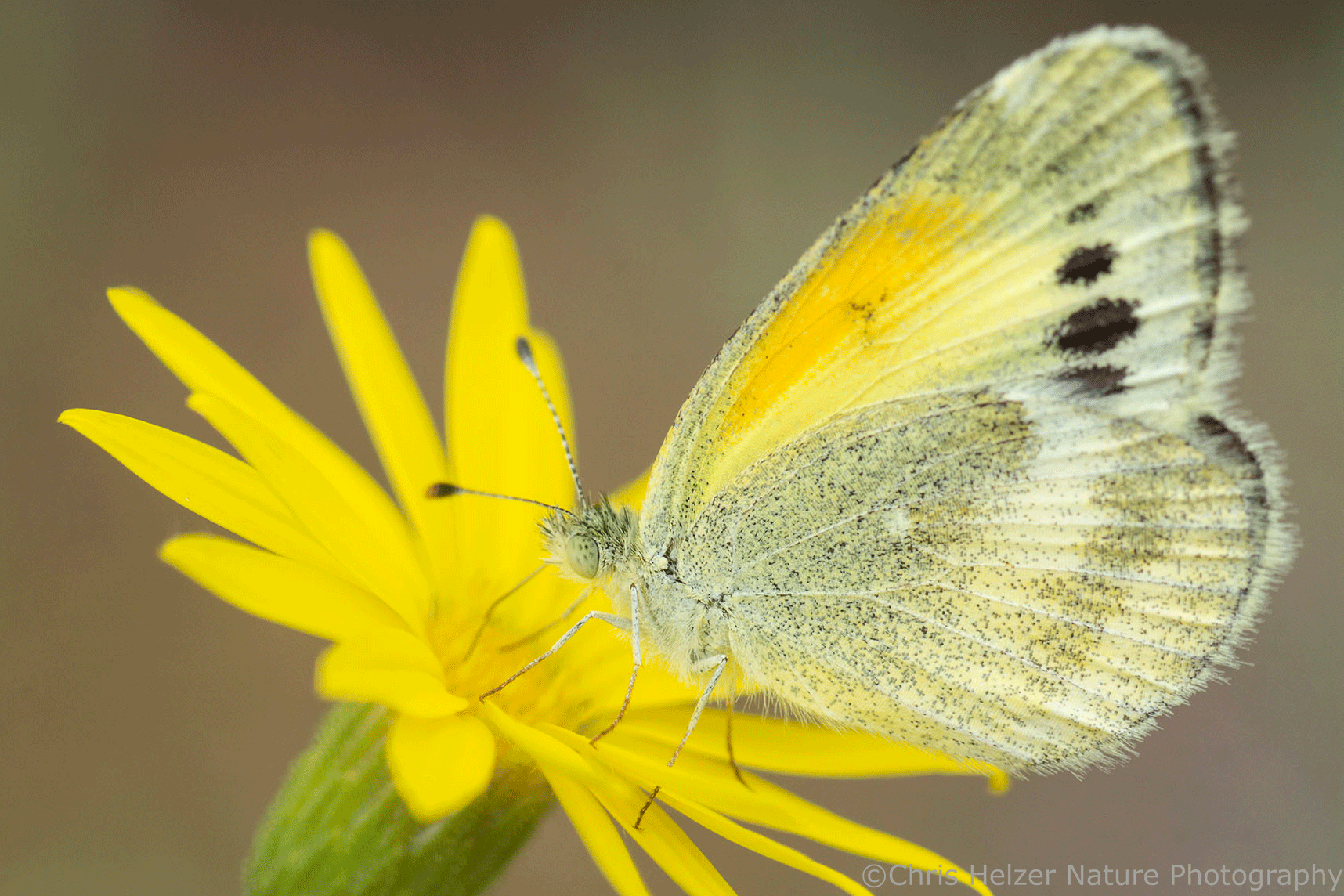
I didn’t have a lot of time to photograph insects during my field trip, but I managed a few. A pearl crescent butterfly (I think?) on New Jersey tea.
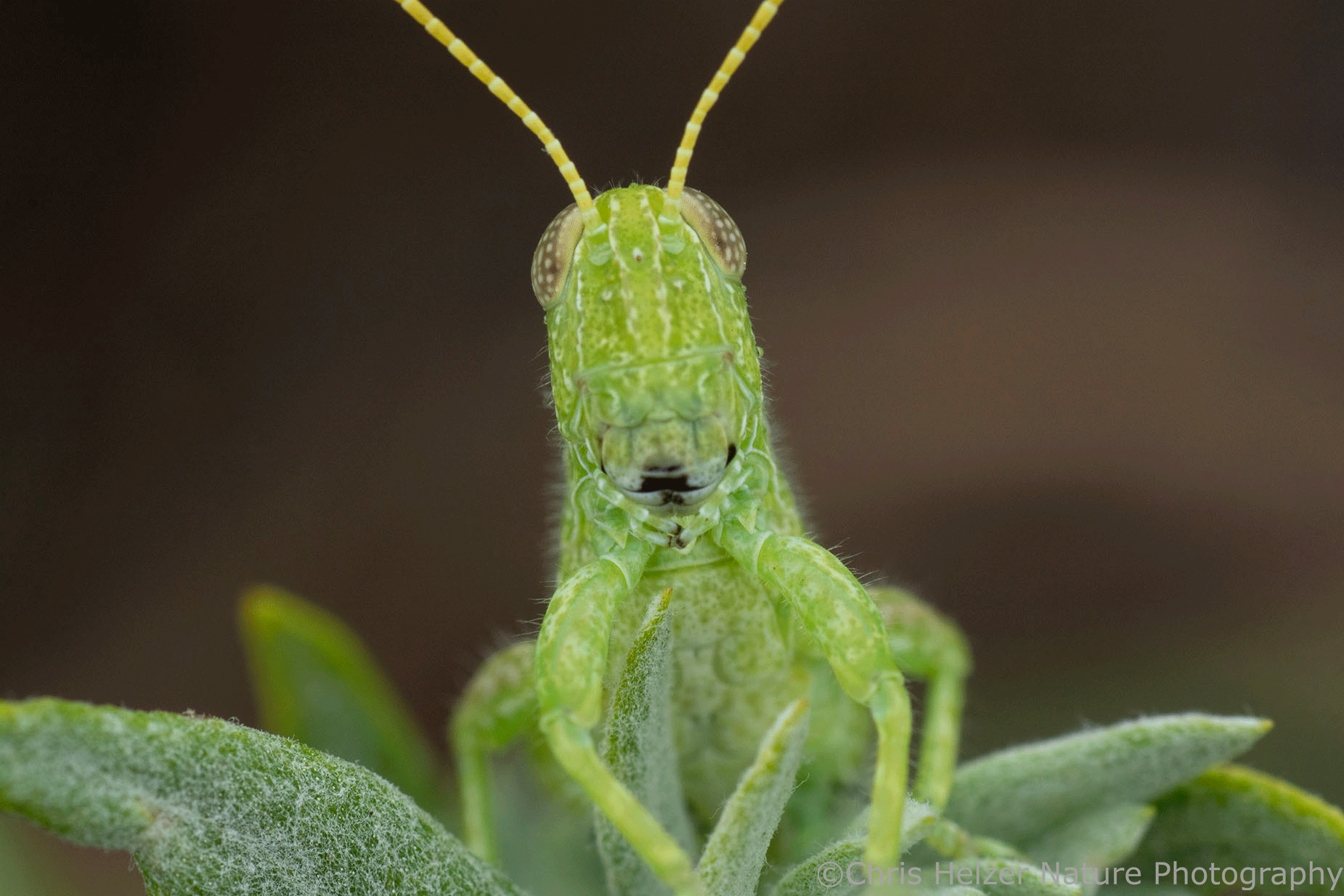
A grasshopper on New Jersey Tea.

Another theme I pulled from the conference was that private landowners are doing some amazing restoration work (both enhancing degraded sites and planting new prairies). In many cases, these landowners start with little to no ecological background, but have become experts through practice and exploration. Iowa has some excellent advisors for those landowners, but I got the sense that much of those landowners’ success is due more to persistence and adaptive management.

People like Beth Henning and Sybilla and Bill Brown have greatly enhanced the habitats they’re working with over many years. They’ve certainly sought and gotten good advice along the way, but I love how much they’re also willing to try out their own ideas, too. Sometimes, those ideas run counter to widely accepted dogma. That doesn’t mean they’re wrong.

The kind of experimentation (yes, Beth, I used the word) being done by these landowners is what pushes all of us forward in our understanding of how to do ecological restoration. Not everything works out, but every trial is an opportunity to learn and improve. I’m really glad those innovative landowners are willing to share what they’ve gleaned from their long years of experience. It’s really inspiring.

Jon Judson (center) points out features of the remnant prairie on his property.
The group explores restored (reconstructed/replanted) prairie at Jon’s property.

There was much more I brought away from the conference, but here’s one final thought for this particular post. We saw abundant evidence, both on field trips and in presentations, that restoration work is making a difference. In particular, prairies that are being reconstructed – planted from seed – can develop into diverse communities that persist over many decades.

We’re still conversing about how to judge the success of those restoration efforts. In one of my presentations, I argued that we should focus heavily on how well planted prairies are improving the health and resilience of nearby remnants. I don’t think a planting necessarily has to closely resemble nearby or historic sites in terms of plant composition, soil communities, etc. If the animals and plants (and other organisms) in the remnant can spread into and through the planted prairie, that increases the long-term viability of that remnant. That seems like success to me (with plenty of caveats, of course).

Of course, we also want those planted prairies to persist and retain their biological diversity and habitat values over time. That means they need to be able to adapt to stresses like the much older remnant sites. At least two different presentations, including one by former Hubbard Fellow Katharine Hogan, shared data that supports that capacity.

I think that adaptive capacity should be a real source of optimism. Reconstructed prairie communities face the same threats as other prairies, and come with some unique challenges (low soil organic matter, for example). In spite of that, they seem to develop a resilience that will help us to help them survive and support nearby remnant sites.

A great spangled fritillary nectars on pale purple coneflower in a planted prairie. This is just one of countless species using and benefitting from this recently-established habitat.
Butterfly milkeed (Asclepias tuberosa) and pale purple coneflower (Echinacea pallida) in Jon’s prairie reconstruction.

Thanks again to everyone involved with the organization of this year’s North American Prairie Conference. I’m anxious to see who hosts the next one (no, it’s not going to be me). I got to catch up with old friends, meet new ones, and siphon some energy from the incredible vibe of the event.

Let’s all get out there and save the prairie!