Ok, here’s the final call. Please join us at The Nature Conservancy’s Platte River Prairies this Saturday. The weather is going to be spectacular and we’ve got some fantastic session leaders lined up.
The full schedule and directions to the site can be found here.
We’re asking for RSVPs via email (see the schedule/directions) so we have an idea how many people to prepare for. If you decide to come at the last minute and don’t RSVP, come anyway. We’d love to have you.
This moth looks like an airplane. It also desperately wants to meet you at the Platte River Prairies Field Day on this Saturday. As far as you know.
.
Why you should come:
#1. I mean, it’s free. How many free events do you get to attend? Not enough, that’s for sure.
#2. Don’t you like butterflies? Everyone likes butterflies. We’ll not only have butterflies, we’ll have Neil Dankert to identify them for you and tell you all about them.
#3. Maybe you don’t like butterflies, but you’re a huge fan of leaf beetles. If so, good for you. Don’t let anyone yuck your yum. Julie Peterson will be at the field day to talk to you about leaf beetles and any other invertebrate you catch with the nets we’ll let you borrow.
#4. How are you at plant identification? Would you like to be better? Sarah Bailey from Prairie Plains Resource Institute can help. She can also talk about lots of other aspects of plant and prairie ecology. See if you can stump her with a hard question. Good luck.
#5. Have you ever seen a plains pocket mouse up close? Did you know their cheeks are lined with fur? On the INSIDE? What’s that about? Mike Schrad will tell you. He’ll probably catch some pocket mice too – in nice safe boxes, from which he’ll then release them – and you can see what all the fuss is about.
#6. Our Hubbard Fellows are the best. Jojo and Sanketh will be leading a bird hike early in the morning and then taking people out to harvest seed later in the morning. You can come do our work for us!! It’s fun, though. After that, Jojo and Sanketh will be hanging around the rest of the day and will be very happy to meet you.
#7. I’ll be there. Say hi when you arrive! More importantly, Cody Miller, the preserve manager for the Platte River Prairies will also be there. Ask him how he controls invasive species or why he’s having our neighbor cut hay in weird patterns in some of our prairies. Or ask him about quantum physics. It’s not his specialty but it might be fun to ask him anyway.
.
If you don’t know anything about prairies, that’s a perfect reason to come. We’ve got lots of people who will find great joy in introducing you to this amazing ecosystem.
If you love prairies and want to learn as much as you can, that’s also a perfect reason. See above.
If you’re skeptical about prairies, or think they’re just a massive conspiracy designed to support “Big Wildflower” I’ll bet you’re fun at parties. Guess, what? You’re welcome, too. Just be nice, ok?
For those of you who aren’t able to travel, you can also join in the fun. Anytime between 7am and 2:30pm Central Time, walk outside, plug your ears, close your eyes and whisper, “I love prairies.” See what happens next.
(Let me know if something happens. Wouldn’t that be amazing??)
Anyway, I really do hope you can come. It won’t be the same event with you there.
Reminder – our 2023 Platte River Prairies Field Day is THIS SATURDAY, July 8. We will have sessions running between 7am and about 2:30pm and you can stop by anytime. This is a free, family-friendly event. Here is the final (?) schedule for the day. Please RSVP (email address in the link) if you plan to come so we can be prepared.The weather forecast looks fantastic!
But anyway, here’s today’s post. It’s a little long (but with lots of photos). If you restore or manage prairies, though, I hope it’ll be thought-provoking and helpful.
How much influence does land management have on prairie plant communities? Two research projects from the University of Nebraska-Lincoln have shed some light on the relative importance of management versus ‘abiotic’ factors such as soil texture, and nutrient levels (especially nitrogen). This week, I was noticing the visual evidence of what Rae Powers and Katharine Hogan found during their graduate research. You can read more about their projects at the end of this post.
Take a look at the photo below. (If you click on these photos, you’ll get much bigger and more clear versions. If you’re reading this within an email, click on the title of the post to open it online and then you can click on images.)
Photo #1. 2002 Planting, west end. July 4, 2023 photo.
The plant community in the above photo is visually dominated by invasive grasses – smooth brome and annual bromes – with some non-native mullein plants in the background. Yuck.
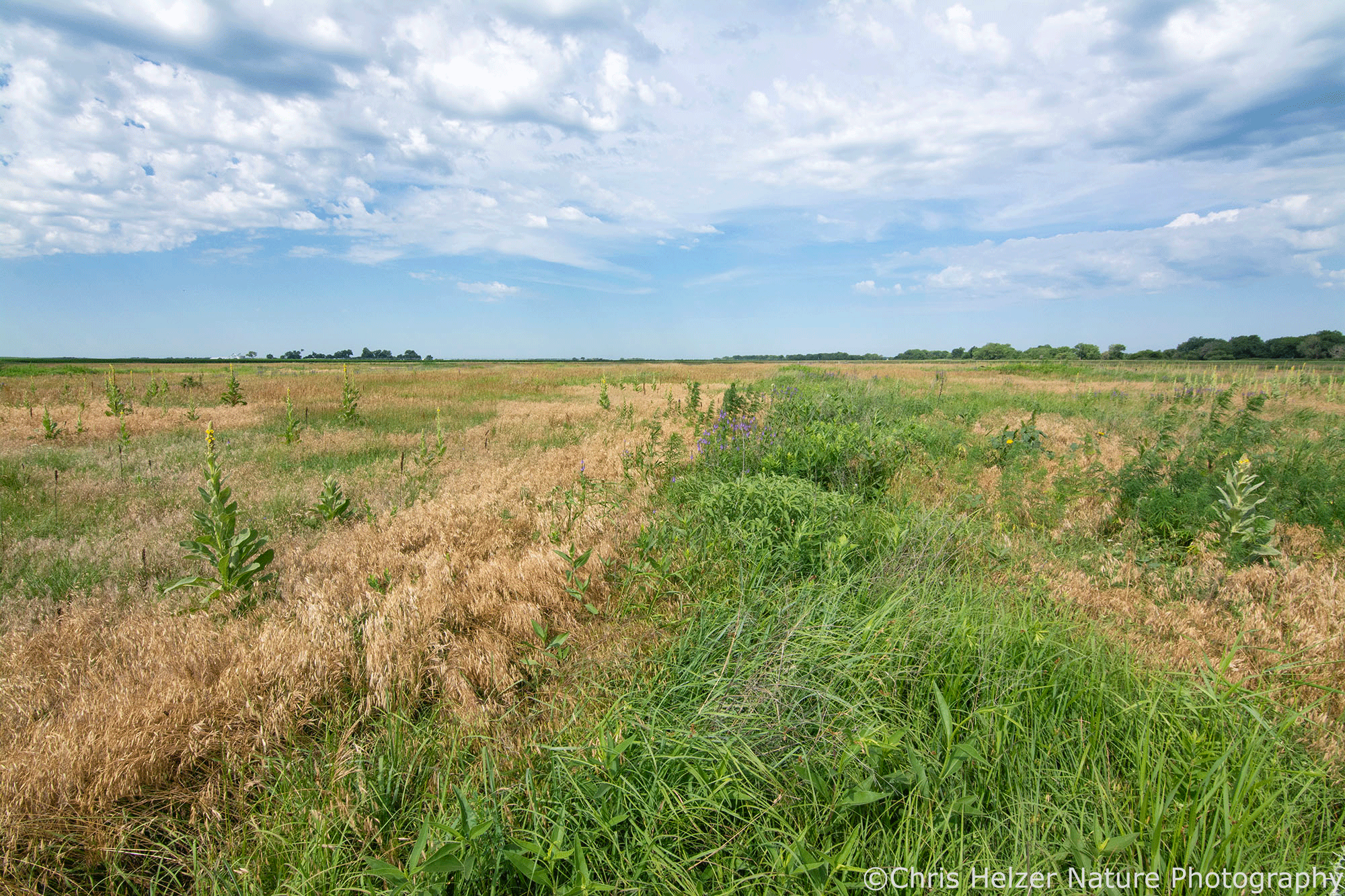
The next photo shows the same site, not far from where the first photo was taken. The second photo is dominated by mullein plants with an understory of annual bromes. If you look closely you can see some native grasses and some ‘weedy’ native wildflowers like hoary vervain and yarrow.
Photo #2. 2002 Planting, west end. July 4, 2023 photo.
If you have much experience with prairie management and restoration, you’ve probably formed an opinion of the prairie planting they’re in, which is over 20 years old. That opinion is probably not very positive. This prairie is a mess, right?
Ok, here’s photo #3:
Photo #3. 2002 Planting, southeast quarter. July 4, 2023 photo.
Now we’re talking! This looks way better. It’s visually-dominated by native species, including sand lovegrass, stiff sunflower, big bluestem, roundheaded bushclover, and sundrops (Calylophus serrulatus). Since I took the picture, I can tell you the scene also features purple prairie clover, shell-leaf penstemon, and Junegrass, among other other plant species. It appears to have nice plant diversity and very few invasive plants.
One more photo:
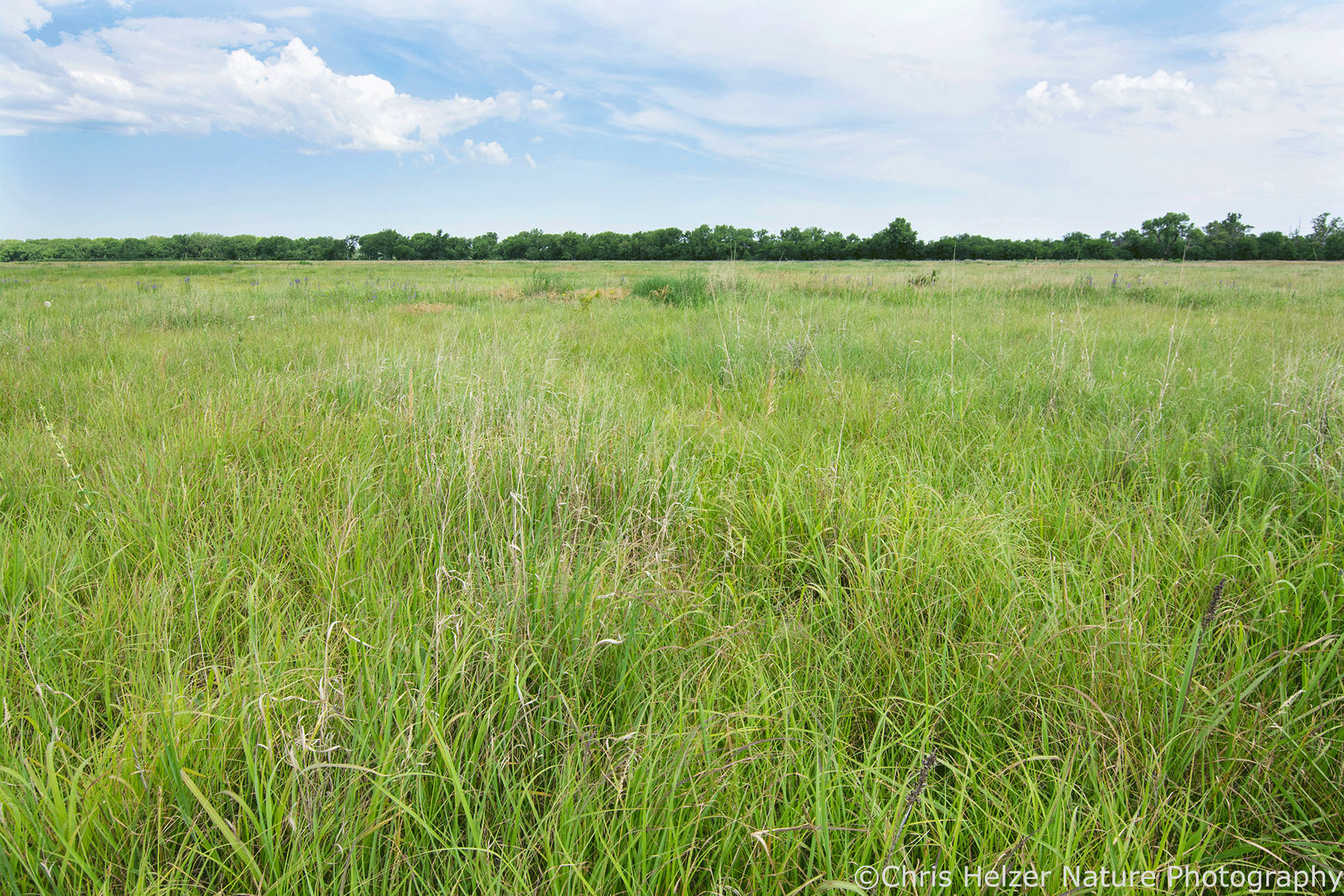
Photo #4. 2002 Planting, southeast quarter. July 4, 2023 photo.
The fourth photo is pretty grassy, but the grasses appear to be mostly native species. Lots of big bluestem, Indiangrass, switchgrass, little bluestem, and others. Not a great place for bees and butterflies to find nectar, but decent habitat cover for some wildlife species.
If you’ve glanced at the captions of those photos, this next statement won’t be a surprise. All four of those photos were taken on the same day from the same prairie planting. What in the world could explain the huge differences between the conditions across that single site? The site, by the way, is about 64 acres in size and was planted with 218 species in late 2001 and early 2002. Here’s a map, showing both the 2002 planting and another one planted in 2000 that I’ll talk about shortly. You can also see a remnant prairie to the west (left) of both those plantings.
See all those patterns in the 2002 planting? They show the alluvial soils that underlay both the remnant (unplowed) and restored (replanted from crop field) portions of this area. In dry years (as in when this aerial image was created) you can really see the old river channels and sandbars upon which today’s prairie grows.
Long ago, the 2002 planting site was leveled for farming. They made it flat so they could irrigate it by running water down the rows. During the leveling process, they knocked the tops off the old sandbars (including the topsoil that centuries of prairie growth had generated) and pushed the soil into the old river channels. As a result, the dark green streaks in the above map have multiple layers of topsoil and the brown areas between have very little.
The differences in soil texture, nutrients (especially nitrogen), and organic matter across that old alluvial network have tremendous influence on plant communities – especially in dry years. Here’s one more photo of the same 2002 planting that really illustrates that. The green stripe down the middle is dominated by native grasses like big bluestem and native forbs like stiff and Maximilian sunflowers (and lots of others). The areas on each side are full of annual bromes and ‘weedier’ native plants like tall dropseed, daisy fleabane, hoary vervain, and others, as well as a few mullein plants.
Photo #5. 2002 Planting, west half. July 4, 2023 photo.
There’s no difference in management between the green and brown areas in the above photo. What’s driving the starkly different plant communities is mainly the soil pattern beneath them (interacting with weather patterns). Among other things, the higher organic matter beneath the green areas have buffered plants much better from the effects of the drought over the last couple years. Often, sandier soils with lower nitrogen foster the highest plant diversity, but drought interactions complicate that and our plant communities can look very different from year to year.
It’s definitely messy, but not necessarily in a bad way. In fact, once you get used to it, it’s fascinating to watch over time. In years of abundant rainfall, the ‘droughty’ areas are pretty green and have decent plant diversity, including both native and non-native plants. In dry years, the soil contrasts are exacerbated and noticeable – like they are this year.
.
It’s taken me a long time to accept that prairies I’ve planted have areas that are pretty and diverse (as I’d envisioned while harvesting seed) and others that are, well, less so – especially in some years. That happens regardless of matter how well we harvested seed, how diverse our seed mixes were, and how diligent we were about site preparation and post-planting management. Some soil patches favor dense grass, others favor opportunistic and/or invasive plants, and others foster diverse plant communities.
At the Platte River Prairies, we’re lucky that those soil variations are intermixed, which automatically creates a lot of heterogeneity across every prairie. In both remnants and restorations, there are dry and ‘weedy’ patches, patches of dense grass, and patches of high plant diversity with lots of the wildflowers we worked hardest to establish. As a whole, all that variety creates lots of habitat for lots of different species.
Now, that doesn’t mean management doesn’t matter. Plant composition and diversity are not pre-ordained by soils, they’re just somewhat constrained by them. Both Rae and Katharine found that while abiotic factors controlled a lot of the variation in plant composition, management had strong impact on plant species richness and evenness (the abundance of species relative to each other).
Here are some visual examples of how that plays out on the ground. The following images show scenes from the 2000 Prairie Planting just to the south of the 2002 Planting we were just looking at.
The first two images below show a portion of that prairie that was unburned and lightly grazed for a couple years before being completely ungrazed this year. They are in a portion of the site that favors plant diversity (sandy soils with low nitrogen) but management has favored grass dominance over the last few years. That management, though, has also encouraged plant species that cattle especially like to eat, including entire-leaf rosinweed (Silphium integrifolium) and Canada milkvetch (Astragalus canadensis).
Photo #6. 2000 Planting, east half. July 4, 2023 photo. Note the abundance of rosinweed (tall) and Canada milkvetch (bushy), both of which will bloom soon.Photo #7. 2000 Planting, east half. July 4, 2023 photo. There is lots of grass, but also purple prairie clover in the foreground, sensitive briar in the background, and other wildflowers intermixed.
Now, here are three photos taken a short distance away, in the same general soil type on the west side of the dotted line in the map above. The prairie here was burned in 2021 and grazed hard all that year. Last year, it was grazed fairly lightly and is ungrazed this year. The impacts of that fire and (especially) grazing from 2 years ago is still very evident. Grasses are much less dominant here than the lightly grazed area just to the east, and the diversity and abundance of flowers is much higher.
Photo #8. 2000 Planting, west half. July 4, 2023 photo. The fire and grazing in 2021 has encouraged an abundance of blooming flowers and shorter, less dense grass.
In the above photo, there is an abundance of purple prairie clover in the foreground, along with yarrow, stiff sunflower, compass plant, rosinweed, cudweed sagewort, upright prairie coneflower, and other wildflowers. In the photo below, Junegrass is having a great year, probably because of the reduced vigor of big bluestem and other taller grass species.
Photo #9. 2000 Planting, west half. July 4, 2023 photo. Junegrass (the brown seed heads) is particularly abundant here.
The soils aren’t driving the differences seen in these last 5 photos – management is. Those management impacts are mostly temporary, though. If we don’t burn or graze that west area where flowers are abundant this year, we’ll likely see fewer flowers and more grass dominance next year. Cody is planning a summer burn on part of the east area where grasses are currently dominant, and then hopes to let cattle in to graze the aftermath of that burn. That will push that area toward a higher abundance of wildflowers for a while.
.
Basically, what we’re seeing here is that soils set the stage for a plant community and determine what plant species are best adapted to grow in a particular place. Management, then, helps determine the relative abundance and dominance of those species (interacting with weather patterns). Grazing on our sites tends to foster higher plant diversity (especially during recovery periods after season-long grazing bouts) and changes the competitive environment.
Some plant species thrive best when an area hasn’t been grazed for a while. Others respond most positively during or shortly after grazing. By cycling through periods of grazing and rest, we hope we’re giving all those species a chance to hang around (and our long-term data supports that).
The data and patterns I’m talking about here are only part of what Rae did for her Master’s degree and Katharine did for her PhD dissertation (not yet available). Their work described what they saw here at the Platte River Prairies and nearby prairies at the Crane Trust. The broad idea that soils constrain plant composition and management influences plant diversity and relative abundance probably extrapolates to most grasslands. The patterns might be a little more obvious in our alluvial soils, though, especially on previously-leveled crop fields planted to prairie.
If you’re restoring/reconstructing prairies or managing them, I’m hoping this information helps you better understand your sites and what’s happening there. For me, it’s been helpful to accept that the impacts of our land management (and restoration) practices are limited. Prairies are really dynamic but the potential variation within a particular plant community is restricted by soils and heavily influenced by weather patterns.
As a result, the old adage, “only worry about what you can control” applies here. Don’t beat yourself up because parts of your site are less ‘pretty’ than others and/or more prone to invasion than others. Instead, explore and document the possible range of variation within plant communities in different locations. Some areas might be able to facilitate tremendous plant diversity, while others might favor a few species over all others or fluctuate wildly based on annual rainfall patterns. Once you know the limitations of particular areas, you can make (and evaluate) stewardship decisions appropriately.
I’m going to end by sharing two more photos from the 2000 planting. Prairies can look very different from year to year. They’re incredibly dynamic and adaptable (and not just the plant communities). These two photos are representative of how the 2000 planting looked in September 2022 and in August 2017. In both cases, the photos were taken a year after the site was burned and grazed all season. One was a drought year (2022) and the other was a year of at least reasonable moisture (2017). Both are within the range of variation possible for that site.
2000 Planting in September 2022 (drought year).2000 Planting in August 2017 (non-drought year).
Have fun. Experiment. Find out what range of variation your soils can provide and then play in that space.






 The Prairie Ecologist