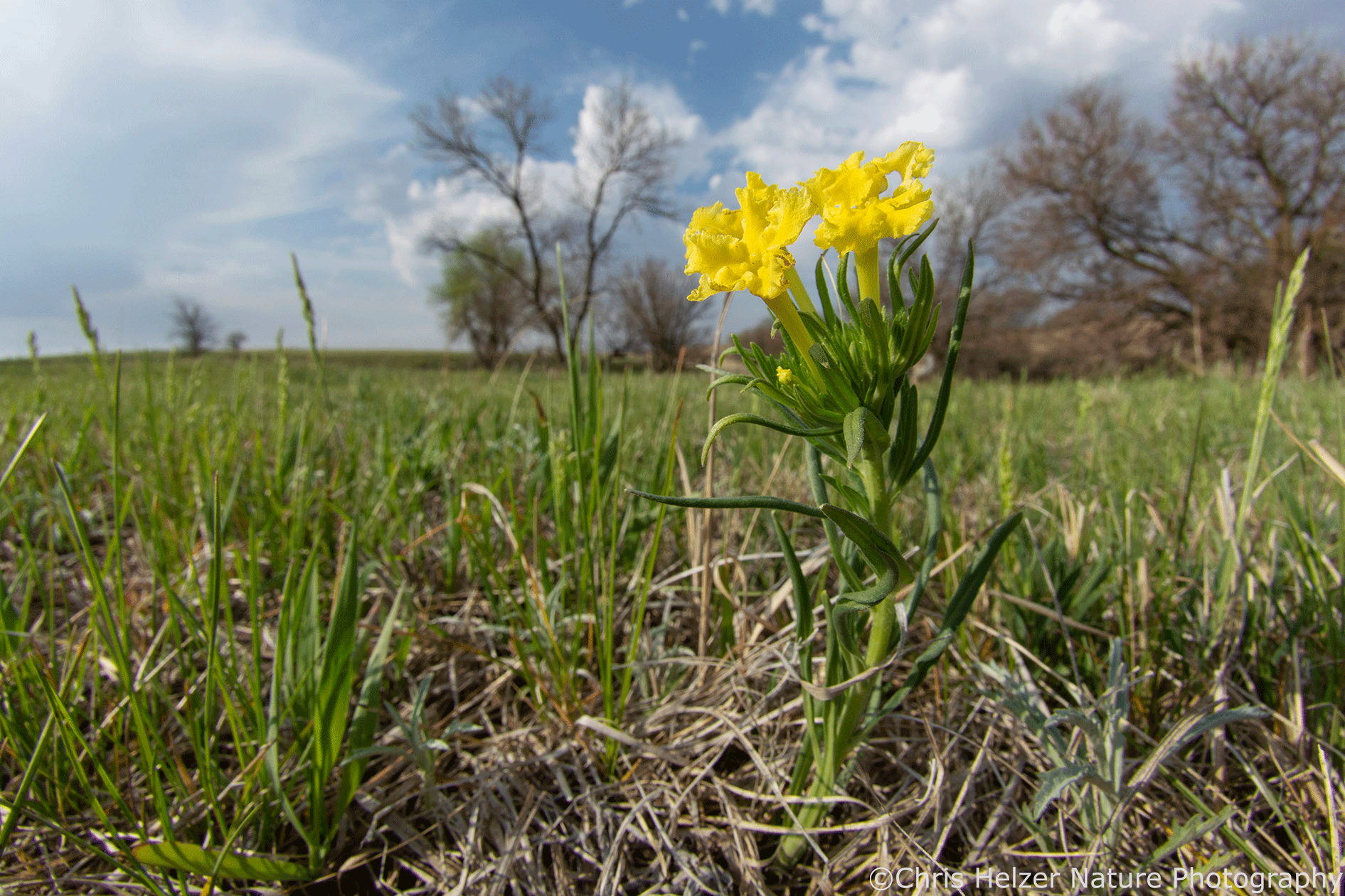
Photos of the Week – April 7, 2023

I didn’t realized how much I needed it until I got it. It’d been a really busy month or so and I hadn’t had a lot of time outdoors. I needed a break. I also needed to get up to the Niobrara Valley Preserve to scout some potential research sites. Trying to accomplish both objectives, I drove up to NVP on Wednesday afternoon.

When I arrived, I first headed to a grouse viewing blind the staff had set up. I was looking forward to photographing sharp-tailed grouse on their lek (courtship display area) the following morning and wanted to be sure I’d be able to find the blind in the dark.

Then, I wandered around the east bison pasture a little before dark. I found and photographed my first burrowing owl of the season and then went looking for the first bison calf of the year. I came upon (and photographed) a small group of bison, but didn’t see any calves. I could feel the stress draining away. (I’ll share some of the owl and bison photos next week.)

Early the next morning, I drove into the hills and found the viewing blind, arriving just as the sky was starting to show some color on the horizon. Freezing rain on Tuesday had coated much of the vegetation with ice and it hadn’t melted much on Wednesday. As a result, my view of the eastern sky was accented by glittering prairie in the foreground.

Tamron 100-400 lens @140mm. ISO 800, f/13, 1/3 sec.

At 6:32am, the first sharp-tailed grouse announced its presence outside the blind and was very quickly joined by five more males. I was counting on the birds sticking around long enough for me to photograph them in good light so I didn’t take many photos during the next half hour. I just enjoyed watching the males posture and dance. At about 7am, I played around with some slow exposure photos to see if I could get any ‘artsy’ blurry shots that showed the movement of the birds. I got a couple that I liked.

I was panning the camera to track the bird as it ran, creating this blurry, but (I think) captivating image. Tamron 100-400 lens @400mm. ISO 800, f/14, 1/10 sec.
Another version of the same technique used in the above photo. Tamron 100-400 lens @400mm. ISO 800, f/14, 1/10 sec.

I’d gotten to the blind a little extra early because the full moon was illuminating the prairie and I was worried the grouse might start their dancing ahead of schedule. As the sun started to come up, the moon was setting.

The moon was setting over the hills to the west just as the sun was rising in the east. Tamron 100-400 lens @400mm. ISO 800, f/6.3, 1/500 sec.

When the first sunlight hit the birds, I started photographing them more in earnest.

First light. Tamron 100-400 lens @400mm. ISO 1000, f/6.3, 1/1250 sec.
Tamron 100-400 lens @300mm. ISO 1000, f/6.3, 1/1250 sec.
Tamron 100-400 lens @400mm. ISO 1000, f/6.3, 1/1250 sec.
Tamron 100-400 lens @380mm. ISO 800, f/6.3, 1/1250 sec.
Preening. Tamron 100-400 lens @400mm. ISO 800, f/6.3, 1/1250 sec.
Picking ice off plants and eating it. Tamron 100-400 lens @300mm. ISO 800, f/6.3, 1/1250 sec.

As the sun rose, the activity actually slowed. There was a sweet spot of about half an hour when the light was still a beautiful golden color and the males were really active. After that, the sun’s intensity let me use faster shutter speeds, but the color was less interesting and the birds weren’t as into it as they’d been. There were still flurries of activity, but there were a lot of staring contests, rather than energetic dances. Two males would just sit nose to nose and look at each other for several minutes at a time.

I’m not great with video and don’t have the equipment to handle autofocusing of moving birds very well, but I got a little video footage of the grouse in case you’ve never seen them before. The first bit of the short video shows two males nose to nose and then some fairly muted dancing (they stayed pretty still, which made it easier to film, but was less exciting than some of the more wide-ranging dancing I saw). The second half shows a male standing around, looking cool, and making attractive (apparently) noises. If you don’t see the video link, click on the title of this blog post (top of the page) to open it online and make links active.

.

Back to still photos…

Tamron 100-400 lens @200mm. ISO 800, f/6.3, 1/1600 sec.
Tamron 100-400 lens @400mm. ISO 800, f/6.3, 1/2500 sec.
Tamron 100-400 lens @400mm. ISO 800, f/6.3, 1/3200 sec.

At almost exactly the two hour mark, four of the males suddenly flew off to the west, joined by a couple females (I assume) I hadn’t previously seen. The other birds had apparently been hiding just over the hill to the west of me. I’m not sure if they were watching the action on the lek from that perspective or not. A few minutes later, the last two males left, letting me pack up my gear and head out myself.

My list of tasks didn’t grow any shorter while I was gone, but it somehow feels a lot less intimidating after my time in the prairie. Two long and peaceful drives through the Nebraska Sandhills, an evening with bison and a burrowing owl, and a morning with sharp-tailed grouse (and later turkeys and prairie dogs!) did wonders for my stress levels. Once I finish banging out this blog post, I’ll start chipping away at that list with renewed energy. Thanks prairie!

Ticking Off All The Reasons to Hang Around Dead Animals

Warning: This post includes photos of a dead deer, along with invertebrates feeding on and around it. I know that’s not everyone’s bag of chips, so to speak, so this is your chance to wander elsewhere.

Yesterday’s weather was far too pleasant to just watch through the window, so I headed down to our family prairie to see what was happening there. Temperatures were in the 60’s (Fahrenheit) and there were some thin clouds overhead, making it a nice day for close-up photography. I hoped I’d find some insects and take advantage of that.

There were definitely insects moving around. Most were flies and sawflies (non-stinging relatives of wasps) and they weren’t very cooperative photo subjects. The breeze wasn’t helpful either.

A saw fly that briefly perched on a grass stem and let me photograph it.

I did, eventually, manage to catch one sawfly sitting still long enough to get a decent photo of it. There was another one nearby that looked similar, but without any red on its thorax, which made me wonder if I was seeing two species or males and females of one species. Given the little I know about sawflies, I’m guessing maybe these had overwintered as pupae and had just emerged to mate. No wonder they didn’t want anything to do with me – they had much more important things on their minds!

The most interesting thing I found was a deer carcass behind the dam of our old pond. It had been there long enough that it had been mostly stripped down to bones, but there was some hair left on the skull and legs. Before I found the full skeleton, I came across its lower jaw bones, which I stopped to photograph mainly because I needed something that wasn’t either blowing in the wind or flying away from me.

Jaw bone.

As I inspected the carcass (because that’s what ecologists do, right?), I spotted a few little creatures crawling around on it and started trying to photograph them. The wind wasn’t a factor, which was nice, but the little buggers didn’t hold still very well, which wasn’t. More experienced carrion-inspectors would surely be able to age the carcass based on the species and life stage of the insects I found, but that’s not my expertise. I was just curious and enjoyed seeing what was there.

Here’s the carcass itself. It had been a pretty big buck.
There were several of these Dermestes beetles doing their work.
Another look at a Dermestes beetle.
Bugguide.net says this is a Cosmopolitan Blue Bone Beetle (Necrobia violacea), which is a terrific name for a carrion feeder.

My curiosity was piqued further when I started noticing dog ticks (Dermacentor variabilis) in the grass around the carcass. When I saw the first one, I didn’t think much of it, other than to recognize it as another sign of the coming spring. After spotting the fourth one, though, I realized maybe there was something going on. A couple were on the carcass itself, but most were perched on plants within a foot or two of it. There were at least half a dozen. All but one of the ticks were males, but I’m not sure if that’s relevant.

Here’s the first dog tick I found.

Why would parasites be hanging around the carcass of a deer? There’d be no food value for them, especially this long after death. Maybe it was just chance, and I noticed them because I had paused to pay close attention to a small area. I don’t think so, though, because I didn’t see a single tick around the rest of the prairie, including while lying on my belly trying to photograph flies and sawflies.

Here’s another tick, perched on a grass blade right next to the carcass (seen in the background).
This one was hanging out on the antlers.
This one was on the carcass itself, but seemed to be travelling, so maybe it was just re-positioning itself.

As I pondered the question, I tried to think from a tick’s perspective. What if they recognized the value of the dead deer as bait for the kinds of creatures ticks like to feed on? That would be a pretty brilliant strategy. The life of a tick in the middle of a prairie has to be pretty frustrating – just sitting there, perched on a plant, hoping an animal will come close enough to grab onto. If a tick could predict where those animals were going to be, that would be of tremendous benefit.

After returning home, I went to the internet to see if there were records of this phenomenon. Sure enough, I found this study, and this one, which both reported finding ticks near carrion (mice and a porcupine, respectively) and the second paper cited an additional researcher who had found ticks around a white-tailed deer carcass. None of them had definitive answers for why the ticks seemed to be attracted to carrion, but my hypothesis matched some of theirs, which was nice to see.

I know ticks aren’t most people’s favorite creature and that’s perfectly understandable. On the other hand, they’re fascinating little invertebrates that have developed their own effective strategy for surviving in a complex and challenging world. If ticks have evolved the tendency to cluster around dead animals as a way to increase their likelihood of encountering the live animals they need to feed on, I think that’s pretty amazing.

If you’re in Nebraska, there’s a great community science project you can help with, aimed at building better understanding of what tick species are in Nebraska, and where. https://ticktaggo.unl.edu/