How Restored and Remnant Prairies Each Contribute Resources for Pollinators – Research by Hubbard Fellow Emma Greenlee

This post is written by Emma Greenlee, who recently completed her Hubbard Fellowship year here at The Nature Conservancy in Nebraska. Emma is now moving on to graduate school, where she’ll have the chance to study prairies in even more depth than she did with us. As her independent project during her Fellowship, Emma helped us evaluate the way our restored prairies contribute toward pollinator resources. Specifically, she counted the number of flowers and flowering plant species available in both remnant and restored (planted from seed) grasslands at our Platte River Prairies site. She is sharing some of the highlights from her findings in this post:

During my time as a Hubbard Fellow I conducted an ecology research project comparing flowering species community composition and floral resource abundance in remnant and restored prairies at the Platte River Prairies preserve (PRP). The Nature Conservancy has been doing restoration work along the Platte River since the 1990s. That work was initially done in conjunction Prairie Plains Resource Institute, a restoration-focused NGO based in Aurora, Nebraska. Prairie Plains has immense expertise in constructing restorations from a high-diversity of locally sourced native prairie seeds.

The Nature Conservancy’s goal for restoration work at PRP is to increase habitat connectivity among prairie sites. The philosophy with which TNC has approached prairie restoration in this area is not that restored prairies should be exact replicas of nearby remnant sites. They don’t need to have the same species composition as neighboring remnants, they need to contribute to the area’s prairie habitat connectivity. That, in turn, will benefit the native species persisting in today’s fragmented prairie landscape. In my project, I investigated what floral resources for pollinators (aka flowering plants/forbs) look like across these remnant and restored sites.
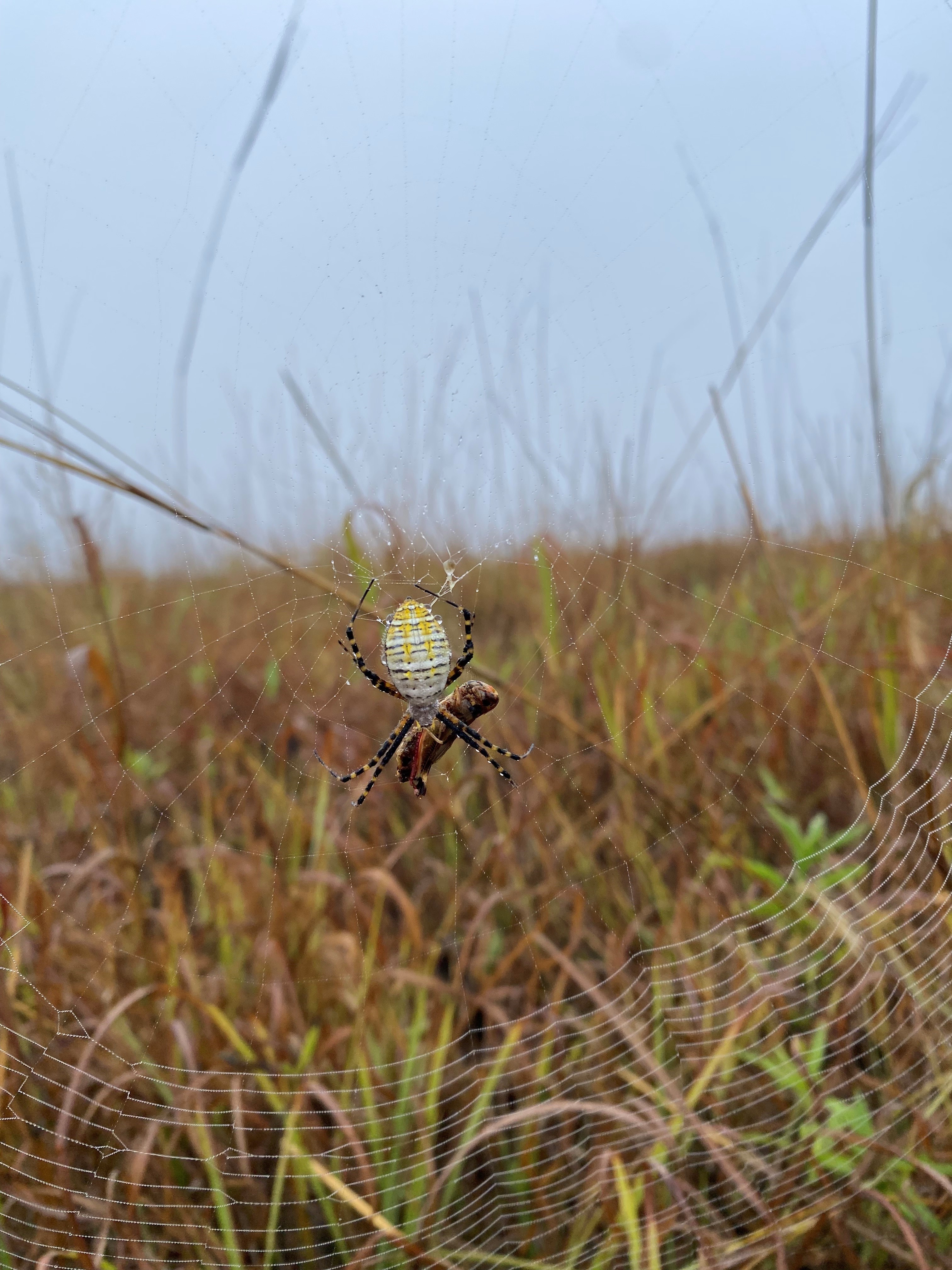
Orb weaver spider eating a grasshopper on a foggy morning, September 2022. Photo by Emma Greenlee

Although TNC’s restoration practitioners and land managers do not seek to create prairie restorations that are identical to their neighboring remnants, it is important to understand how both compare in terms of the resources they provide to prairie communities. That way, we can assess our restoration and management approaches and alter our techniques if needed. There are so many aspects of a prairie ecosystem that one could measure to determine this, but because I’m really excited about plant community ecology, I chose to approach my project from that direction. In addition, I wanted to address the role plants play in supporting the prairie ecosystem, and thinking about floral resources for pollinators appealed to me as a way to do this (while still focusing my data collection efforts on the plant community!).
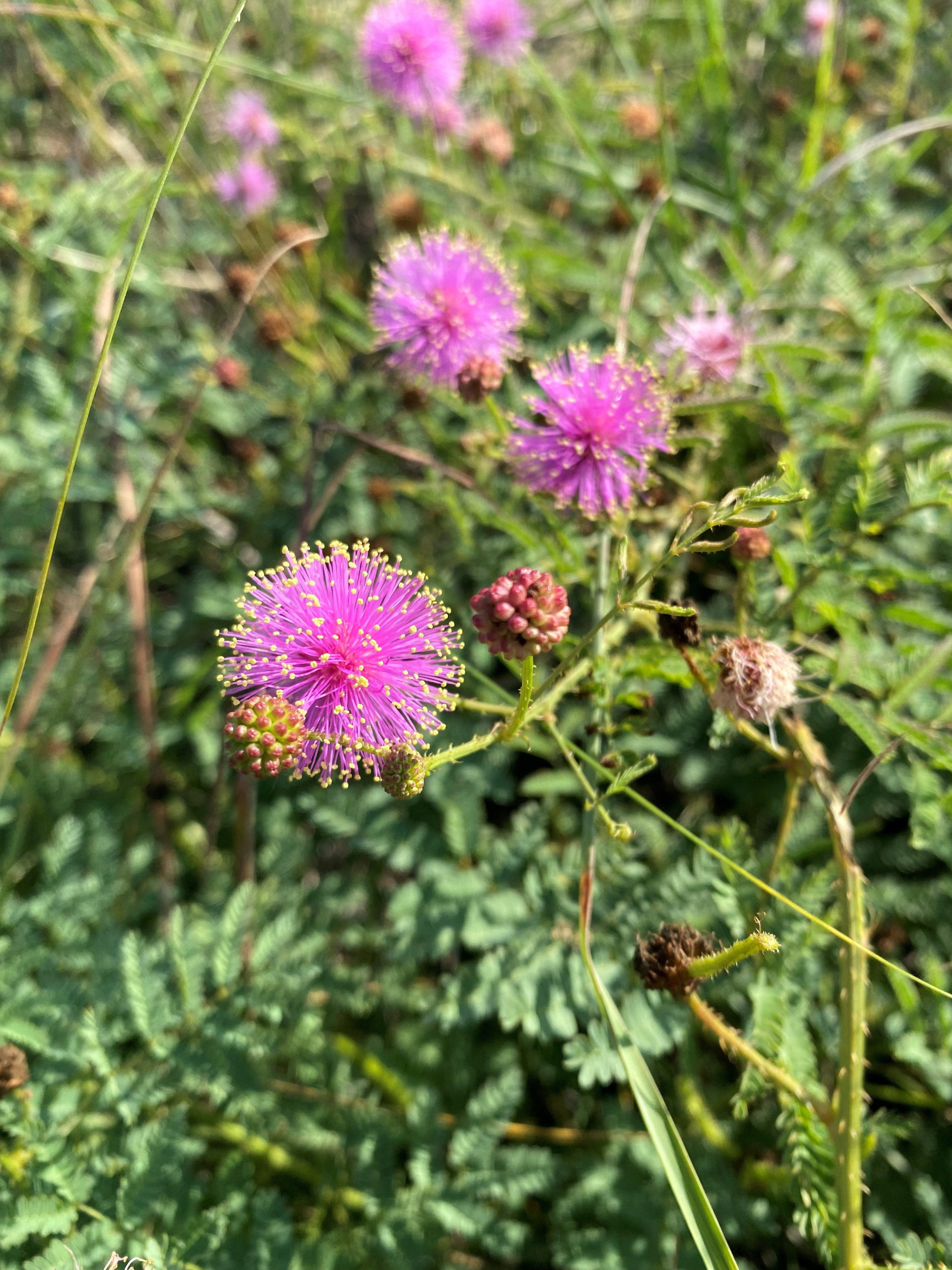
Catsclaw sensitive briar (Mimosa quadrivalvis var. nuttallii), July 2022. Photo by Emma Greenlee

I selected five sites at PRP that contain a remnant and an adjacent restored prairie undergoing similar management. Every two weeks, from early May through mid-October, I collected data within a designated sampling polygon in each of the remnant and restored prairie sites I had selected. Collecting data through time in this way allowed me to see how the prairies changed throughout the season, and this was a highlight of my project.

From seeing the first flowers of the year, like fringed puccoon (Lithospermum incisum), to the new plants I learned about throughout the season like catsclaw sensitive briar (Mimosa nuttallii) and Illinois bundleflower (Desmanthus illinoensis), to the bobolinks I heard singing and the cool invertebrates I saw along the way, I noticed something new every time I went out to collect data. Especially satisfying was the day in June when, as if a switch had flipped, the native tallgrass big bluestem had suddenly overtaken the invasive smooth brome that had been widespread in many sites early in the season. Even though my project primarily involved collecting data on wildflowers, it provided me the opportunity to notice so much more.

Monarda (Monarda fistulosa) was particularly abundant in one of my transects on this sampling day, July 2022. Photo by Emma Greenlee

.

Results and Discussion

In general, my results suggest that floral resources in remnant and restored sites at the Platte River Prairies were similar this year! The flowering species that were available in a given location, as well as their abundances, varied throughout the season, but I found no evidence that remnants or restorations as a group had more or fewer flowers than the other at any point during the growing season.

In fact, some of my results (see graph below) suggest that remnant and restored sites complement each other in terms of the flowering species they provide. This complementarity indicates that there are different floral resources in adjacent remnant and restored sites at a given time, but that remnants and restorations flip-flop throughout the season in terms of which offer more flowering species for pollinators. Because the paired sites I studied were located geographically near to each other, this suggests that insects are able to move between neighboring remnants and restorations to fulfill their needs throughout the season.

Graphs of the number of flowering species in each of my five sites over time. Red lines correspond to remnants, and blue lines to restorations.

Within the above graph, the red and blue lines zigzag many times, with a remnant (or restoration) containing more flowering species, and then its paired restoration (or remnant) overtaking it to have more flowering species the next month, and then vice versa. This should overall be a positive for pollinators who are able to move back and forth between neighboring sites to fulfill their needs at a given time. (If you’re looking for a clear example of the pattern I’m describing, it’s especially visible in the East Dahms NW site (top middle graph) from August through October.)

Additionally, my results suggest that factors apart from a site’s status as a restoration or a remnant are likely responsible for much of the variation in flowering communities found at PRP. Some sites have sandy soils and hilly topography, while others are largely flat with a shallow water table (underground water is fairly near the surface) and wetland sloughs running through them. Variations like these shape the suite of plant species that is able to establish in an area. In the sites I studied it seems likely that factors like these (soils, topography, hydrology…) are important drivers of plant community composition in the patchwork of prairies along the Platte River, regardless of whether a site is a restoration or a remnant (see graph below).
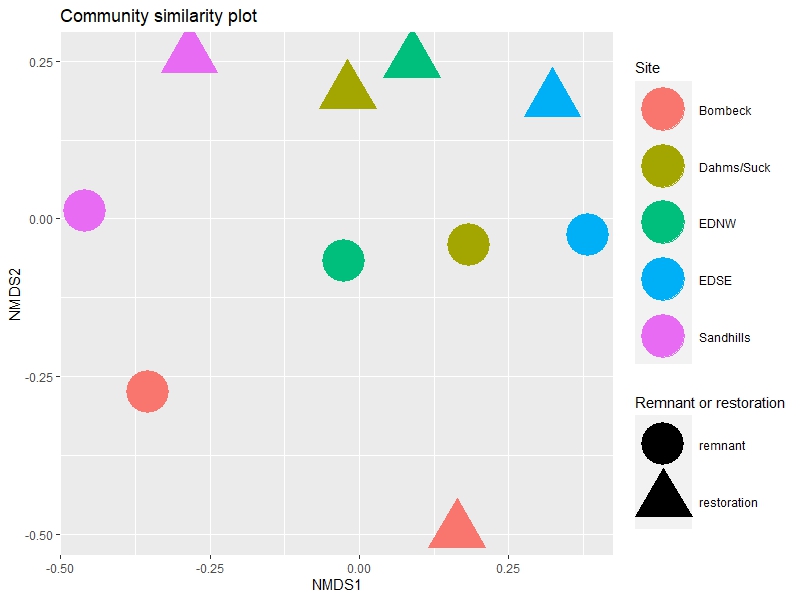
This type of graph is used by community ecologists to simplify many aspects of the communities they’re comparing down to a two-dimensional plot. In my case, it represents the flowering plant species composition and floral abundance of each of my sites! The axis labels aren’t important, they just represent community similarity: the points that are closer together on the graph are more similar in species composition and flowering abundance, and points that are farther apart are less similar.

On the above graph, circles represent remnants and triangles represent restorations, and each remnant/restoration pair is a different color. Most of the color-coded remnant/restoration duos are found close to each other on the graph, indicating floral community similarities. Interestingly, most of the restorations are also grouped fairly near to each other, as are the remnants! This suggests some community similarities among remnants overall and among restorations overall, but it would take more statistics than I accomplished on this project to find out what those might be!

We can’t draw too many firm conclusions from only one year’s data––factors like that year’s weather, the number of sites I collected data from, and each site’s management all may play a role in the patterns I saw. However, this is still useful information that can be built on in the future, or simply serve as a single-year snapshot of a few aspects of prairie community health on the preserve. In general, what I found this year suggests that restoration work at the Platte River Prairies preserve is largely effective in increasing prairie habitat connectivity by the metric of providing floral resources for pollinators. This is encouraging news, and suggests that the methods used here (and in many other places!) of restoring prairies with a diverse mixture of locally sourced native seeds are sound and contribute to the prairie patchwork landscape of central Nebraska.

I learned so much from this project and from the Fellowship more broadly, and I appreciate everyone who has read my blog posts along the way! It’s been a pretty cool privilege having such an enthusiastic audience to share some of what I’ve learned this year with. Next I’ll be pursuing a Master’s degree at Kansas State University studying plant-pollinator interactions in prairie, and I’m very excited for that! I also look forward to finding new ways to share my prairie enthusiasm with a wide audience.

Caption: A snapshot of the floral diversity at the Platte River Prairies, August 2022. Photo by Emma Greenlee

How do you tell the difference between… (Episode 1 – Butterflies and Grasshoppers)

As a prairie ecologist who tries to help others fall in love with prairies, one of the primary obstacles I run into is that most people can’t recognize very many of the incredible species that live in grasslands. If one plant or animal looks just like another, everything looks the same! As a result, when those people visit a prairie for the first time, it appears to be a flat, boring wasteland – a monochromatic smear of vegetation and bugs. That’s uninteresting, unattractive, and uninviting. It’s also a huge problem for conservation since we need people to care enough to support our work.

As a response to this crisis, I’ve decided to start a new periodic series of blog posts aimed at helping people distinguish between some of the more common groups of prairie species they might encounter. This is not a field guide and won’t (usually) help people identify individual species. Instead, the purpose is simply to provide some very basic tips that will help them tell some organisms apart from others and start to see some of the diversity those of us familiar with prairies sometimes take for granted.

For this inaugural installment, I’ll start with two common groups of animals: butterflies and grasshoppers. Those of us who see these animals frequently can easily tell one from the other but probably don’t think much about how we’re doing it. For the uninitiated, the two can look very similar.

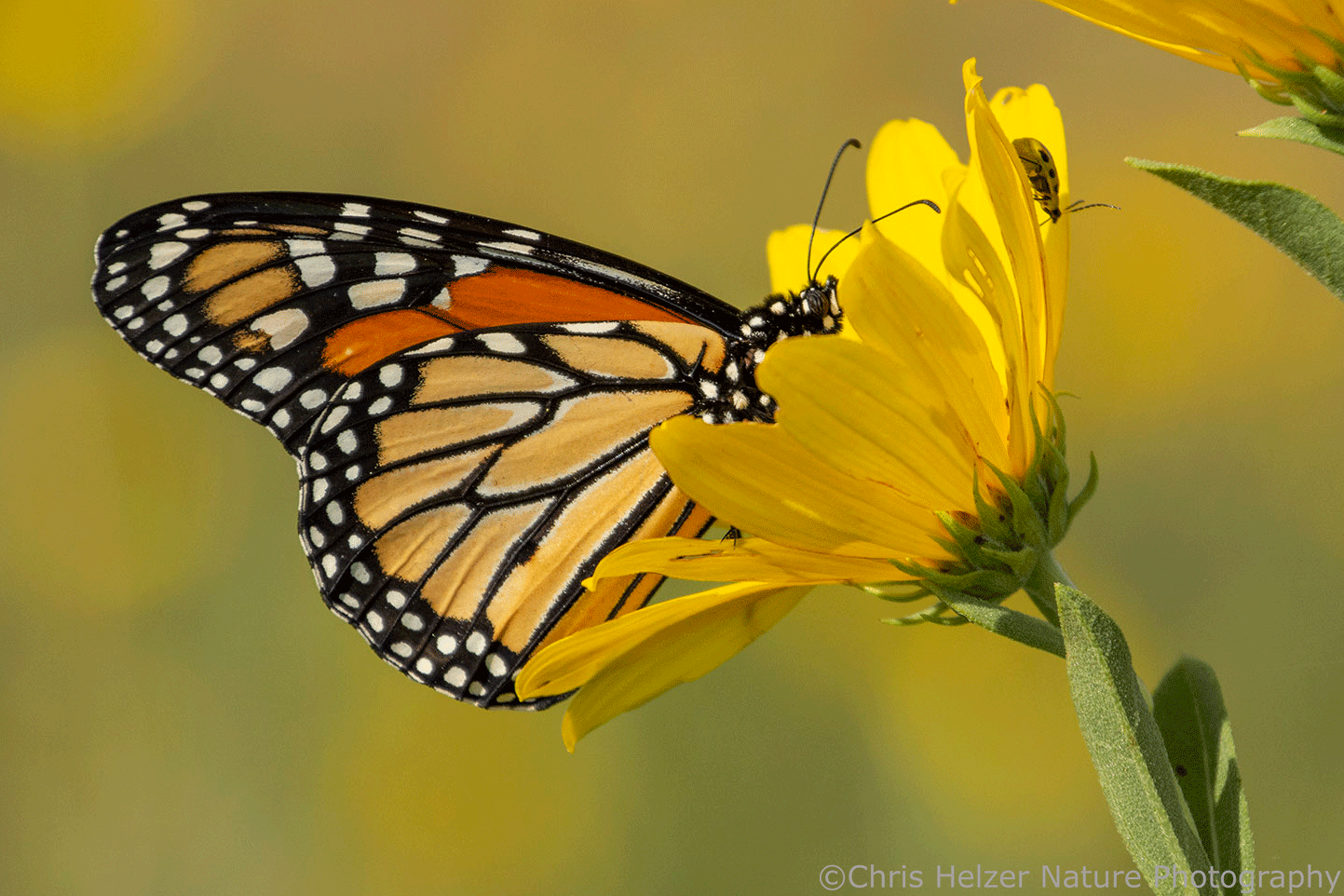
Butterfly
Grasshopper

It’s easy to see how these two organisms can be difficult to distinguish from each other. Both have long bodies, large eyes, six legs, and antennae, and those are just a few of their similarities! There are some stark differences too, but it’s important to know which are consistent, and thus useful.

For example, when looking at the above photos, you might immediately think, “Oh, that’s easy! Grasshoppers and green and butterflies are multi-colored!” I implore you not to fall into that trap. Both grasshoppers and butterflies can come in a wide variety of colors and color combinations, making color completely unreliable as a way to separate them. However, there are a few key characteristics than can help you tell them apart. We’ll start with the most helpful…

Tongue

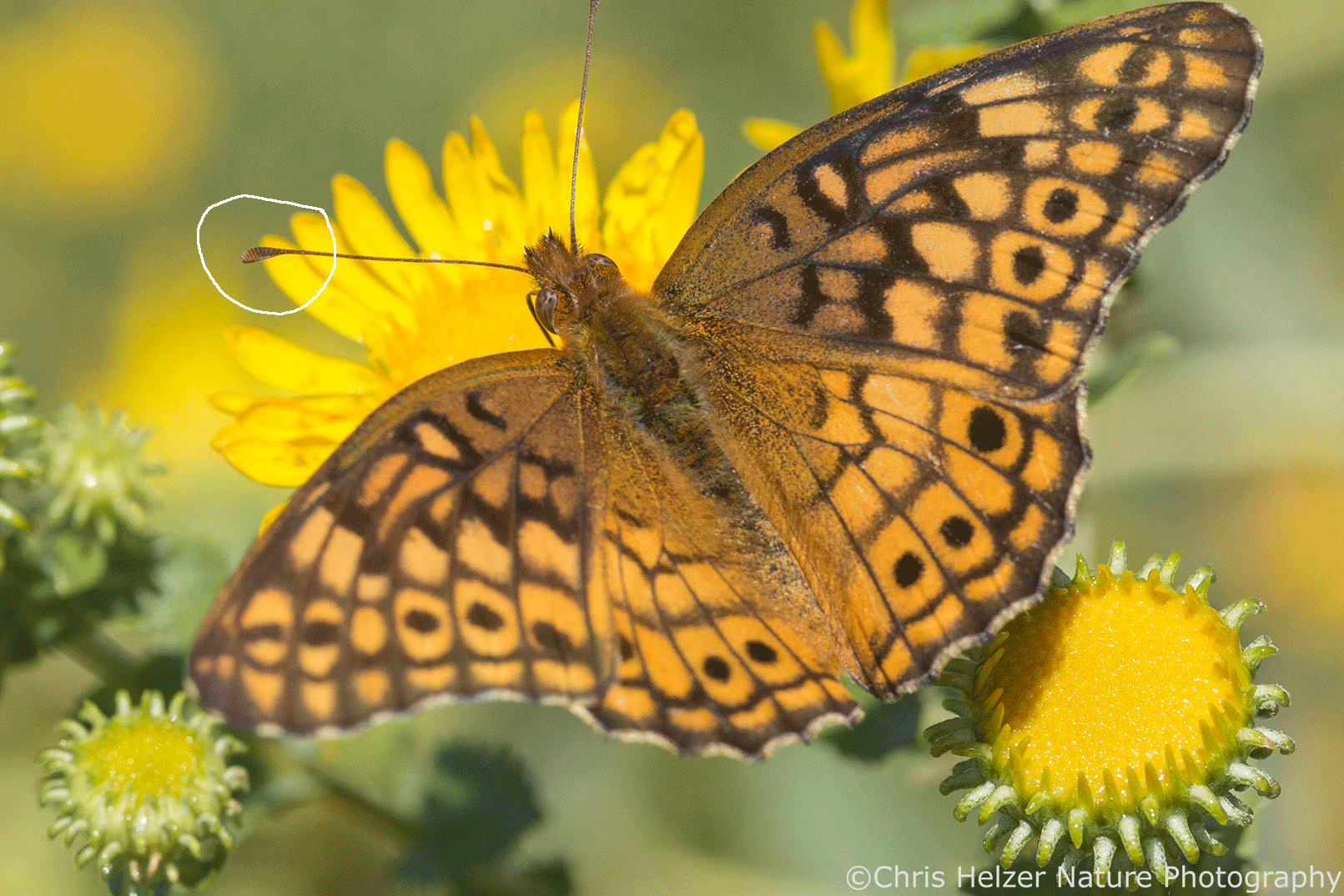
If you look closely at a butterfly, you may be able to see the long curling tongue it uses to access nectar from deep inside a flower. When it is feeding, this tongue is often extended in a way that makes it relatively easy to spot. Grasshoppers, on the other hand, don’t have a tongue. Instead, they have various other anatomical features that fill some of the roles of a tongue, but come with complicated names like “hypopharynx” or “three-segmented labial palps”.

The circled structure in this butterfly photo is the tongue, which you can see it using to extract nectar from this flower.
Grasshoppers have no tongue. Instead, they have complex, confusing-looking mouthparts designed to bite and chew plant matter.

Since butterflies have long tongues and grasshoppers have no tongues, this is obviously a great first step toward separating the two animals from each other. When you see an insect and you’re not immediately sure whether it is a butterfly or grasshopper, look first for the tell-tale tongue. It’s even alliterative!

Spines on legs

Unfortunately, it’s not always possible to use the presence or absence of a tongue to tell a grasshopper from a butterfly. Sometimes, butterflies either don’t have their tongue extended or it is out of sight because of the way the butterfly is positioned. This is problematic, but not a complete catastrophe. If you can’t see the tongue but aren’t completely sure you’re looking at a grasshopper, look next at the legs.

As you can see in this photo, the place where this creature’s tongue might be is obscured by the petal of whatever kind of plant that is. This unusual situation makes it necessary to have more than one characteristic to rely on when trying to decide if it’s a butterfly or grasshopper.

Most grasshoppers have spines on their legs. No one knows why this is, but it can be helpful when trying to distinguish between grasshoppers and butterflies since butterflies have hairy legs but almost never spiny legs.

The front legs of a grasshopper may or may not have obvious spines. Some do, but others merely have hairs like those seen on butterfly legs. However, if you focus on the rear legs (the big ones), grasshoppers almost always display prominent spines, especially on the leg segment closest to their feet.

There’s a simple rhyming phrase than can help you remember this clue. It’s easy to imagine the spines on a grasshopper’s leg as being able to pop a balloon. Thus, you can remember that grasshoppers have spiny legs with the phrase, “Grasshoppers are balloon poppers”. Easy peasy!

The spines on the lower segment of this grasshopper’s leg clearly distinguishes it from a butterfly. That’s particular helpful in this case because its mouth is partially obscured by one of its front legs, making it difficult to tell if it has a tongue.

Used in tandem with each other, the combination of tongues and leg spines will usually be sufficient to tell whether a particular insect is a grasshopper or a butterfly. In desperate situations, however, there is one final feature that can be used…

Bulbous antennae tips

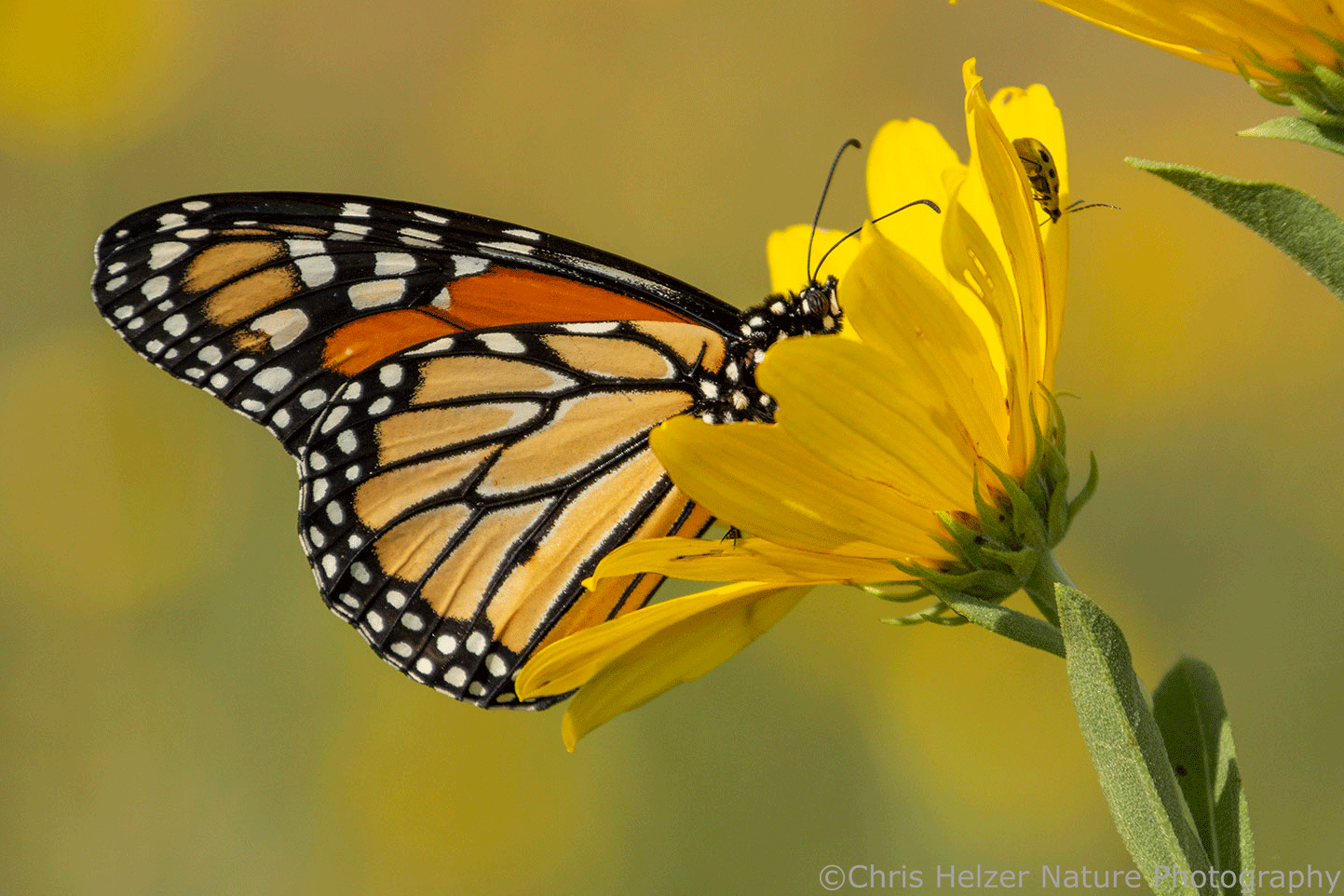
While the tongue or leg spines of these creatures can (rarely) be simultaneously concealed, the antennae will almost always be visible in those cases. For example, if you look back at the earlier photo of the orange creature in which the tongue wasn’t visible, you’ll notice that the legs are also concealed. Vexing! But look closer, and you’ll see that the antennae are clearly visible. This saving grace will allow us to decide with confidence whether it is a butterfly or grasshopper.

Antennae are the two linear projections protruding from the heads of both grasshoppers and butterflies. These likely serve a purpose that science will someday discover. Initially, you might think the fact that both creatures have antennae would make those structures unhelpful in telling one creature from another. Look more closely, however, and you’ll notice that butterflies have little knobs or bulbs at the extreme tips of their antennae. The antennae of grasshoppers do not have this feature.

In this photo, both the tongue and legs are difficult to see, but the circled portion of the antennae clearly shows a swelling, or thickening of the structure. Thus, we can safely conclude that it’s a butterfly.

There’s a fun and easy way to remember the significance of the bulbous tip of a butterfly’s antennae. The term ‘grasshopper’ implies a creature that can jump, right? Whether or not that’s true isn’t important. What matters is the following phrase: “If it has a bump, it probably can’t jump.” In other words, a creature with a ‘bump’ on the tip of its antennae isn’t a grasshopper.

You’ve now learned three different cues you can employ to tell whether an animal is a butterfly or a grasshopper. First, look for a tongue. Second, try to see whether there are spines on the legs (especially the hind legs). Third, check the antennae to see if they have a swollen tip. Any one of these may be enough to make an identification, but two or more are firmly diagnostic.

Let’s test your knowledge by looking again at a photo shown earlier.

Can you tell if this is a grasshopper or butterfly?

Only one of the three key characteristics is visible in the above photo. Can you tell whether it is a butterfly or grasshopper?

It is, of course, a butterfly because “if it has a bump, it probably can’t jump”. Well done!

I hope this has been a helpful guide for telling the difference between butterflies and grasshoppers. If you did find it useful, please share it with your friends and family – then stay tuned for future installments of this series and learn about other fascinating and beautiful prairie plants and animals!