
Prairies are often defined as plant communities dominated by grasses, sedges, and wildflowers. However, prairies are also home to thousands of animal species, not to mention countless varieties of fungi, bacteria, and other microbes. Animals are just as much part of the prairie as plants, and they can have immense impacts on the plant community and overall prairie function.
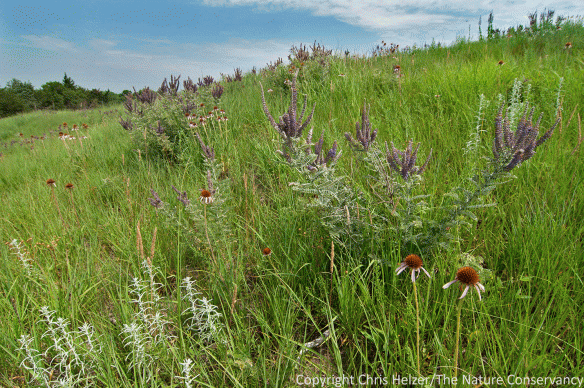
For most of us, prairies are characterized by the plants we see when we walk through them. Gjerloff Prairie – Prairie Plains Resource Institute. Nebraska mixed-grass prairie managed with periodic fire and intensive grazing.
Despite the importance of animals, many prairie managers and biologists focus largely on plants when evaluating the quality of a prairie or when making management decisions. Interestingly, many ranchers do the same thing, though they tend to focus mostly on dominant grasses while biologists often look more at plant species diversity and/or rare plant species. Regardless, it is rare that the needs of harvest mice, leafhoppers, or smooth green snakes are incorporated into management plans or evaluations of prairie quality. (A major caveat is that some prairies are managed primarily for bird habitat – either song birds or game birds – a practice that has its own set of ramifications.)

Deer mice and other small mammals are rarely considered during management planning. Small mammals and other animals have specific needs for habitat structure, however, and their populations can decline or disappear after several years of unfavorable habitat conditions.
To be fair, there are good reasons to give plants primary consideration in management planning. Cattle ranchers correctly recognize that cattle feed mostly on grass, so maintaining robust stands of grasses is critical for a successful ranching operation. For biologists and conservation land managers, plants are often good indicators of prairie health. Plant communities are easier to assess than insect or small mammal communities, and they provide the foundation for many ecological processes. Pollinators, for example, rely on plant diversity and abundance of flowering plants. Many other insect species need particular plant species or groups of plant species for food and/or living quarters. A diverse plant community also provides a consistent supply of vegetative growth and seed production for plant-eating animals.

Bees and other pollinators rely upon plant diversity to provide a consistent supply of flowers throughout the growing season. This bee (Svastra sp) is on a native tall thistle (Cirsium altissimum) in September.
Not only are plants helpful in assessing prairies, every plant species is also significant and worthy of conservation for its own sake. However, the same is also true for animal species. A prairie without birds, ants, butterflies, or grasshoppers just wouldn’t be the same, and not just from an aesthetic standpoint. The complex interactions between all the various organisms in prairies are difficult to study, but absolutely critical to ecological function. Studies that have excluded or suppressed populations of small mammals or insects have documented tremendous changes to the plant community – usually resulting in lower plant diversity and dominance by a few species at the expense of others.
Animal communities are vital to prairie communities and ecological function, and conserving healthy animal communities relies on at least two broad factors: plant diversity and a variety of habitat structure. As mentioned earlier, most pollinators and herbivores rely upon a wide range of plant species in order to be able to find food at all times of the season, and many insects depend upon particular plant species for survival. However, habitat structure is also critically important for animal communities, and because every animal has its own unique habitat requirements, prairies need to provide a wide variety of habitat conditions.
Habitat structure for animals is driven by factors such as the amount of plant litter covering the ground and the height and density of the vegetation. Some animals depend upon short vegetation with lots of exposed bare ground, some need tall dense vegetation, and still others prefer something in-between – or combinations of several habitat types. The size and distribution of habitat patches is also important. For example, some animal species need fairly large areas of a particular habitat structure, while others thrive best in situations where small patches of short and tall vegetation are intermixed.

A variety of habitat structure types across a prairie helps ensure that a diversity of animal species, including invertebrates, will thrive. This area of intensive grazing is adjacent to other patches of taller and thicker vegetation. Restored prairie in The Nature Conservancy’s Platte River Prairies, Nebraska.
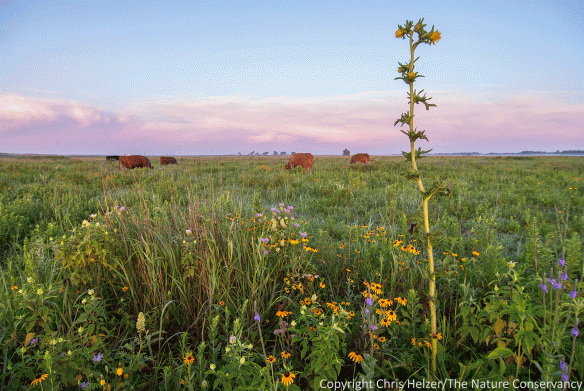
This is the same restored prairie as shown in the previous photo, but in a year when management provided different habitat structure. Cattle have grazed much of the grass, but have left behind a diversity of blooming plants, including Canada milkvetch (Astragalus canadensis), compass plant (Silphium laciniatum), black-eyed Susans (Rudbeckia hirta), bergamot (Monarda fistulosa), and many others. Platte River Prairies, Nebraska.
Prairie management regimes that don’t consider animals’ needs can lead to problems. For example, prairies with relatively uniform vegetation structure provide limited options for animals, regardless of whether that structure is uniformly short, tall, or somewhere in the middle. A subset of animal species will thrive in those prairies, but other species can experience significant population declines. If those same conditions persist for too long, some animal species can disappear completely. Whether or not those species return depends upon the mobility of the animals and the degree of habitat fragmentation around the prairie.
Some management tactics can also cause animal populations to disappear or decline dramatically. While it is an important part of prairie management, prescribed burning can be particularly dangerous to animals, especially if an entire prairie is burned at once. Fire can directly kill animals, including insects overwintering or living inside plants, but animals can also suffer from the sudden loss of habitat. These impacts are especially severe in fragmented landscapes where there is nowhere for animals with limited mobility to go for better habitat, and no way for recolonization by species wiped out by fire. Uniform haying and intensive grazing can have some similar impacts to fire, although both tend to leave a little more habitat for at least some species.
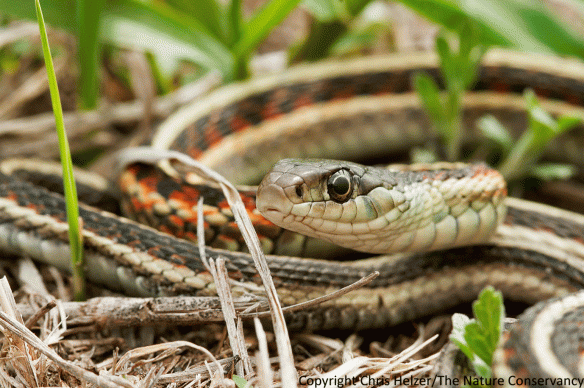
Snakes like this red-sided garter can be vulnerable to fires that occur during the growing season. However, dormant season fires can also be very damaging for insects and other species that overwinter in grass litter or in aboveground stems of plants.
Plant diversity and the survival of rare plant species are important objectives for prairie management. However, the same can be said for animal diversity and rare animal species. In some cases, well-planned management can largely account for the needs of both. Providing a shifting mosaic of habitat patches across big prairies can usually facilitate plant and animal diversity, and accommodations can be made for rare species or species sensitive to particular management tactics such as fire or grazing. Understanding the needs and evaluating responses of various groups of plants and animals, however, is crucial to successfully adapting management strategies over time.
Conserving all species is much more difficult in small and/or isolated prairies. A single prescribed fire can potentially wipe out animal species, and repetitive use of any management tactic, including fire, grazing, haying or rest risks eliminating species as well. Read more about the challenges of managing small prairies here.
In both large and small prairies, setting clear objectives for management is very important. Ideally, those objectives will accommodate the needs of most or all animal and plant species and sustain ecological resilience. In reality, it’s more likely that the needs of some species will have to be sacrificed or given less priority than others. As an example, frequent burns might sustain high populations of many plants (including some rare species) and help suppress invasive trees or grasses, but are likely to eliminate some species of butterflies and other invertebrates, and potentially some snakes and other vertebrates as well. Alternatively, applying periodic patchy grazing and rest treatments in the same prairie could increase habitat heterogeneity to the benefit of many animals, but could reduce the relative abundance of some sensitive plant species while stimulating higher populations of more grazing tolerant plants.
These kinds of management decisions can be extremely difficult, and there are no easy answers. The disappearance of any species from a prairie is a big loss, particularly at isolated sites, and we don’t yet know how to predict the ripple effects of losing most species. Even when management decisions don’t directly eliminate species, reducing population sizes can make species more vulnerable to diseases or other factors that could eventually wipe them out.

The regal fritillary butterfly is one of many prairie animals that has been shown to be vulnerable to disappearing from prairies because of incompatible management. Even for fairly mobile species like butterflies, recolonization after local extinction is far from assured, especially in fragmented landscapes.
No matter what management decisions are made, it’s crucial that land managers consider the needs of as many species as possible – including both plants and animals. It’s not necessarily wrong to manage a prairie primarily for plant diversity or to sustain populations of rare plants. It’s also understandable that a cattle rancher would want to sustain consistent vigorous stands of grass. However, in both cases, managers need to acknowledge and accept that optimizing conditions for a particular suite of plant species will lead to negative consequences for other species, including both animals and plants.
Hopefully, continuing research and experience will help us better understand the inescapable tradeoffs that come with these kinds of difficult decisions. For now, the impacts of losing plant or animal species and the potential for those losses to affect ecological resilience are still very unpredictable. The best we can do is to be clear and honest with ourselves and others about why we’re making decisions, and do our best to evaluate the results and learn as we go.
If you’re interested in learning more about how excluding or suppressing animal populations can lead to unexpected and complex reactions in grassland communities, here are a couple example research papers.
 The Prairie Ecologist