Hubbard Fellowship Blog – Carp Fishing

Guest Post by Anne Stine, one of our 2013-14 Hubbard Fellows:

The carp are so thick in one of our restored creeks near the Platte that their top fins stick out of the water like a shark’s and you can see small schools of their long bodies grubbing around nose-down in the shallows.  Fish over a foot long fling themselves into the air above the creek’s slow pools when they’re spooked, seemingly at random.  I noticed this abundance on my first day out on the prairie with Chris.  With his blessing, it became my mission to harvest a quantity of this invasive fish-flesh in our stretch of creek near the crew quarters.

My fishing spot.  Photo by Anne Stine.

My fishing spot. Photo by Anne Stine.

I found a beautiful fishing spot on a bridge over the pinch between two large pools.  From the bridge, you could see carp and gar loitering below.  The view of our pastures to the west of the bridge promised a lovely sunset for an evening angler.  I baited my hook with corn kernels and cast it in.

Less than ten minutes later I’d hooked a carp as long and meaty as my forearm.  Supposedly tricky to catch, these trash fish do love corn.  The carp pulled and struggled while I attempted to tire the fish before hauling it in.  I was wary- I’ve snapped lines before by reeling in too soon.  One fish had gotten away after breaking my line above the bobber.  I watched him tow my bobber around and continue to forage for the rest of an evening, the red bobber dragging behind him like a balloon on a string.

Carp are an invasive species for much of the United States.  They are considered problematic because they become over-abundant and eat food used by native fish, and their foraging method stirs up mud and increases turbidity in the creeks, rivers, and ponds where they are established.  It used to be illegal to throw them back in Minnesota.  Nebraska and Iowa still host a “Carp-O-Rama” bowfishing tournament, with prizes awarded based on the highest total weight and the highest total number caught.

Carp’s bad reputation is bolstered by its arguably inferior flavor.  Carp are generally considered trash fish because they can have an earthy taste partially sourced in a ‘mud vein’ running along their sides.  They also have a complex bone structure that makes filleting a challenge.  Common recommendations for preparing carp fillets include scoring the fillets in the diagonal strips so the small bones are softened enough to eat with ease.  Smoking carp is also frequently recommended for the same reason.  Naturally, I didn’t read any of this and assumed that Americans were just being snobby by snubbing this fish that is widely eaten in Europe and Asia.  After catching two moderately sized carp, I went home to fillet the fish and fried them up for my coworkers.
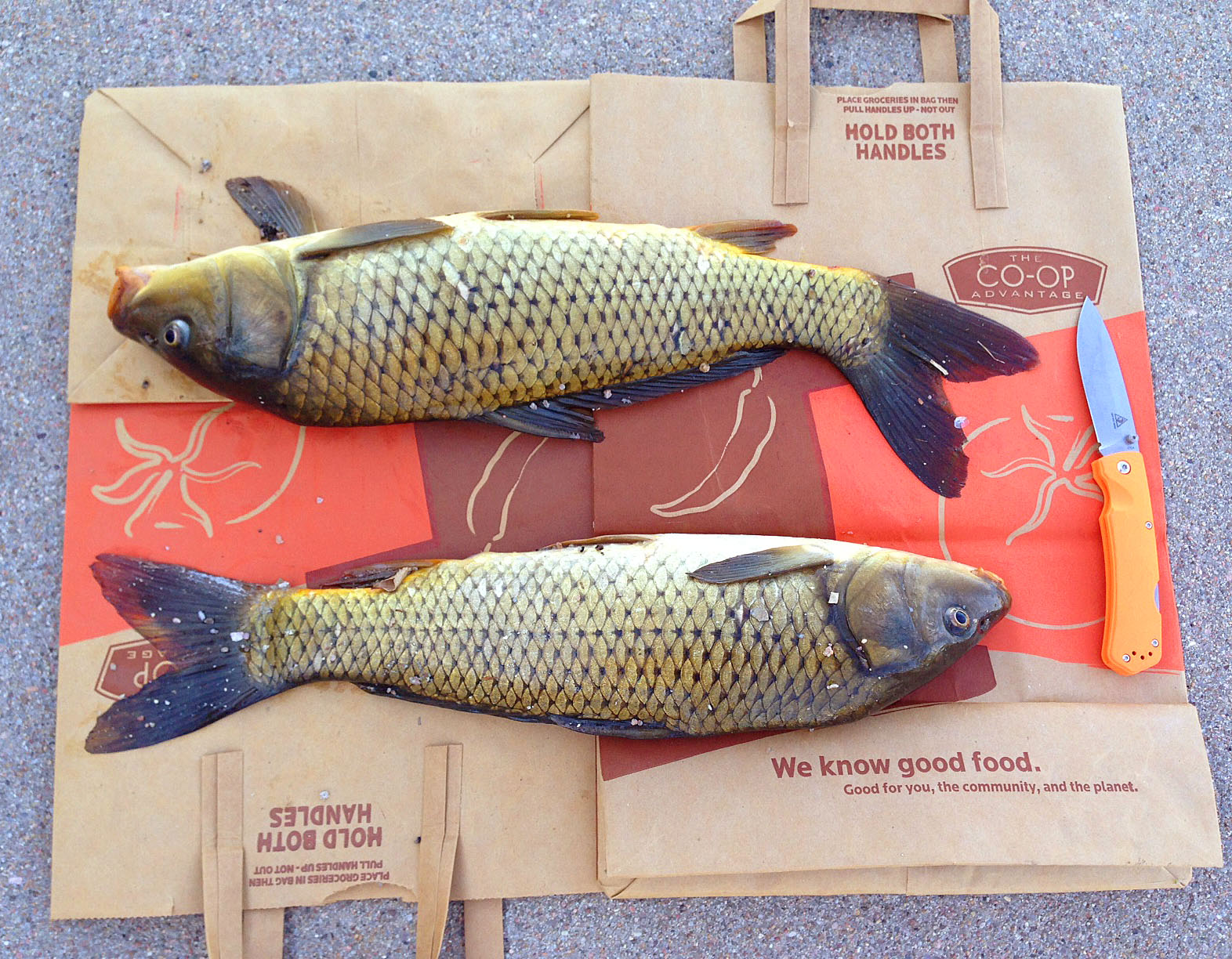
Dinner!  Photo by Anne Stine.

Dinner! Photo by Anne Stine.

I want to say the carp were delicious.  I want to say “Everyone! Go out and help yourself to amazing, readily available fish. Do your river a favor and eat carp.” Frankly, carp is bony with a muddy aftertaste.  I’ll try a few more prep methods, but my enthusiasm for utilizing this neglected resource is greatly diminished now that I’ve had it.  Hopefully bunnies this fall will be easier on the palate.

Hubbard Fellowship Blog – Weed Whacking with Konstantin

Guest Post by Anne Stine, one of our 2013-14 Hubbard Fellows:

When one considers that the weed-whacker is the modern incarnation of the scythe, Konstantin Levin’s ecstatic enlightenment while cutting wheat with his peasant tenants in Anna Karenina comes across as a little ridiculous.  It is easy to imagine him, a ruddy-faced and awkward aristocrat, smiling beatifically in the center of a line of serious men going about the business of mowing.

Instead of a wheat field in Russia, this is my work site.

Instead of a wheat field in Russia, this is my work site.  The Nature Conservancy’s Platte River Prairies, Nebraska.

Scythes and weed-whackers use the same efficient, swaying pivot through the body. Back and forth, back and forth, the returning stroke hitting the grass missed in the initial swing.  Such work does provide the opportunity for quiet thoughts.  Unlike Levin, however, I did not achieve enlightenment while weed whacking the grass beneath the 14-gauge wire of an electric fence.  Drifting into the repeating beat of the movement, my mind rippled towards the remarkably competent field technicians I have known.

I have been continuously impressed by the manual aptitude of the technicians I have worked with in my academic career.  If something broke, rather than sitting completely stumped, they had the know-how to wire it together and make it work. I hope to gain a measure of this generalized comfort with mechanical workings during my tenure as a Hubbard Fellow.  I’ve already learned to drive an ATV, a tractor, and a riding mower; and to operate weed-wackers and backpack sprayers.  I’ve set electric fence and helped cut free a calf tangled in wire.  I want to write all of my physically competent colleagues and say “See! I’m learning.”

Similar to on a farm, the summer season in our pastures is the busiest time of year.  We’ve spent most of our hours so far as plant executioners- mowing, spraying, and spading invasives, aggressive natives, and other plants growing where we don’t want them to.  The major difference is that our primary product is a restored and healthy prairie rather than cattle or corn.

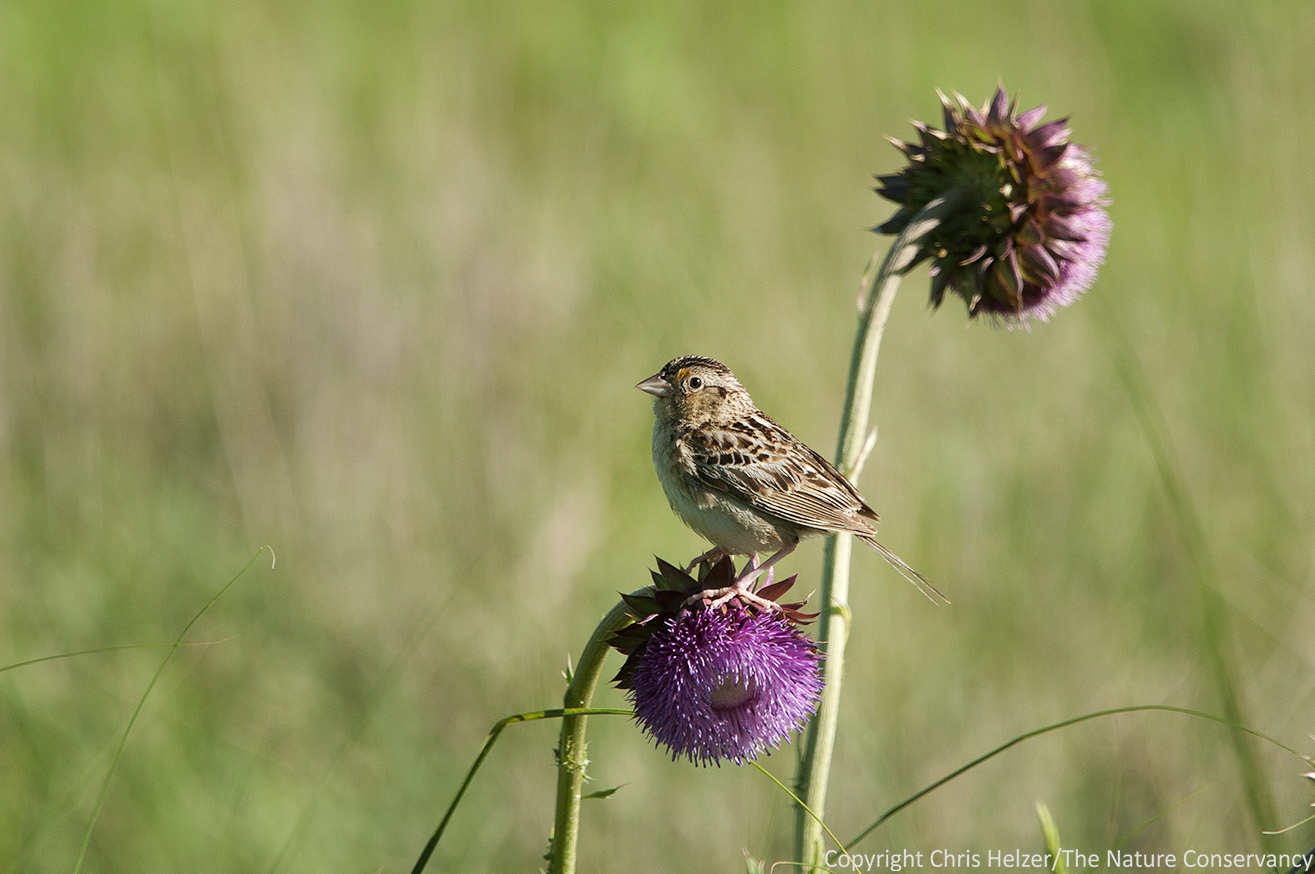
Thistle chasing has been our primary objective.  The musk thistle is classified as a noxious weed—this means that we are legally obliged to assist in its eradication.  The musk thistle can grow to be well over a meter high, with multiple fuchsia flower heads.  Their leaves are edged in sharp thorns but no hair, and the undersides of their leaves are green rather than white like the native thistles.  Originating in Europe, it gets its name from the supposedly odiferous roots and vegetation.  We attack them with herbicides and spades.  They are prolific seeders.  Sometimes killing musk thistles can feel like a Quixotic quest, like we are fighting the tide with a bucket.

The enemy (with a grasshopper sparrow sitting on it).

The enemy (with a grasshopper sparrow sitting on it).

.

My weapon of choice.

My weapon of choice.

Killing plants and fixing fences is a full time job in the summer growing season.   I have already gained an appreciation for the broad-based knowledge necessary to maintain a working pasture.  I hope to continue to develop my applied skill-set, and I will keep saying to the world: “See! I’m learning.”